
Problem framing shapes what becomes visible, who is involved, and what kinds of action seem possible. This post reflects on why complex, multi-actor work needs more than a quick move from issue to solution. It also considers how models, frameworks, theories of change, logic models and systems maps can help people think together when they are held as aids to inquiry rather than fixed accounts of the situation.

In many initiatives, people are under pressure to move quickly from problem to solution. The issue is named, a plan is developed, and attention turns to delivery. In some settings, this works well enough. But in complex, multi-actor work, moving too fast from problem to action often creates difficulties that emerge later: responses that do not quite fit the situation, evidence that points in unexpected directions, or stakeholders who feel that the real issue was never properly addressed.
The reason is usually not poor planning or bad intent. It is that the problem was framed too quickly, in too narrow a way, before people had worked together to understand what they were actually dealing with.
In complex settings, the way a problem is framed shapes almost everything that follows. It affects who is involved, what knowledge is valued, what actions seem possible, and what kinds of learning are supported over time. This matters for people working close to the ground: design facilitators, programme leads, community leaders, modellers, researchers, policy advisers, and others trying to make progress in difficult conditions.
The aim of framing is not to find the perfect description. It is to make the current description visible enough that people can question it, test it, and adjust it as understanding grows.
Problems don’t arrive already defined
Different people looking at the same situation may see quite different kinds of problem. Each contains some truth, and each points attention in a different direction.
Consider a freshwater issue in a catchment where water quality is declining and relationships between farmers, Indigenous groups, regulators and communities are under strain. Depending on who is asked and what they bring to the conversation, the problem might be framed as a technical water quality challenge, a farm practice problem, a governance failure, a trust and relationship breakdown, a knowledge-sharing gap, a policy implementation issue, or a wider land-use and economic problem. Each of these framings captures part of the situation. But each one leads to different responses, different measures, different roles, and different timelines.
A problem frame is not just a description of a situation. It is also an invitation to act in some ways rather than others. When a frame is chosen quickly or implicitly, that invitation is accepted without being examined.
Framing shapes what becomes visible
A frame does more than describe. It structures attention. It influences who is invited into the conversation, what evidence is treated as relevant, which histories and relationships are recognised, where boundaries are drawn, what counts as success, and which actions appear practical or legitimate.
The diagram below traces this through: from a situation open to many readings, to the frame currently in use, to the responses that follow from it. It also distinguishes two kinds of learning – refining responses in light of experience, and the less common step of returning to the framing itself to ask whether a different understanding is now needed.
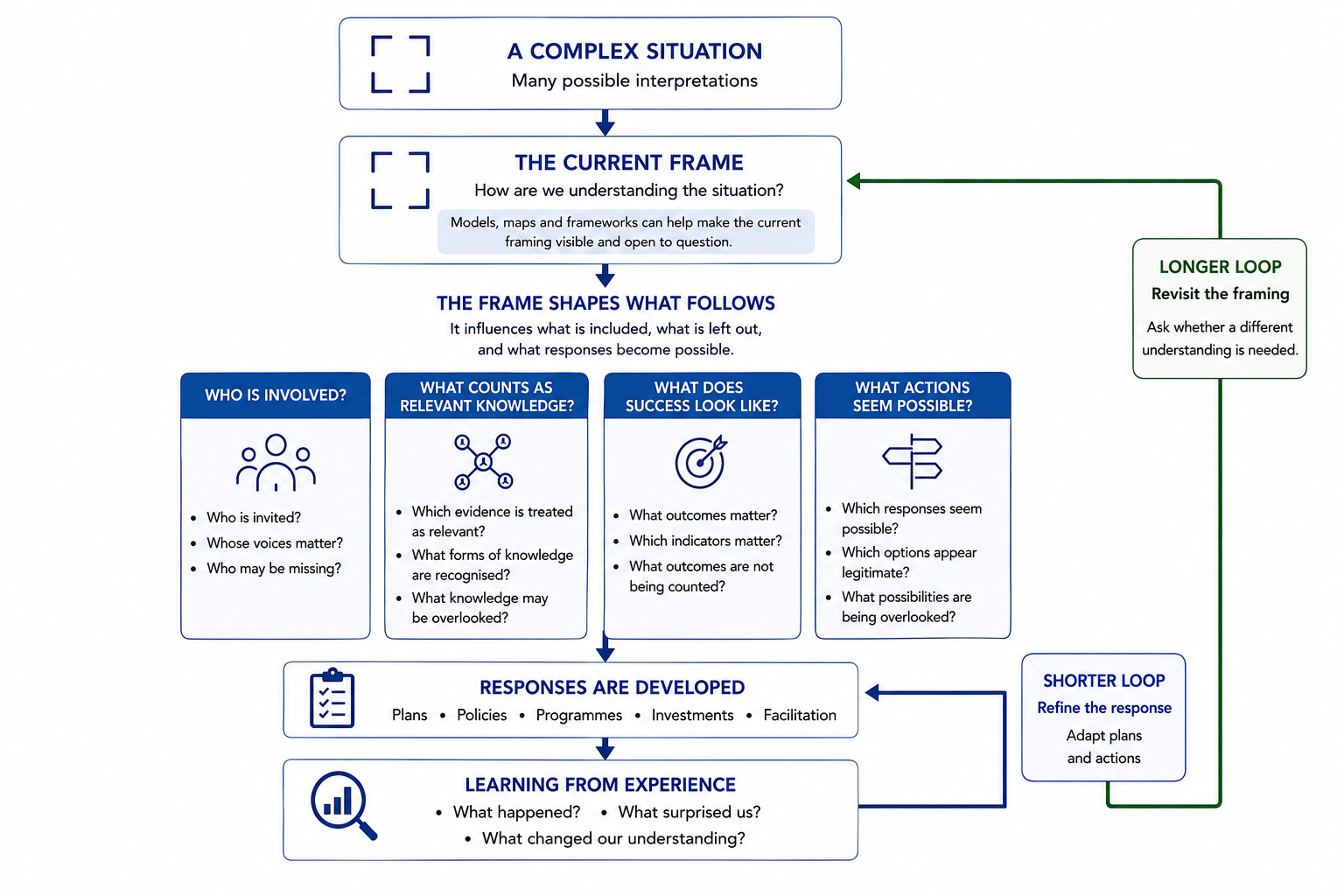
Narrowing is what creates the characteristic difficulties here. A narrow frame makes a complex issue look more manageable, and that is part of its appeal. It produces a scope that can be agreed, a budget that can be defended, and a plan that can be signed off. Most of the pressures acting on a piece of work push in this direction. But the manageability is achieved by leaving things out: the relationships that sustain or undermine action, the histories that shape what is trusted, the structural conditions that constrain what is actually possible.
In the catchment example, framing the issue as a water quality problem gives a clear task and a familiar set of measures. It also quietly settles who needs to be at the table, which is likely to be those in technical and regulatory roles. The relationship strain that shaped the situation in the first place sits outside the frame, so it is nobody’s job to address, and it continues to act on the situation regardless. The process may become efficient without becoming well-grounded. The work becomes technically sound but poorly fitted to what the situation requires.
Early conversations about scope, boundaries and assumptions are not a delay before the real work. They are part of the real work. They are also easier to hold at the start than later, when positions have hardened and a plan is already in motion. The time spent exploring what kind of problem this actually is tends to pay back later, when responses are better matched to the conditions people are working in.
Models and frameworks help shape attention
Tools for visualising and thinking through complex situations are sometimes discussed as if they fall into two distinct categories. One useful way to distinguish them is that a model represents selected parts of a system: causes, relationships, flows, dynamics. A framework orients attention and supports how people make sense of what to do. It helps people recognise what kind of situation they are in and what kinds of responses might be appropriate.
The distinction is useful, but not absolute. In practice, many planning, design, modelling and learning tools sit somewhere between representation and orientation. A conceptual model or a systems map can represent selected aspects of a situation. It can also act as a structure for conversation, helping people surface what they assume, notice what they have left out, and ask better questions together. This is close to the reasoning behind problem structuring methods, which use qualitative models to help people explore different interpretations of complex situations, build shared understanding, and identify feasible action.
The same is true of theories of change and logic models, although they are often used in different ways. These tools are sometimes treated as predictive representations: if we do this, that will follow. Held in this way in complex and uncertain settings, they can create problems. The pathway looks more certain than the situation warrants, and the model becomes something to defend rather than something to learn from.
But a theory of change or logic model can also be held differently, as a framework for inquiry. Developed with the people who will use it, and revisited as understanding grows, it becomes a way of asking: what are we assuming about how change happens here? What might we be missing? What would make us rethink this? Used that way, the same tool that might close down inquiry can instead open it up.
The same tool can close down or open up inquiry
The issue is less which tool is used, and more how it is held and what it is asked to do.
A systems map can become a frozen picture, treated as an authoritative account of how things work rather than as one possible representation developed at a particular moment. A logic model can become a compliance diagram, something produced to satisfy a funder rather than something used to support learning. A theory of change can become a fixed pathway, defended against evidence rather than revised in response to it. A conceptual model can sometimes remain a modeller’s artefact, technically sophisticated but never quite owned by the people it is supposed to serve.
But each of these tools can also work in the opposite direction. Used with care, they can help people ask what they are assuming, whose perspective is missing, where relationships matter, where action might be possible, and what would prompt them to rethink. They can hold the current framing lightly enough that it remains available for revision.
For modellers, this can mean treating early diagrams and conceptual models as shared surfaces for discussion, rather than as technical products to be finalised too quickly.
The value of a tool lies less in the label attached to it and more in whether it helps people think together without closing the situation down before it is properly understood.
Good framing remains open to revision
In complex settings, the first framing is always provisional. As work unfolds, people learn more about the situation. New actors arrive. Assumptions are tested. Relationships shift. What first looked like a technical problem may turn out to be a governance problem. What looked like a knowledge gap may turn out to be a trust issue. What looked like a behaviour change challenge may reveal itself as a structural one.
When this happens, the natural response is to adapt the plan. But the plan emerged from a frame, and if the frame is not also revisited, the new plan may simply be a better response to the original framing. This is the difference between the two loops in the diagram above. Refining the response is the more familiar move.
Returning to the framing is the harder one, and the one more often skipped. Readers familiar with Argyris and Schön will recognise this as a version of the distinction between single- and double-loop learning, applied here to how the problem itself is understood rather than to the goals and assumptions behind a course of action.
This is one of the places where review and learning processes can do more than track progress against plans or indicators. They can ask not only whether the work is on track, but also whether the way the problem was first understood still holds. That is a harder question to raise, because it can feel like questioning the foundations. But in complex settings, it is often one of the most useful questions of all.
Bringing framing into practice
Problem framing is not a specialised technique that requires its own separate process. It can be woven into planning conversations, workshops, modelling sessions, and review meetings without adding significant overhead.
A few practices tend to support it. Asking people to name the problem in more than one way, before settling on a shared description, surfaces the diversity of perspectives that is usually present but often unspoken. Inviting different actors to describe what they think is driving the situation, and what they think is keeping it in place, often reveals assumptions that would otherwise remain invisible. Using a systems map or conceptual model as a conversation starter rather than a final account changes the dynamic: the tool becomes a shared surface for inquiry rather than an expert product to be received.
At key decision points, it is worth pausing to ask what the current framing makes visible and what it might be leaving out. That question is easier to raise in a group if it has been raised before, early in the process, when it feels less threatening.
Good problem framing does not require everyone to agree on a single perfect description. It requires enough shared understanding to act together, while maintaining enough openness to keep learning as the work unfolds.
Closing
Problem framing is one of the quiet foundations of collaborative work in complex settings. It is where people begin to surface what they think is happening, what they value, what they assume, and where they believe action might be possible. These things are often implicit. Making them visible, even partially, creates the conditions for more deliberate and better-fitted responses.
Models and frameworks can support this work, but only when they are held with care. Their value lies less in whether they capture the whole situation and more in whether they help people notice, question, connect and adapt.
In this sense, problem framing is not something we complete before the real work begins. It is part of the work itself. And in complex settings, it is not something we finish. As situations develop, we may need to revisit not only our actions and plans, but also the way we first understood the problem we were trying to address.
If you want to follow these ideas further, the page on conceptual modelling looks at how models and maps can be developed as shared surfaces for inquiry. Theory of change covers how those pathways can be held as working assumptions rather than fixed predictions. And planning, monitoring, evaluation and learning takes up the question of how review processes can ask whether the original framing still holds.
[*1 Image by Foundry Co from Pixabay]
[*2 Graphic: Will Allen, with ChatGPT assistance, 2026]
