
This post introduces Theory of Change as a practical way to support shared thinking, surface assumptions and connect strategy with learning. It also points to an updated Learning for Sustainability resource page with curated and annotated links to guides, papers and examples on Theory of Change, contribution analysis, sustainability science and complex intervention design.

Theory of Change is now widely used across programme design, evaluation, research planning, policy work and strategy. It can be a useful way to clarify how and why change is expected to happen, particularly where people are working across different roles, organisations, knowledge systems and timeframes.
But its value depends on how it is used.
At its weakest, a Theory of Change becomes a tidy diagram prepared for a proposal, report or funder requirement. It may show activities, outputs and outcomes, but do little to help people think more carefully about change, or to learn as the work unfolds.
At its best, it supports a shared conversation, helping people make sense of change together. It invites different perspectives into the process, helping people explore what they are trying to influence, who needs to be involved, what assumptions are being made, and what may need to be learned or adjusted along the way. Used well, it becomes an ongoing resource for reflection and adaptation, not a fixed document produced at the start of a project.
That distinction matters in complex settings. Change rarely follows a simple line from activity to outcome. It is shaped by context, relationships, institutions, incentives, power, history, resources, timing and wider system conditions. A useful Theory of Change does not remove that complexity, but it can help teams engage with it more deliberately and return to their thinking as conditions shift.
More than a diagram
A Theory of Change is often represented visually, and a clear diagram can be genuinely helpful. It can make the main pathways of change easier to see, discuss and test.
But the diagram is not the Theory of Change.
I tend to think of the diagram as a one-page summary of the larger conversation. It can show the main structure of the thinking, but the detail often sits underneath: the context analysis, actor perspectives, assumptions, evidence, risks, supporting conditions, and the questions that need to be revisited over time. A short narrative can also sit alongside the diagram to explain the reasoning in plain language.
The value lies in the thinking behind it, and in the conversations that continue around it. I find it useful to think of a Theory of Change as a shared working hypothesis: a current account of how change may happen, why our actions might contribute, and what else may need to be in place. That hypothesis can be revisited as conditions change, as new evidence emerges, or as the team learns from what is and is not working.
This is also why a Theory of Change is best understood as an ongoing process, not a one-off exercise. Whether used in programme design, evaluation or applied research, it earns its place when it remains a living part of how a team works.
Six elements worth thinking through together
A useful Theory of Change brings together several kinds of thinking. It needs to say something about the context, the direction of change, the outcomes being sought, the assumptions being made, and the practical logic that links activities with outcomes. The diagram below offers one way of holding these elements together. There is some deliberate overlap between these elements, because in practice they are worked through together rather than separated neatly.
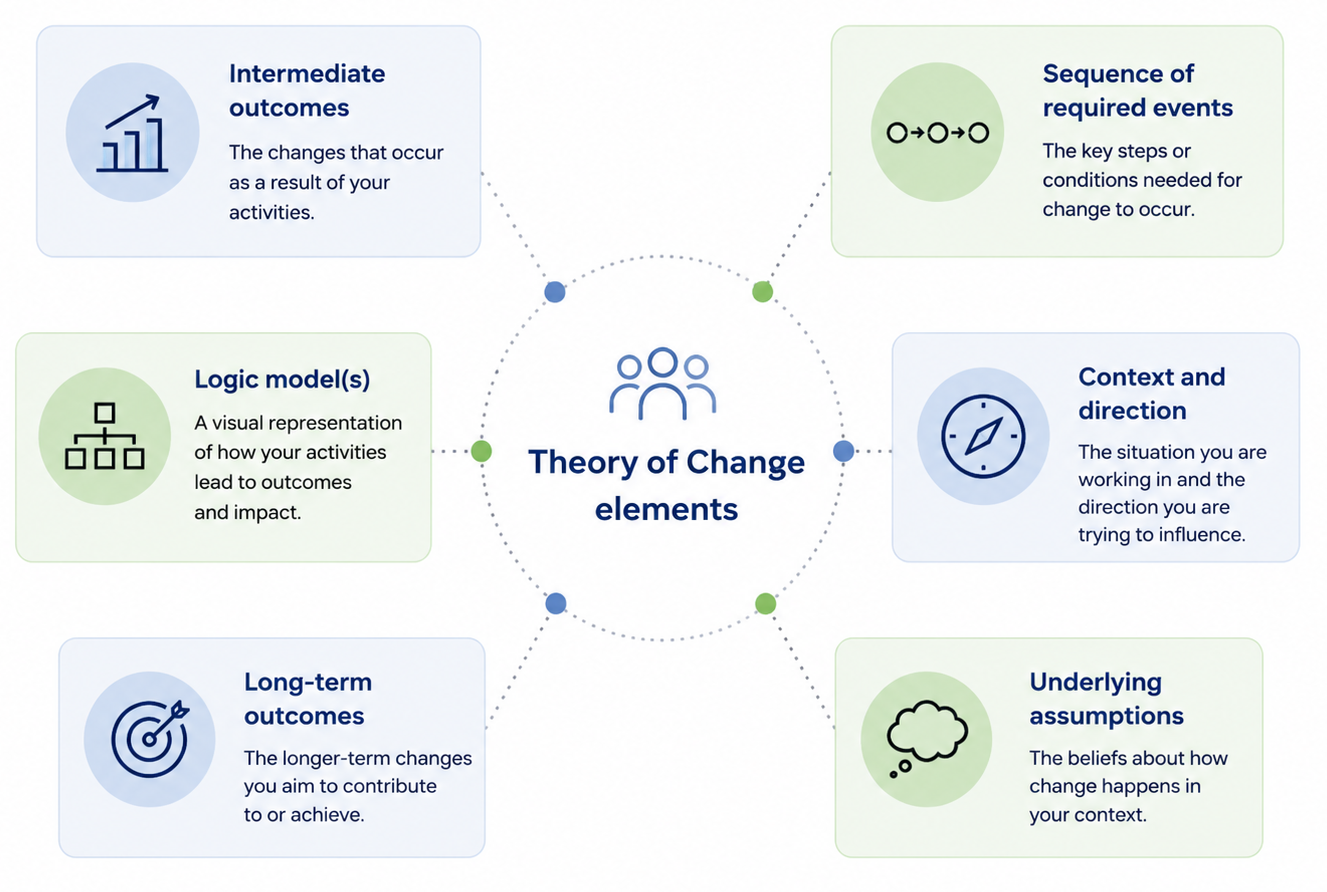
Context and direction. Every Theory of Change starts somewhere. What are the social, ecological, cultural, political or institutional conditions shaping the work? What broad direction are we trying to support? It is also worth asking: what change, for whom, and on whose terms? This means being clear about the boundaries of the system in focus, recognising that no initiative can address everything.
Long-term outcomes. These are the wider changes the work hopes to contribute to over time. They are usually beyond the direct control of any one programme or organisation, but they help clarify purpose and give the work direction. It can help to distinguish between what the work can control, what it may influence, and the wider changes it hopes to contribute to.
Intermediate outcomes. These are the changes that may need to happen along the way, in understanding, relationships, capability, behaviour, practice, policy or institutional support. Thinking carefully about these helps teams see where their work may make a real contribution, and where they depend on others. A useful question here is: who needs to do what differently, and why might they do so?
Sequence of required events. Some changes depend on others happening first. Thinking through the sequence helps teams consider what may need to be in place early, what can happen in parallel, and what becomes possible only later. Clarifying that sequence often surfaces assumptions that had previously gone unexamined.
Underlying assumptions. Assumptions are central. What are we assuming about how people, organisations or systems will respond? What are we assuming about incentives, relationships, capacity, authority, trust or timing? Which assumptions are well supported, and which need to be tested or tracked? Making assumptions visible creates an opportunity to question and strengthen the design.
Logic model(s). I tend to see logic models as part of a wider Theory of Change, rather than as something separate from it. Logic models can help show how activities, outputs and outcomes connect, but they become more meaningful when they sit within a wider conversation about context, actors, assumptions, evidence and uncertainty. The useful level of detail will vary. Too little detail can hide important assumptions; too much can make the model unusable. In more complex programmes, nested, actor-based or scenario-based models can help show different pathways of change without forcing everything into a single linear diagram.
Why assumptions need attention
One of the most practical contributions a Theory of Change can make is to bring assumptions into the open.
Many programmes carry hidden assumptions about what will change, who will act, why they will act, and what conditions will support that action. These assumptions may seem obvious to some people, but unclear, unrealistic or contested to others.
Surfacing them matters because it gives people a chance to question, strengthen or revise the design before it is locked in. It also helps monitoring, evaluation and learning focus on what counts. One useful facilitation prompt is: what needs to be true for this part of the change pathway to work?
Making assumptions visible also helps avoid treating any one perspective as the whole account of change. A useful Theory of Change process creates space for different actors to test assumptions, challenge the logic, and build a more shared account of how change may happen.
As the programme unfolds, teams can move beyond asking whether activities were delivered. They can ask whether the expected changes are beginning to occur, whether the original assumptions still hold, and what needs to be adapted. This is where Theory of Change connects closely with contribution analysis, outcomes-based evaluation and complexity-aware MEL. Each offers a different way to link action, evidence, reflection and learning.
The same point applies to tools and models. In earlier work on decision support systems, we argued that a Theory of Change approach can help clarify how a tool is expected to support better decisions, what wider conditions are needed, and what outcomes it is intended to contribute to.
Keeping the Theory of Change in use
The point of developing a Theory of Change is not to produce a final account of change once and for all. It is to create a shared reference point that can be used as the work develops.
This means returning to it at useful moments: when planning activities, reviewing progress, interpreting evidence, making strategic decisions, or responding to changes in context. It can help teams ask whether the expected changes are beginning to happen, whether the right actors are involved, whether assumptions still hold, and whether new risks or opportunities have emerged.
Used in this way, a Theory of Change becomes part of the learning cycle, helping teams ask not only what has happened, but what that suggests for the next stage of the work.
The diagram may stay simple, but the learning around it can deepen over time. Teams may add notes, evidence, reflections, examples, risks or questions under each part of the model. In this way, the Theory of Change becomes less a static product and more a practical record of shared reasoning.
In the end a Theory of Change is only as useful as the conversation it generates. The resources are a starting point. What matters most is the quality of the thinking that develops around them, and whether that thinking remains open to revision as the work unfolds.
For more, see the Theory of Change – resources and guidance page, the broader Theory of Change hub, and related pages on monitoring, evaluation and learning, logic models, facilitation guides and frameworks, and strategic planning and direction setting.
[*1 Photo by Flamingo Images / Adobe Stock]
[*2 Graphic: Will Allen, with ChatGPT assistance, 2026]
