
Theory of change is a practical way to explore how and why change is expected to happen in programmes, policies, research, and place-based work. It helps people clarify intentions, surface assumptions, and link strategy with monitoring, evaluation, reflection and learning.
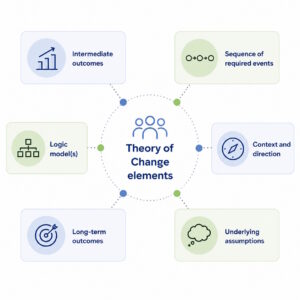
A useful theory of change is more than a diagram. It can support shared conversations about context, actors, outcomes, contribution, uncertainty and adaptation. It can also help teams test whether their assumptions still hold as conditions change.
In practice, a theory of change can work at different levels of detail. It may begin as a simple shared sketch of expected change, then develop into a fuller account of outcomes, assumptions, actors, evidence and possible risks. The value lies less in producing a perfect model than in creating a useful basis for discussion, testing and adaptation.
This page curates open-access guides, papers and examples from different fields and organisations, alongside related Learning for Sustainability material. The resources highlight different ways of developing and using theories of change, including their links with logic models, outcomes thinking, contribution analysis, policy influence, sustainability science and complex intervention design.
For a short introduction to this topic, start with the LfS post Theory of Change as a shared learning practice, then explore the wider set of links below.
Introduction to Theory of Change
This 2019 IDS resource guide by Louise Clark and Marina Apgar offers a clear introduction to Theory of Change thinking. It explains ToC as both a process and a product, with visual and narrative elements, and highlights its role in supporting structured conversations, shared ownership, learning and adaptation. It also explains the links between ToC, logframes, MEL systems and impact pathways.
Countering misunderstanding and misuses of theories of change
This CDI/IDS practice paper by Isabel Vogel, Niki Wood and Tom Aston responds to common critiques of Theory of Change. It argues that many concerns arise from misunderstanding, misuse, or treating ToC too narrowly. The paper is useful for practitioners who want to use ToC as an aid to thinking, learning and adaptation, rather than as a fixed diagram or compliance exercise.
Theories of Change in Reality: Strengths, Limitations and Future Directions
This 2024 open-access book, edited by Andrew Koleros, Marie-Hélène Adrien and Tony Tyrrell, brings together perspectives from nearly 30 contributors working with programme theory and evaluation. It explores how theories of change are used in practice, including their role in causality, public policy, societal change, multiple perspectives and wider systems of change. It is a useful collection for readers wanting a broader view of current ToC practice and debate.
Taking stock of contribution analysis: Reflecting on the past to inform the future
This 2025 review by Steffen Bohni Nielsen and Sebastian Lemire examines how contribution analysis has developed over the past two decades as a theory-based approach to evaluation. It outlines key methodological refinements and the growing theoretical base for making contribution claims. The paper is useful for evaluators and programme teams interested in how ToC can support careful reasoning about contribution, evidence and uncertainty.
Using Theory of Change in inter- and transdisciplinary research
This 2021 open-access paper by Lisa Deutsch, Brian Belcher, Rachel Claus and Sabine Hoffmann examines how theories of change were developed and used within a large inter- and transdisciplinary research programme. It is especially useful for people leading research collaborations, as it discusses practical challenges such as time constraints, group composition, balancing abstract and concrete discussion, and using ToC to support communication, integration and learning.
Change theory and theory of change: what’s the difference anyway?
This 2020 article by Daniel Reinholz and Tessa Andrews explains the distinction between change theory (which provides general theories about how change occurs) and theory of change (a project-specific model for planning and evaluation). It highlights how understanding change theories can strengthen the design and implementation of a ToC.
Theories of change in sustainability science: Understanding how change happens
This 2019 paper by Christoph Oberlack and colleagues argues for wider and more thoughtful use of theories of change in sustainability science. It presents a framework for using ToC to strengthen reflexivity, learning and impact in sustainability research. The paper is useful for researchers and practitioners working across knowledge systems, disciplines and long-term change processes.
Guidance on how to develop complex interventions to improve health and healthcare
This 2019 paper by Alicia O’Cathain and colleagues provides practical guidance for developing interventions in health and other complex settings. It emphasises the importance of involving stakeholders, drawing on evidence and theory, understanding context, and refining intervention design through iterative cycles. The resource is useful beyond health, particularly for people designing programmes where context, implementation and adaptation matter.
Contribution analysis and estimating the size of effects: Can we reconcile the possible with the impossible?
This 2019 CDI Practice Paper by Giel Ton, John Mayne, Thomas Delahais, Jonny Morell, Barbara Befani, Marina Apgar and Peter O’Flynn explores how contribution analysis can assess an intervention’s role in broader change processes. It is especially relevant for Theory of Change practice because it shows how ToCs, impact pathways and system maps can support contribution claims, while also examining whether evaluators can give a cautious sense of the size or importance of a contribution.
The Truth of the Work: Theories of Change in a changing world
This 2017 paper by Doug Reeler and Rubert Van Blerk argues for deeper engagement with stakeholders in theorising and learning from change initiatives, rather than involving them only in implementation. It is useful for readers interested in ToC as a participatory and reflective practice, especially in complex settings where change cannot be fully planned in advance.
How Decision Support Systems can benefit from a Theory of Change approach
This 2017 paper by Will Allen, Jen Cruz and Bruce Warburton illustrates how ToC can be integrated with Decision Support Systems. It shows how a ToC approach can strengthen problem-framing, clarify intended outcomes, and support monitoring and evaluation of decision-support tools. The paper is useful for people working in applied research, modelling, decision support or tool development.
Representing Theories of Change: A Technical Challenge with Evaluation Consequences
This 2018 paper by Rick Davies examines the technical challenges involved in visually representing theories of change, especially how causal connections are shown. It explains how weak or unclear linkages can undermine evaluability, and is useful for people designing or reviewing ToC diagrams for monitoring, learning and evaluation.
You can return to the Theory of change hub page for an overview of how these approaches come together in practice. The related page on logic modelling offers another way to explore pathways, assumptions and outcomes, while the social learning section highlights how groups make sense of change together in complex settings. Earlier theory of change links and notes are also available on an older ToC resource page.
If you’ve found this page helpful, consider sharing it with others who might benefit. You can also sign up for occasional site updates to hear about new tools, guides, and key resources.