
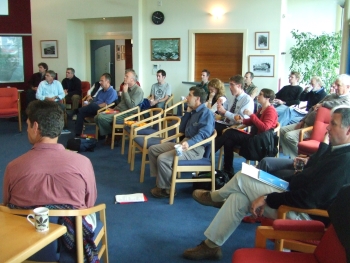
Over the past few years, a number of reviewers have pointed to the need for greater accuracy in how we use the term participation. Too often, participation is discussed as if it is simply about increasing the engagement of citizens and stakeholders. However, an equally important dimension is the capacity of governments and other agencies to support meaningful engagement.
here is growing recognition that we need to move beyond recipe-based approaches—which focus on selecting the right tools—to an approach that treats participation as an ongoing process. This shift highlights the importance of relationship-building, facilitation, and conflict management in multi-stakeholder processes. Ensuring that participation is well-facilitated and genuinely inclusive is as much about power and process as it is about selecting the right methods.
A key challenge is ensuring that marginalised voices are not just present but empowered in participatory processes. This raises difficult but necessary questions:
- How do we design participation so that all voices are genuinely included?
- How do we ensure that the process is empowering for marginalised groups while still being acceptable to dominant stakeholders?
The links below explore these challenges across different social contexts—from organisational change to community development—offering insights into how participation can be structured to support more equitable engagement and drive meaningful change.
A practical reflection
Good engagement does not mean involving everyone in everything – Looks at why people have different needs, capacity and reasons for taking part at different times, how some remain connected through people they trust, and why varied participation still requires attention to representation, influence and accountability.
Selected readings and resources
Stakeholder engagement: Past, present, and future
This 2022 paper by Johanna Kujala, Bryson Borys, Ana Maria Suarez Herrera, and others reviews the evolution of stakeholder engagement, from early concepts to contemporary approaches. It highlights the shift from instrumental to relational and systemic perspectives, integrating dialogue, co-creation, and sustainability. The paper also explores the darker side of engagement, addressing power imbalances and exclusion. Looking ahead, it calls for deeper collaboration, ethical considerations, and adaptive strategies to tackle complex societal challenges.
Stakeholder Participation for Environmental Management: A Literature Review
This 2008 paper by Mark Reed examines participation as a process rather than a one-off event. It identifies best practices and argues that participation must be institutionalised to foster cultures of negotiation and collaboration. While participatory processes may seem risky, the paper suggests that well-designed approaches can enhance decision-making and sustainability outcomes, balancing stakeholder interests in uncertain and evolving contexts.
Community participation: Who benefits?
This report by Paul Skidmore, Kirsten Bound, and Hannah Lownsbrough examines whether policies aimed at increasing community participation effectively build stronger social networks. Through case studies and research, the authors explore key factors influencing engagement in governance. They highlight how participation is often dominated by a small group and suggest ways to integrate informal social networks into formal decision-making processes for more inclusive participation.
Dare we jump off Arnstein’s ladder? Social learning as a new policy paradigm
This paper by Kevin Collins and Ray Ison questions the limitations of Arnstein’s ladder of citizen participation, arguing that participation should go beyond shifting power to support social learning. The authors propose a paradigm shift where policy-making embraces learning-based approaches that enhance collaboration and adaptability. They explore how participation has diversified across governance levels and call for more reflective, inclusive, and dynamic processes.
Using participatory and learning-based approaches for environmental management to help achieve constructive behaviour change
This report by Will Allen, Margaret Kilvington, and Chrys Horn examines how agencies can influence behaviour to improve environmental management. It highlights participatory approaches that enhance motivation, information flows, and collaboration. Covering policy development, behaviour change frameworks, and group capacity-building techniques, the report provides practical insights into designing participatory processes that support long-term environmental change.
Unpacking “participation” in the adaptive management of social-ecological Systems: a critical review
This article by Lindsay Stringer and colleagues critically examines how stakeholder participation functions in adaptive management. Using case studies at different scales, it explores when and how stakeholders can contribute and the mechanisms that support social learning. The authors highlight the need for reflection in participatory research, focusing on how power, institutions, and knowledge interact in adaptive environmental governance.
Further reading on this topic can also be gained by the pages on behaviour change – guides to approaches and theories and guides to help initiate and manage social processes. The page on risk communication and engagement is also closely related. Another page looks at building networks for learning outlining the management of different engagement approaches including partnerships, team building, communities of practice and learning groups. Other related pages cover topics such as stakeholder mapping and analysis, governance and participatory action research.