
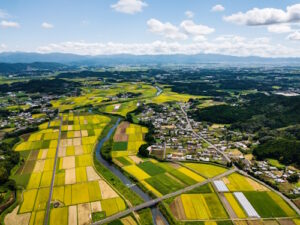
Place-based and landscape approaches recognise that complex social, environmental, cultural and economic challenges are rarely confined to a single sector or policy domain. Instead they unfold across places — the lands, waters, communities and economies that people share. By focusing attention on a defined place rather than on isolated problems, these approaches enable collaboration across actors (community groups, government agencies, businesses, researchers), drawing on local knowledge, relationships and identities to shape interventions tailored to context.
This orientation matters because many common issues, such as sustainability, adaptation, natural resource management, social wellbeing, equity, and resilience, emerge from interactions between humans and place. Place-based work is not a one-size-fits-all model. It does not ask practitioners simply to deliver a fixed “programme.” Rather, it asks them to engage with place over time, weaving together past legacies, present conditions and future uncertainty. The result can be stronger local ownership, greater relevance, and adaptive learning through long-term commitment.
This page gathers a curated set of guides, reviews and frameworks that can help people design and support long-term, place-based work. Use it as a starting point — a way to explore both conceptual foundations and practical tools, drawn from public-service guides, academic reviews and applied practice. The resources here complement other parts of the site (e.g. multi-actor processes, monitoring, evaluation and learning, systems thinking) and are intended to help you shape collaborations rooted in place, informed by evidence, and sustained through learning.
Working with place over time: eight lessons from complex, multi-actor programmes
This long-form LfS reflection distils eight recurring practice patterns from three decade-long Aotearoa New Zealand programmes and wider international reviews. It highlights how collaboration, purpose, learning, relationships, systems and complexity thinking, evidence, institutional settings, and institutional memory interact over time. The post offers a practical lens and guiding questions for people designing, leading, funding, or evaluating long-term, place-based, multi-actor work.
VPS Place-based Guide
This 2023 guide from the Victorian Public Service introduces a practical approach to designing and supporting place-based initiatives. It outlines principles, governance considerations, engagement strategies, and ways to align system settings with local priorities. Written for public servants, it offers a clear structure that practitioners and programme leads can adapt to different community and regional contexts.
Integrated landscape approaches to managing social and environmental issues in the tropics
This peer-reviewed review article by James Reed and colleagues examines the evolution of integrated landscape approaches and distils lessons from decades of practice. It highlights common enabling conditions, governance challenges, and the need for long-term commitment and adaptive learning. Although focused mainly on tropical contexts, the findings apply widely to place-based and multi-actor initiatives.
Place-based policies for the future
This 2025 OECD report synthesises international experience with place-based policy and outlines design principles for effective, long-term interventions. It explores multi-level governance, funding models, data and evidence, and the importance of tailoring interventions to local contexts. While written for policy-makers, its analysis of enabling and constraining system settings is valuable for practitioners and programme designers.
Complexity-aware thinking and practice
This Learning for Sustainability hub introduces complexity-aware thinking for practitioners working in dynamic, uncertain settings. It explains why linear planning often falls short in place-based work and outlines practical implications for design, facilitation, monitoring, and evaluation. The page links to additional guides and tools that help teams work adaptively while remaining accountable.
Operationalizing integrated landscape approaches in the tropics
This 2020 open-access book From Jame Reed and colleagues provides guidance on putting integrated landscape approaches into practice, drawing on case studies from several tropical countries. It covers multi-stakeholder platforms, governance arrangements, knowledge integration, and adaptive management. Although framed around tropical forest landscapes, the principles and tools are widely applicable to place-based and landscape-scale initiatives elsewhere.
Practical place-based initiatives: a better practice guide
This 2022 guide distils lessons from Australian place-based initiatives and offers a structured approach for design, governance, funding and evaluation. It covers readiness, partnering with communities, aligning system settings, and planning for adaptation over time. The emphasis on roles, authorising environments and learning makes it particularly relevant for public servants and intermediaries supporting complex, multi-actor work.
i2Insights: principles for place-based community participation
This short synthesis outlines a set of principles for effective place-based community participation, drawing on practice and research across sectors. It highlights the importance of relationships, trust, power-sharing and long-term engagement, and complements more formal guides by focusing on the lived dynamics of working with communities in place.
Success frameworks for place-based initiatives
This 2021 toolkit sets out a success framework for place-based initiatives, informed by New Zealand experience. It provides questions and templates for clarifying purpose, governance, measurement and learning, and is written with central and local government collaborations in mind.
Place-based work rarely stands alone. It sits alongside other ways of supporting collaboration, learning and adaptation. The multi-actor processes hub provides a broader orientation to these practices, with links to cross-sector partnerships, managing participation, monitoring, evaluation and learning, systems thinking. Together these pages offer practical guidance for people working across organisations and communities over time.
[* Image: Adobe / TM]