
Indicators are most useful when they help people notice what matters, discuss what they are learning and make better decisions. This post introduces a new guide for practitioners working with indicators in place-based initiatives, from catchment projects and climate adaptation to community development and regional planning.
The problem with indicators is rarely a shortage of them. Most initiatives can find plenty of things to measure. The harder challenge is connecting those measures to the questions people are actually asking, the decisions they need to make, and the places where change is unfolding.
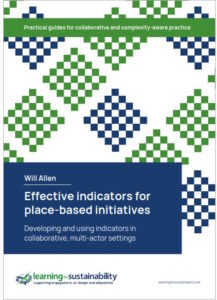
This post introduces a new Learning for Sustainability guide, Effective indicators for place-based initiatives: Developing and using indicators in collaborative, multi-actor settings.
The guide builds on earlier LfS resources on systems thinking, monitoring and evaluation, collaboration, and work in complex settings. Its focus is practical: how to develop and use indicators where multiple organisations, communities and knowledge systems need to work together.
Where the guide may help
The guide responds to a practical challenge that shows up across many place-based initiatives. Indicator work is often treated mainly as a technical task: define the outcomes, select the measures, collect the data, report the results. That work matters, but it is rarely enough on its own.
In complex settings, indicators become useful when they are connected to purpose, context, interpretation and decision-making. They need to help people ask better questions, test assumptions, recognise progress and decide what to do next. Otherwise, even technically sound indicators can drift into passive reporting or compliance.
The guide has been written for practitioners, programme managers, policy staff, evaluators and applied researchers working in areas such as catchment initiatives, environmental restoration, climate adaptation, community development and regional planning.
It may be useful in three main situations. The first is when a team is designing a new initiative and needs to agree what to monitor and why. The second is when people are reviewing or refining existing indicators that may no longer reflect what matters or support useful decisions. The third is when practitioners are working with indicators from national or external monitoring systems and need to interpret or adapt them for use in a particular place.
In each case, the guide focuses less on finding the perfect indicators and more on developing indicators that are meaningful, usable and connected to the decisions people actually face.
A central argument
The guide’s central argument is straightforward: indicators are most useful when they are part of a wider process of sense-making, judgement and adaptive management, rather than being treated as technical measures on their own.
Indicators simplify. That is both their strength and their limitation. A good indicator gives people something useful to look at. It can help show whether things are moving in the right direction, whether assumptions need testing, or whether a programme needs to adapt.
But an indicator is not the thing itself. It is a pointer, an approximation, and often a proxy for something harder to observe directly.
In complex, place-based work, this matters. The things people care about are often relational, cultural, ecological, institutional or long-term. They may become visible only through conversation, local knowledge, or reflection over time. This is why indicators need interpretation. Changes in an indicator invite further questions: what is happening, why might it be happening, who is affected, and what should we do next?
Used well, indicators become prompts for better conversations. Used poorly, they become reporting burdens, compliance exercises, or sources of false confidence.
A six-step process
At the centre of the guide is a practical six-step process for developing and using indicators collaboratively:
- Clarify purpose, scope and scale
- Involve the right people
- Develop a shared understanding of the system
- Identify possible indicators
- Select a small set of useful indicators
- Use indicators to support monitoring, evaluation and adaptive management
The steps are presented as an iterative cycle, not a fixed sequence. Most teams will move back and forth between them as their understanding develops.
A catchment group, for example, might begin by clarifying purpose and sketching a simple system map. In doing so, they may realise that important knowledge sits with people not yet involved. Bringing those people in changes the shared picture of how the system works, which in turn shapes which indicators get selected, what gets monitored, and what the programme learns about itself over time.
The process of developing indicators together is often as valuable as the indicators that result. The conversations help people clarify what matters, how they think the system works, what progress might look like, and where different assumptions sit. That shared understanding creates a better basis for coordinated action.
Indicators need frameworks
One of the recurring weaknesses in indicator work is that measures are selected before people have developed a shared picture of what they are measuring. The guide therefore gives attention to conceptual frameworks, including programme-based approaches such as logic models and theories of change, and system-based approaches such as DPSIR.
The point is not to choose a perfect framework. The value of these frameworks lies in making assumptions visible. They help people ask: what are we trying to change, how do we think change happens, what system are we working within, and where might our actions make a difference?
Without this shared picture, indicator selection can become a disconnected technical exercise. Measures may be valid in themselves, but still fail to help people understand the system or support decisions.
In practice, useful indicator work often needs both programme and system lenses. One asks: what are we doing, and how do we expect it to contribute to change? The other asks: what wider system are we working within, and how does that system behave? Indicators become more useful when they are connected to both.
Indicators create a basis for judgement
Indicators do not remove the need for judgement. They create a better basis for it.
In many settings, especially where progress involves relationships, governance, capability or partnership quality, the question is not simply “what number changed?” It is also “what does this tell us about the quality and direction of change?”
Rubrics can help make this judgement more explicit. They provide a structured way of describing what meaningful progress looks like and bringing different types of evidence together.
The guide gives particular attention to single-point rubrics. These are useful in complex settings because they provide a shared reference point for discussion without forcing people into rigid scoring categories. Rather than pretending that progress can always be ranked neatly, they create space to ask what is working well, what needs attention, and what evidence supports that judgement.
Used alongside indicators, rubrics help teams make their reasoning more transparent and open to discussion.
Working across knowledge systems
Indicator work is also shaped by whose knowledge is included, and this connection to shared understanding runs through every part of the process.
Scientific data, policy frameworks and technical monitoring systems are important, but they are not the only ways of understanding change. Local knowledge, Indigenous knowledge, lived experience, cultural values and qualitative observations can all shape what matters and how change is interpreted. Different knowledge systems bring different ways of seeing a place, and what counts as meaningful evidence is not the same across all of them.
This matters because knowledge systems do not usually meet on equal terms. Scientific and policy-based frameworks often carry more institutional authority, shaping what counts as credible evidence and how resources are allocated. Local and Indigenous knowledge may carry forms of place-based understanding that are not easily represented in technical monitoring systems, yet still be treated as supplementary unless the process is deliberately designed otherwise.
The guide recognises that Indigenous-led and community-based approaches to monitoring and knowledge exist in their own right, and does not attempt to speak for them. Instead, it highlights the practical responsibility of designing indicator processes that create space for different knowledge systems and do not simply reinforce existing institutional hierarchies. In place-based work, this is not an optional consideration. It is central to whether indicators are meaningful, credible and useful.
Good enough to be useful
A recurring theme in the guide is that indicator work needs to be practical, and this applies as much to how teams engage with real-world constraints as it does to which indicators they choose.
Data will often be incomplete. Baselines may need to be reconstructed. Capacity will be limited. Reporting requirements may pull in different directions from local learning needs.
Waiting for perfect data or ideal indicators often means waiting too long.
In many settings, the most workable indicators are proxies: indirect measures that provide a useful signal about something harder to observe directly. Riparian planting may signal the direction of ecosystem health, while participation rates may tell us something about social engagement, even though neither captures the full picture. These are not simply second-best options. In many place-based settings, proxy indicators, qualitative evidence, local knowledge and structured judgement are part of how useful monitoring systems are built.
The task is to be transparent about limitations, clear about assumptions, and willing to refine indicators as understanding develops.
The guide includes two practical tools: an indicator profile and a monitoring action plan. The indicator profile helps teams record what each indicator is for, how it will be measured, what it does not capture, and what assumptions it rests on. The monitoring action plan organises monitoring around outcome areas and connects each area to the forums where information will be discussed and used. Both tools are designed to capture the results of conversations, not to replace them.
Indicators in a changing monitoring landscape
The wider monitoring landscape is changing quickly. Remote sensing, sensors, environmental DNA, citizen science, large datasets and AI-assisted analysis are making more information available at larger scales.
This can be valuable. Larger monitoring systems can provide consistency, coverage and policy-level reporting. But more data does not automatically make decisions easier. In some cases, it increases the burden of interpretation.
Place-based processes bring something different. They connect information to meaning, context, relationships and decisions. They help people ask whether an indicator is relevant for this place, what it does and does not show, and how the information should be used.
Seeing change is not the same as understanding it. The work lies in interpretation, dialogue and the willingness to act. This is why the practical skills in the guide matter more, not less, as monitoring becomes more data-rich.
A practical question to return to
The guide is written as a practical resource rather than a technical manual. It does not offer a fixed method, but a framework that can be adapted and revisited as understanding develops. At its heart, it returns to a simple question: Are our indicators helping us notice what matters, discuss what we are learning, and make better decisions?
The guide is available here: Effective indicators for place-based initiatives: Developing and using indicators in collaborative, multi-actor settings
Indicators are often developed alongside programme design and system frameworks. This page focuses on practical resources for developing indicators; for a broader overview of how indicators and metrics are used in practice, see the indicators and metrics hub. Related pages on this site also cover approaches such as theory of change, logic models, and DPSIR, which help link indicators to activities, outcomes, and wider system dynamics.
