
Planning, monitoring and evaluation are most useful when they are connected through learning. Planning helps clarify the situation, set a shared direction and decide what action is needed. Monitoring and evaluation help us understand what is changing, what is working, and what may need to be adjusted.
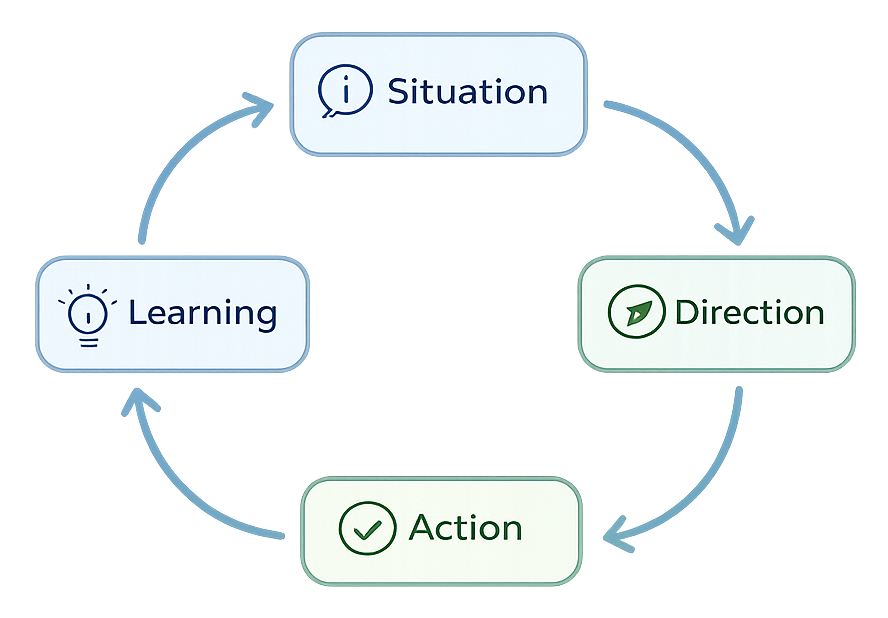
To chart a useful route, we first need to understand the situation: where we are now, what is shaping the context, and what issues or opportunities need attention. We also need to clarify direction: where we want to go, what outcomes matter, and what would count as progress.
Action plans then help translate that direction into practical steps. But plans are based on our current understanding and assumptions about what may work. Monitoring and evaluation help us notice what is happening, make sense of progress and contribution, and reconsider those assumptions where needed.
Learning connects these activities. Together, planning, monitoring, evaluation and learning (PMEL) form an ongoing process in which experience can inform decisions, reshape action and sometimes lead us to reconsider the direction itself.
Connecting planning with learning
Planning is more than setting out activities in advance. It helps people understand the situation, explore possible futures, clarify direction and decide how they might move towards it.
Different approaches can support different parts of that work. Futures thinking and scenarios can help explore uncertainty and alternative pathways. Strategic planning and direction setting can help clarify priorities and choices. Theories of change and logic models can help make assumptions and intended pathways of change visible.
In complex and multi-actor settings, none of these should be treated as fixed. Conditions change, different actors influence what happens, and new information becomes available. Planning therefore needs to provide direction while leaving room for learning and adaptation.
Making the reasoning visible
Theories of change and logic models can help make the reasoning behind an initiative visible.
A logic model generally shows the intended connections between activities, outputs and outcomes. A theory of change goes further by exploring why those connections are expected to occur, including the assumptions and conditions that may affect change.
Both are most useful when treated as aids to thinking and conversation rather than fixed descriptions of how change will unfold.
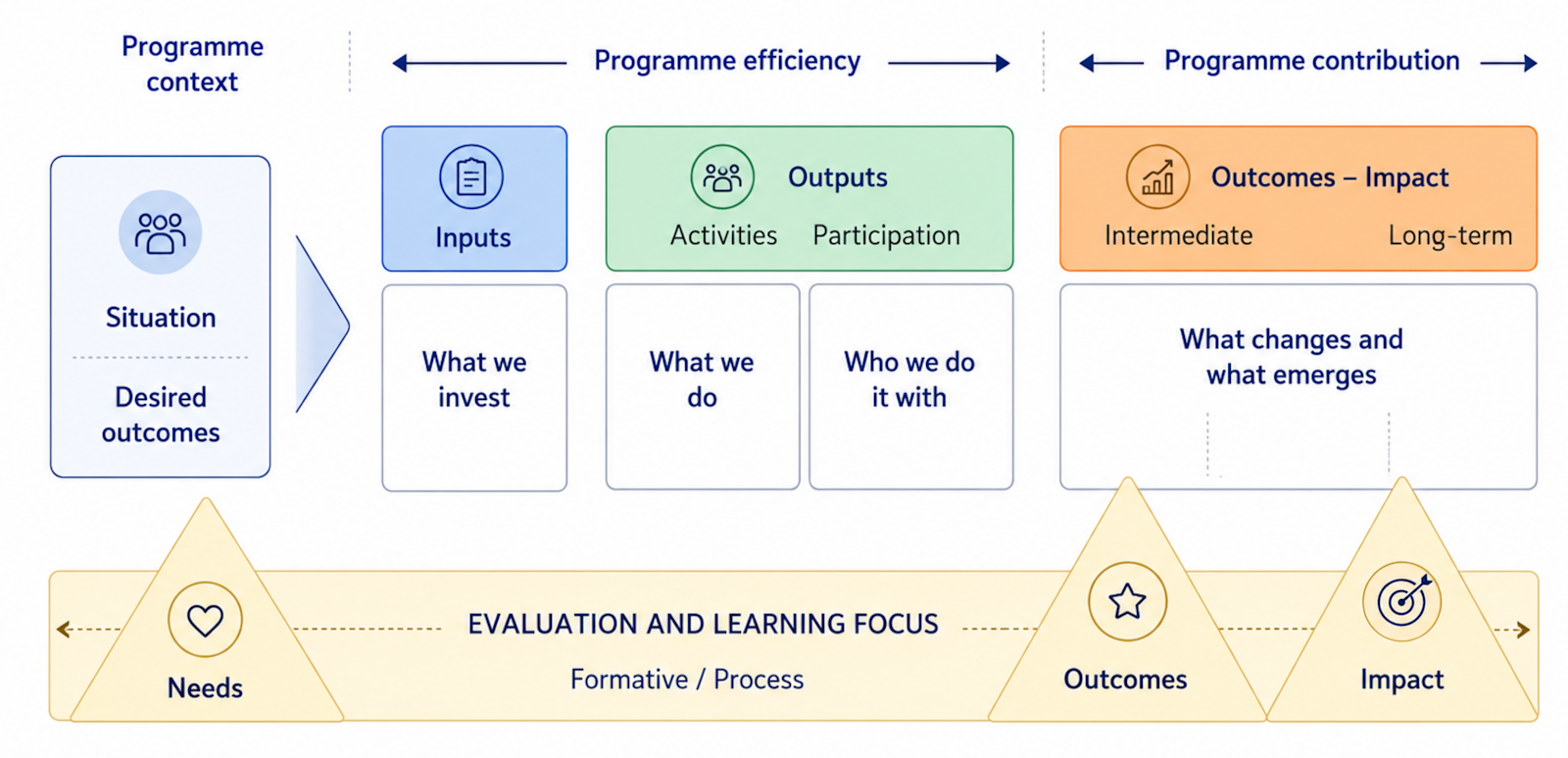
While logic models provide a useful structure, they are best used as working models rather than fixed plans. Real-world initiatives often require iterative and adaptive approaches, where the model is revisited as context, relationships and evidence shift.
They can then provide a shared point of reference for monitoring and evaluation:
- What did we expect to happen?
- What are we seeing?
- What are we learning?
- Are our assumptions still reasonable?
- What, if anything, should change?
Monitoring and evaluation as part of learning
Monitoring helps us notice what is happening as the work unfolds. Indicators and other forms of evidence can help track changes in context, implementation and outcomes, while evaluation helps us step back and make more considered judgements about progress, contribution and what the evidence means.
Their value increases when they are connected back to planning and decision-making rather than treated mainly as reporting requirements. Indicators are most useful when they help answer the questions that matter, rather than becoming ends in themselves.
This is where learning matters. Evidence becomes useful when people have opportunities to interpret it, compare perspectives, question assumptions and decide what should happen next.
Keeping the parts connected
Keeping planning explicit matters because many of the choices that shape later monitoring and evaluation are made early: what outcomes matter, whose perspectives are included, what assumptions are being made, what questions need answering, and how learning will influence decisions.
The aim is not simply to create a monitoring and reporting system. It is to keep direction, action, evidence, reflection and decision-making connected as the work develops.
Learning with others
In place-based and multi-actor initiatives, learning is often shared.
Different people bring different knowledge, experience, responsibilities and perspectives. Bringing these together can help develop a fuller understanding of what is changing, why it matters and what should happen next.
This connects PMEL directly with social learning. MEL helps generate and organise evidence about change. Social learning helps us think about how people make sense of that evidence together and use it to shape future action.
For further resources, three closely connected areas are particularly useful: strategic planning and direction setting, monitoring, evaluation and learning, and social learning.
- Strategic planning and direction setting
Explore approaches to understanding context, considering possible futures, clarifying direction and making strategic choices under changing conditions. - Monitoring, evaluation and learning
Explore the MEL hub for resources on Theory of Change, indicators, evaluation approaches, complexity-aware MEL, reflective practice and using evidence to support adaptation. - Social learning
Explore the social learning hub for resources on shared reflection, dialogue, collaboration, knowledge co-production and learning together in complex settings.
Together, these three areas support a learning-based approach in which planning, evidence, reflection and adaptation remain connected over time.