
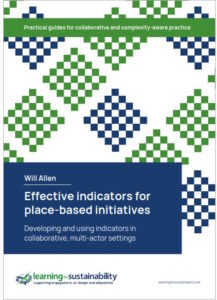
This guide brings together practical guidance on developing and using indicators in collaborative, multi-actor settings. Indicators are widely used across environmental management, climate adaptation, community development, and policy, but in practice they are often difficult to use well. They can become overly technical, disconnected from decision-making, or reduced to reporting requirements that add little value.
The guide focuses on how indicators are developed and used in place-based settings, particularly where multiple actors, perspectives, and knowledge systems are involved. It looks at how indicators can help people understand change, support shared judgement and learning, and inform decisions as circumstances develop.
This includes attention to relational, institutional and practical signs of progress, such as changes in capability, relationships, governance and practice, which can help people judge whether the conditions for longer-term outcomes are being created and adapt their approach where needed.
Indicators are most useful when they do more than provide data. In these and similar settings, they can help people make sense of change, test assumptions, discuss different perspectives and decide what to do next.
At a glance: This guide supports practitioners working in place-based, collaborative and multi-actor initiatives where change is difficult to measure through simple metrics alone.
Download the guide ( PDF, Version 1.2, October 2026)
What this guide covers
A six-step process for developing and using indicators is at the centre of the guide:
- Clarify purpose, scope and scale
- Involve the right people
- Develop a shared understanding of the system
- Identify possible indicators
- Select a small set of useful indicators
- Use indicators to support monitoring, evaluation and adaptive management.
The guide also explores:
- how indicators relate to programme design and system understanding
- the role of conceptual frameworks (e.g. logic models, DPSIR)
- using rubrics and structured judgement alongside indicators
- working across different knowledge systems and perspectives
- practical challenges such as data gaps, competing priorities, and institutional constraints.
It includes simple tools and templates to support use in practice.
Who this is for
This guide is intended for people working in collaborative, place-based settings, including:
- programme managers and policy staff
- evaluators and monitoring, evaluation and learning (MEL) practitioners
- facilitators and advisers supporting multi-actor processes
- applied researchers and practitioners working in environmental and sustainability contexts
It is most useful where indicators need to support shared understanding, reflection, decision-making and adaptation, rather than simply reporting.
How it can be used
The guide can be used in a range of situations, for example:
- designing indicators for a new initiative
- reviewing or refining an existing set of indicators
- interpreting indicators drawn from larger monitoring systems
- supporting workshops or discussions with partners
In practice, the process is iterative. Teams often move back and forth between steps as understanding develops.
Related pages on this site
- Developing indicators and metrics – practical guidance on designing and using indicator systems
- Indicators and monitoring resources – curated approaches, frameworks, and tools for indicator development
- Monitoring, evaluation and learning (MEL) – working with evaluation and learning in complex settings
- Theory of change – linking activities, outcomes, and indicators within a shared framework
These pages provide additional curated and annotated links, tools and examples that complement the approach outlined in this guide.
A note on use
This guide is part of the Learning for Sustainability website, which curates resources and reflections on systems thinking, evaluation, collaboration, and working in complex settings.
If this is relevant to your work and you would like to explore how it might apply in your context, you are welcome to get in touch.