
Organisations evidence participation through its visible products: workshops held, submissions received, themes identified, reports produced. Much of the documentary record around those activities can now be generated in minutes. That makes it possible to produce a convincing account of a participatory process while a good deal of the process itself has quietly gone missing, and nothing in the reporting will show the difference. The question this raises is not whether to use AI in engagement work. It is what participation was doing that the record was never able to capture.

Organisations report participation through what it leaves behind. A consultation is evidenced by the number of workshops held, submissions received, themes identified and documents produced. An evaluation reports how many people took part, how many focus groups were run, and what findings emerged. Funders, auditors and governance bodies read those products and reasonably conclude that a process took place.
Much of that record can now be generated. AI can transcribe a discussion, sort comments, identify themes and produce a summary that reads as though a group worked its way towards something. The artefacts look much as they always did, because they were always the visible part: the part that could be counted, inspected and filed.
It’s worth being precise here. The artefacts were evidence of something. The question is what, and what happens when they can be produced without it.
The gains are real
Engagement has often placed unreasonable burdens on people, and those burdens have fallen most heavily on those with the least time and resources. Attending three evening meetings, reading a hundred-page discussion document, and writing a submission in a register that officials will take seriously are all forms of unpaid work.
AI can genuinely reduce some of this. It can make asynchronous and recorded contributions easier to translate, summarise and work with, while plain-language tools can make material accessible to more people.
The effort was never evenly shared, which complicates any argument for preserving it.
Nor does every process need to involve shared framing or collective decision-making. Much statutory consultation is legitimately about gathering responses within a decision frame that has already been set, and I have argued elsewhere that good engagement does not mean involving everyone in everything. Where that is the honest purpose, doing it faster and more accessibly is often better, though it still leaves questions about how responses are categorised and represented.
There is another complication here. AI may increasingly be used by participants themselves, to understand material, translate it, prepare for a discussion, organise their thoughts or help put a contribution into a form they feel will be heard. That does not necessarily weaken participation. Some of these uses may reduce barriers that participatory processes have always created for people who are less confident with formal language, working in another language, short of time, or unfamiliar with professional ways of presenting an argument. But it makes clarity about the purpose of the activity more important. A contribution developed with AI may be perfectly good evidence of someone’s considered view, while being much weaker evidence of their unaided understanding, their first response, or the way they themselves initially framed an experience. The issue is less whether AI was involved than what we are treating the contribution as evidence of.
The distinction becomes more important when a process was meant to do more.
When participation is intended to do more than gather responses, the difference between supporting the process with AI and producing its visible record without the process becomes important. The diagram below shows how the visible products can look much the same even when the relational work beneath them is very different.
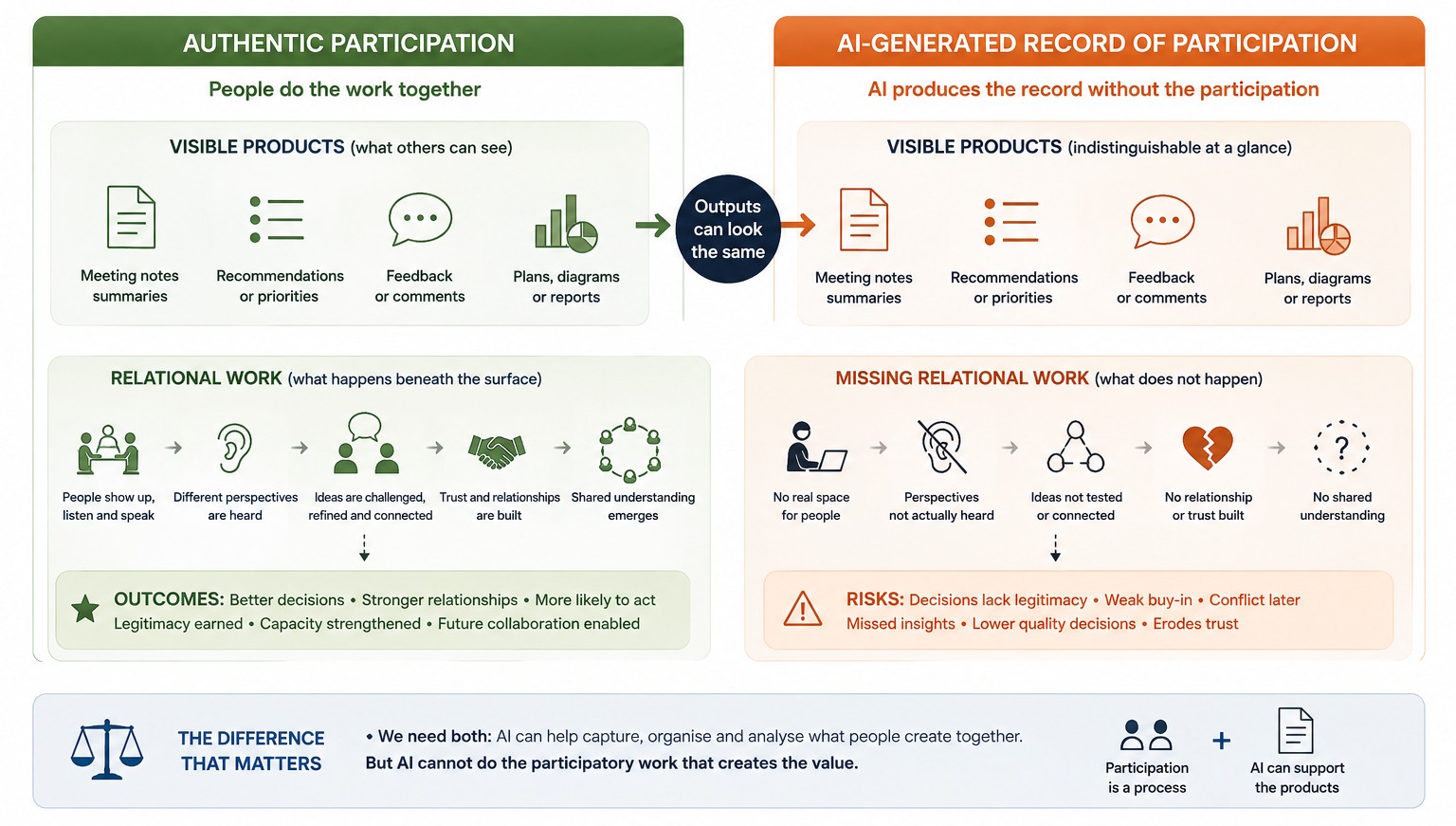
What the process was doing
Participation can allow people to influence how an issue is understood, hear and respond to one another, test interpretations, work through disagreement and develop some ownership of what happens next. It can build relationships and shared judgement that stay useful long after the report is filed. Those outcomes are why the effort was worth spending.
None of them appear in the record. A summary cannot show whether participants influenced the framing or merely commented on someone else’s. Themes cannot show whether a disagreement was worked through or smoothed over. A list of workshops cannot show whether people left understanding how a decision would be made and who would make it.
We have relied on the artefacts as a proxy because the things that mattered were hard to evidence and the products were easy to count. The proxy was never reliable. Arnstein made the point nearly sixty years ago: consultation can be an empty ritual, and institutions have long been able to report participation that gave nobody any influence. Much of that was never deliberate. It was habit, procedure, and the momentum of a process that had to be seen to happen.
What has shifted is how much easier the gap is to open. Producing a convincing record used to require sustained contact with the material even where the engagement behind it was thin. That contact is now optional. An organisation acting in good faith can meet every reporting requirement, produce material of a better standard than it has managed before, and see nothing in its own reporting that would suggest anything was missing.
A good record of a collaborative process is not the same as a collaborative process, and it has become considerably easier to have one without the other.
Which effort was carrying the work
As a facilitator I have an obvious interest in arguing that process matters, and the argument should not rest on that. Activities should not survive because facilitators have traditionally done them, and nothing here requires collaborative work to stay labour-intensive.
The question is which effort was carrying part of the work, and it is harder to answer than it first appears. Some of it was clerical. Reformatting a document for a third audience, chasing attendance lists, tidying a table: reducing that is a plain gain.
But the obvious candidates are not always the safe ones. Transcription is what most people cut first, and qualitative researchers have argued for decades that transcribing is where you come to know your material. Listening twice, deciding how to render a hesitation, noticing on the second pass what you missed on the first: that is analysis, not typing. When AI does it, the text arrives without the immersion that used to come with producing it. The time is genuinely saved, and something now has to replace what the time was also doing.
Other effort was more obviously doing the work. Comparing two readings of the same material and finding they do not agree. Struggling to name an outcome and discovering in the struggle that the group means different things by it. Returning to a disagreement that was parked three meetings ago because it has surfaced again in a different form. These look inefficient, and they are often where the understanding actually forms.
Holding several readings at once
There is a way of describing this that I have found useful.
In a long collaborative process I am rarely reading one thing. I am reading the people, and whether they are anxious, tired or engaged. I am reading the state of the task, and whether we are generating enough or converging too early. I am reading the maturity of the process itself, and whether the design is still doing what we set it up to do. I am reading the trajectory towards whatever we agreed we were working on, and whether we have drifted. And I am reading the wider context: the relationships, history and commitments outside the room that will determine whether any of this holds.
Those readings frequently disagree with one another. The energy in the room says stop while the funding timeline says push on. The content is converging nicely, and converging on the wrong problem. The group is ready to decide something the wider context is not ready to receive.
Holding those readings open, rather than resolving them too early, is a big part of the work. The judgement lies in the conflicts, not in any single reading.
Producing an account usually means collapsing them into one version, arrived at by deciding which readings governed. It does not have to. An account can carry competing interpretations, name what remains unresolved, and say which questions a group could not answer. Those accounts are harder to write and harder to commission, and they are rarer than they should be. The skill is knowing when to collapse them, and when to leave them open until the group is ready to make that judgement and own it, which is the argument I made in an earlier post about the authority of the first synthesis.
An AI synthesis can only work with what has been made legible to it. Some of the readings can be supplied. You can describe the history, hand over earlier reports, say where the process has drifted, and ask explicitly for contradictions to be kept rather than resolved. Most of us do less of that than we should.
But much of what is being read never enters the record in the first place. It is embodied, provisional, held tacitly between people who have worked together for two years, or noticed and not yet put into words. It was never in the transcript to be handed over. An account can therefore read as coherent partly because tensions that were live in the process were never present to the system as tensions. The output is coherent because, as far as the system could tell, nothing was in conflict.
Where this leaves AI policy
Many organisational responses to AI sit with information technology, legal, privacy or risk teams, and they ask whether a use is permitted, secure and appropriately disclosed. All of that matters. On its own it is not well placed to notice what this post describes.
A consultation report can be produced in a compliant environment, clearly labelled as AI-assisted, meet every privacy requirement, and still leave participants with no way to challenge how their contributions were categorised. Nothing prevents a governance framework from asking about contestability, participant review, or how an interpretation was arrived at, and it is worth looking at whether yours does.
The distinction to look for is between oversight of an output and attention to the process that produced it. That attention may increasingly need to extend to how contributions themselves are produced, but without turning transparency into surveillance. The relevant question is not whether every use of AI can be identified, but whether we know enough about the process to interpret what people contribute appropriately.
The practical response therefore sits largely with the people designing the processes. It might mean delaying the first synthesis until participants have developed their own reading of the material. It might mean asking AI for three possible interpretations rather than one, and putting all three in front of the group. It might mean deliberately preserving disagreement instead of resolving it, keeping source material accessible so people can check what happened to their contribution, or inviting participants to revise the categories rather than only comment on the summary.
It also means being honest about where the time goes. If AI saves a facilitator two days, those two days can be absorbed as efficiency or spent on interpretation and dialogue. The second does not happen by itself, and ordinary reporting will not register which one occurred.
What we now have to say out loud
The uncomfortable implication is that we can no longer let the record stand in for the process. It never fully could, and the gap has widened.
That means saying what participation is for in a given piece of work, before it starts, and being willing to report on whether it did that rather than on how many workshops were held. It is harder than counting. It is also what now separates a process that genuinely achieved its participatory purpose from one that only sounds as though it did.
AI will keep getting better at producing the outputs of collaboration. We will have to get clearer about what the collaboration itself was for.
This post forms part of the Learning for Sustainability resources on AI in research, professional practice and collaborative work. Visit the AI in research, practice and collaborative work page for related essays, practical guidance and curated resources.
[*1 Image by Jintana / Adobe Stock]
[*2 Graphic: Will Allen, with ChatGPT assistance, 2026]
