
Not everyone needs to be in every meeting. This reflection looks at how people get involved in collaborative work over time. It considers why they have different needs and reasons for becoming involved, how some stay connected through others they trust, and why varied participation still requires close attention to representation, influence and accountability.
In my recent post on distributed collaborative planning, I described place-based work as something spread across many actors and organisations, often unfolding over months or years. Such processes are held together by a shared design rather than carried by any single group, and this shapes how people can realistically stay involved over time. What that post did not explore was how people take part in work like this, or why involvement varies so much from person to person, and from one stage to the next.
Trying to involve everyone all the way through can sound inclusive. In practice, it often leaves people tired, frustrated and less willing to come back. The same people are invited to repeated meetings and asked to comment on matters well outside their interests. Continuous involvement becomes the ideal, and those who take part less often can begin to look less committed.
But people come to a process with different roles, relationships, knowledge, authority, available time and reasons for being there. These also change. The aim is not equal participation at every stage. It is meaningful involvement over time.
These ideas are not new. Participation literature has long distinguished between being present and having influence, while practitioners have used ladders, the participation spectrum and circles of involvement to describe different forms of taking part. The purpose here is not to offer another model, but to consider what these ideas mean in practice: people do not all have the same need, capacity or reason to take part at the same time.
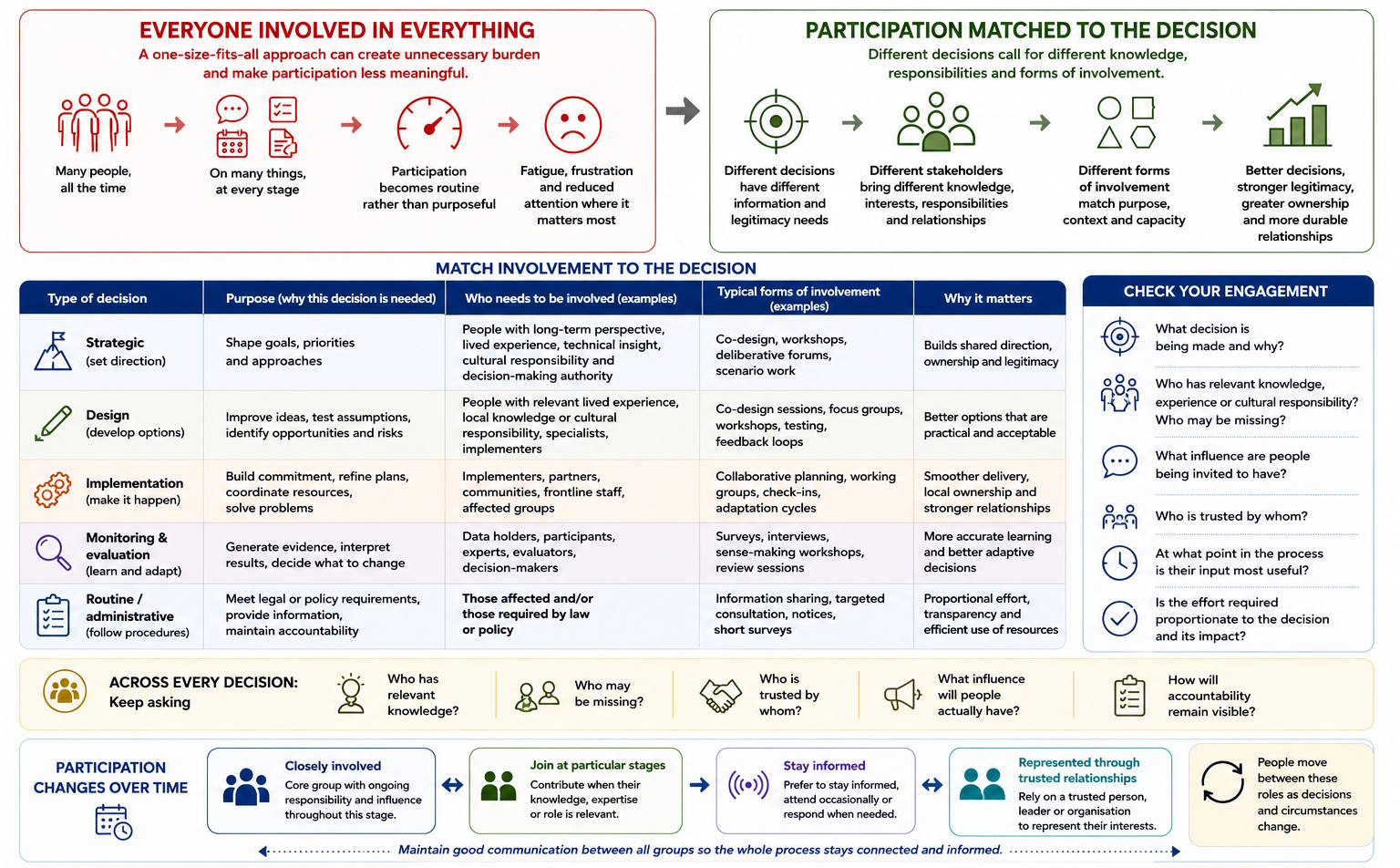
Good engagement therefore starts with the decision rather than with a fixed level of participation. Different decisions call for different knowledge, responsibilities and forms of involvement. The diagram below contrasts this with a one-size-fits-all approach and offers some practical questions for matching participation to the work.
People have different reasons for taking part
Some people have an immediate reason to become involved. Others may see an issue as important without feeling any need to take part personally, at least for now.
Consider the planning of local health services. A family caring for a sick child may be keen to contribute, because the quality and accessibility of those services affect their daily life. Another family nearby, where no one has needed a doctor for years, may feel far less urgency. That does not mean they are uninterested or do not value the service. The issue is simply less immediate for them.
The same pattern appears in many settings. People become involved in flood planning after their home is affected, in school decisions when their children reach a particular age, or in transport planning when their work or caring arrangements change. Need, relevance and interest are not spread evenly across a community, and they do not arise at the same time for everyone.
This matters because limited participation is too quickly read as apathy. Often people are simply busy, the issue does not yet feel relevant, or they are content for others to carry the work for a time.
Different ways of staying involved
In most collaborative processes, a small number of people carry ongoing responsibility. They convene the work, maintain relationships, organise activities and keep the wider purpose in view.
Others contribute more at particular stages, joining a working group, helping define the issue, testing options or supporting implementation when the work connects with their interests or responsibilities. A wider group may prefer to remain informed, attend occasionally or respond only when something affects them directly.
Some people may feel no need to take part themselves if they trust that someone else is involved – a neighbour, community leader, colleague or organisation that understands their concerns. Participation does not happen only through formal meetings and submissions; it also runs through relationships, conversations and informal representation. Someone who trusts a person already at the table can step back, provided they can see who is taking part, how to raise a concern, and how they will hear of anything important. All of these can be legitimate ways of participating.
The difficulty comes when they remain unspoken. People who engage intermittently may feel their contribution counts for less. Those carrying the ongoing load can quietly become overloaded. Repeated invitations can lead to engagement fatigue. And a small core group can, over time, begin to speak as though it represents the wider community.
Making these different forms of involvement visible helps clarify what is being asked of people, what influence they have, and how they can move into or step back from more active involvement as the work develops.
Participation changes over time
Someone may be closely involved in framing an issue, step back during a period of technical analysis, then return when options are being considered. Another person may begin at the edge and become more active as the implications become clearer, or the work moves closer to their area of responsibility.
Life circumstances change too. Work, illness, caring or other commitments can make active participation difficult for a time, and being unable to attend is not the same as not caring. Good process design lets people step forward, step back and remain connected without feeling they have failed a commitment.
That depends on continuity between the more active periods. A short update, a clear record of what was decided, or a well-timed invitation to contribute may be more useful than another general meeting. Staying connected can matter as much as turning up.
This is also about power
Differences in participation are not only about enthusiasm or available time. They also reflect authority, knowledge, cultural responsibility, material resources (money, job security), institutional support and who is affected by the decisions.
The people most active in a process are not always those most affected, most knowledgeable or best placed to speak for others. Some have more confidence, flexibility or organisational support to participate. Others hold local knowledge or lived experience that formal settings may not readily bring forward. Trusted representation can reduce the need for everyone to participate directly, but it should not be assumed. Knowing someone is in the room is not the same as trusting that they understand your interests, or that they have a real opportunity to influence the outcome.
It is therefore worth asking – and revisiting – questions like:
- Where are decisions actually being made?
- Who needs to be closely involved?
- Whose knowledge and experience matter at different stages?
- Who may be missing?
- Who is trusted by whom?
The point is not to divide people into more and less valued participants. Varied participation only works when representation, influence and accountability remain visible; it should never become a convenient reason to leave affected people at the margins. This is not an argument for less engagement, but for more deliberate engagement with clearer expectations and explicit attention to power.
Designing for varied participation
A more realistic starting point is that not everyone needs to be involved in everything. The practical task is to offer different ways for people to contribute and to be clear about what each involves: identifying when particular perspectives are needed, making it easy to move into and out of more active roles, keeping less-active participants informed, and being open about where decision-making authority sits. Recognising trusted relationships is part of this, without relying on them as a substitute for genuine representation.
This becomes especially important in long-term, place-based work involving communities, public agencies, technical specialists, governance groups, funders and delivery organisations. No single group can sustain continuous, high-level involvement across all of it. That is part of the wider challenge described in the earlier post: connecting different actors and streams of activity over time. Designing for varied participation is one part of that. It makes involvement more realistic, reduces unnecessary demands on people and creates better conditions for engagement that can be sustained.
The question is not simply, “How do we involve everyone?” It is, “Who needs to be involved, in what way, at which points, and with what influence?”
For related resources and further reading, see the Managing collaborations hub, the Managing participation page, and the Facilitation section.
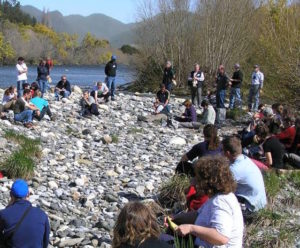
[*1 Image: Motueka-ICM programme fieldtrip]
[*2 Graphic: Will Allen, with ChatGPT assistance, 2026]
