
Many of us focus on the tools and strategies for change, yet much depends on how we show up with one another. This piece reflects on the inner side of sustainability practice and how the Inner Development Goals offer one lens for noticing that work.

In many of the settings where I work, progress often hinges less on technical expertise and more on how we show up with one another. Whether it’s a catchment group, a cross-agency project, a community initiative, or a co-design process, the way people listen, relate, make sense together, and stay open to learning has a direct influence on what becomes possible. Strategies and evidence matter, but without the inner and relational capabilities to work well together, they struggle to take root.
The UN Sustainable Development Goals offer a widely recognised set of outcomes for a more just, thriving, and sustainable world. However, many of the barriers are not only technical or structural, but often relational and human. This recognition helped prompt the development of the Inner Development Goals, with a focus on the qualities that support that work. The framework groups a set of inner and relational capabilities into five broad areas: how we show up (Being), how we make sense (Thinking), how we connect (Relating), how we work together (Collaborating), and how we move into practice (Acting).
There is growing recognition across different fields that progress depends not only on strategies, tools, and expertise, but also on the human capacities we bring to working together. In design, there is a shift towards ideas such as Design for Planet and Design for Humanity, which acknowledge that mindset and presence shape impact as much as method.
Many Indigenous and community traditions have always held this inner work as central to collective wellbeing and decision-making. These practices remind us that the ideas behind personal and collective development are not new, and have long helped people act with care, responsibility, and connection.
The IDGs are one recent attempt to give shared language to this territory. They highlight inner and relational capabilities that support more thoughtful, inclusive, and adaptive action, with many seeing value in naming the inner and relational side of change. While not the only lens we could use, I can see how closely many of the IDG themes sit alongside long-standing inner practices in sustainability, collaboration, and systems work.
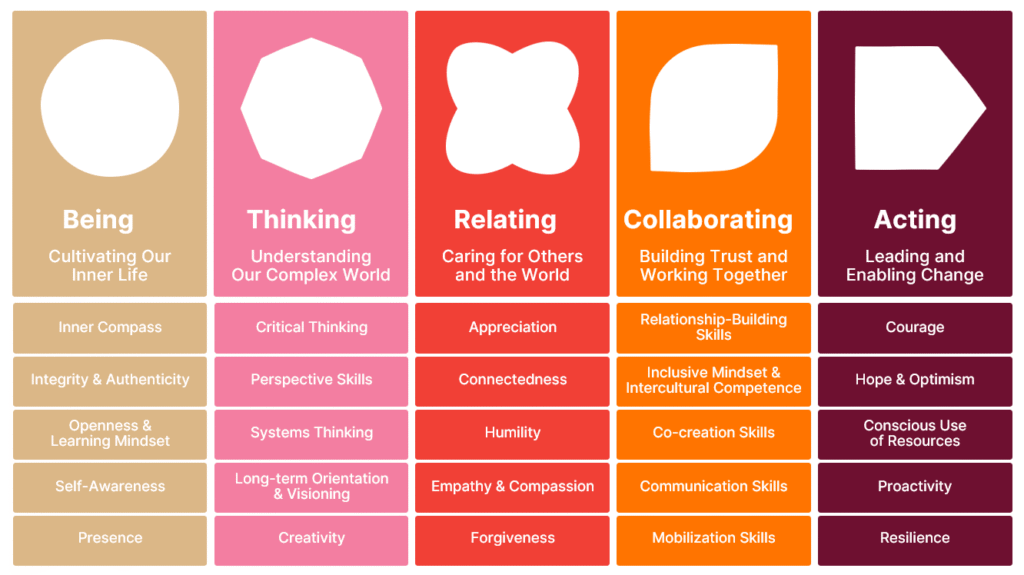
The IDG framework brings together five dimensions of inner and relational development. Within each are five capabilities that speak to how we show up (Being), how we think and inquire (Thinking), how we connect with others and place (Relating), how we work together (Collaborating), and how we move into practice (Acting). They offer one way of naming qualities that can support change work.
As the framework above shows, each dimension includes five specific capabilities. Rather than list them all here, the reflections that follow simply draw out a few natural connections with themes already on the Learning for Sustainability site.
With that as background, the next section offers a brief overview of how the IDG dimensions relate to the structure and content of the Learning for Sustainability site. This isn’t a formal mapping, simply a way of noticing where similar ideas already appear in our work.
Relating the IDG dimensions to the LfS site
Before stepping into the five dimensions, a small note on how to read what follows. It is simply an invitation to notice where the themes behind the IDGs already show up in the areas of practice reflected on the LfS site.
Being – how we show up
Much of our practice begins with who we are when we step into a room or conversation. The IDGs include five capabilities under this dimension, touching on qualities such as a steady inner compass, self-awareness, presence, openness, and a willingness to learn. These capabilities shape how we show up for ourselves and others, especially when things feel uncertain.
The Learning for Sustainability site touches on similar skills, including reflective and reflexive practice, values and behaviours, and ethics in practice. These offer gentle prompts to pause, notice what is influencing our actions, and stay curious about our assumptions. Small habits of reflection help us act with care and clarity rather than reacting on autopilot. Being grounded in this way makes it easier to hold steady in complex or high-stakes settings.
Thinking – how we make sense
Thinking well is central to navigating complexity. The IDGs highlight skills such as perspective-taking, critical thinking, and systems thinking. These help us understand what is happening, how issues connect, and where there may be space to act.
The Learning for Sustainability site includes resources related to systems thinking, futures and foresight, and monitoring, evaluation and learning. These encourage us to explore patterns, question assumptions, and make sense of what we are seeing. Bringing these perspectives into our work supports more thoughtful judgement and helps us avoid moving too quickly to solutions without understanding the wider system.
Relating – how we connect
Meaningful change grows through relationships. The IDGs emphasise empathy, compassion, humility, and a sense of connectedness. This includes valuing different forms of knowledge and making space for voices that are often less heard.
The Learning for Sustainability site provides links to resources on cross-cultural work, and approaches such as co-design that centre lived experience, along with material on paradigms, identity, and collective action. These encourage us to approach conversations with care, notice our own stance, and build trust over time. Attending to relationships in this way helps create the conditions for more inclusive and respectful practice.
Collaborating – how we work together
Working well with others takes intention and practice. Under this dimension the IDGs highlight qualities such as communication, co-creation, and shared leadership. Together, these help groups learn with one another and move with a sense of shared purpose.
Collaboration sits at the heart of this site. The pages on multi-actor processes, cross-sector partnerships, and facilitation offer practical guidance for working alongside others over time. Much of this is about paying attention to process and creating space for different perspectives to be heard. It reminds us that collaboration is something we grow through ongoing practice rather than a fixed set of tools.
Acting – how we move into practice
Turning ideas into action asks for courage, care, and a willingness to learn as we go. The IDGs include qualities such as hope, creativity, and perseverance. Acting well is not about pushing harder. It is about taking thoughtful steps, learning from experience, and adjusting our course.
The Learning for Sustainability site includes resources on Theory of Change, climate adaptation, and adaptive management. These encourage a steady movement from intention to action, grounded in reflection and learning. They help groups stay aligned with purpose, experiment, and adapt in real-world settings, so momentum builds without losing sight of relationships or values.
Reflecting on using this lens in practice
Exploring the IDGs in relation to this site naturally raises questions about how inner development can be grown in practice. Many people recognise the value in naming these capacities, especially in settings where collaboration is essential. The IDG lens can give permission to talk about the relational and reflective side of change work. Used lightly, it can help normalise conversations about presence, listening, courage, and learning.
At the same time, inner work is not new. Many Indigenous, community, faith, and place-based traditions have long cultivated reflection, relational awareness, and shared responsibility as part of everyday life. For those already working in these ways, the language of IDGs may be useful as a bridge into organisational or policy settings, but it should sit alongside and not overwrite existing wisdom.
One question that keeps emerging is whether inner development is something we try to grow at an individual level or nurture collectively. Personal reflection helps each of us notice our patterns and take responsibility for how we show up. Yet if we focus only on individual “skills”, we risk turning deep work into a personal performance exercise. The alternative is to treat inner development as a shared practice that grows through relationships, culture, and the work itself. Both matter, and they reinforce each other.
For me, one value of the IDG language, and similar approaches, is that they offer a shared way to talk about the inner and relational side of our work. This can help groups look beyond tools and techniques and notice qualities such as reflection, presence, and care. A common language can also support facilitation and co-design by helping groups name what supports good practice and where they want to grow together, without needing to adopt a full framework.
Many people working in sustainability, facilitation, and systems change already draw on some form of inner practice, whether through cultural or spiritual traditions, time in nature, or everyday reflective habits that keep them grounded. Few of us are skilled across all areas the IDGs describe, as deep practice sits within different communities of expertise. The value lies less in individual mastery and more in bringing these strengths together in collective practice.
There are also reasons to take care. Frameworks can make inner work sound neat and teachable, when in reality it is slow, contextual, and shaped by culture and lived experience. Some people have raised concerns about universalising ideas of inner development in ways that overlook cultural or spiritual traditions, or about inner work becoming instrumentalised as a productivity tool rather than a practice of care and connection. These are useful reminders to stay grounded and attentive to context.
Much of the Learning for Sustainability site has always focused on ways of being and working that support thoughtful, collaborative, and adaptive practice. The IDG lens highlights threads that are already woven through the pages: reflection, listening, systems awareness, participation, and learning as we go. For those exploring this territory, the site offers practical tools, questions, and resources that can sit alongside the IDGs or any other approach that values the inner and relational side of change.
If this lens is helpful, use it lightly and adapt it to your context. I’m interested to hear how others are making sense of the inner side of sustainability and systems work, and what supports them to keep learning together.
If you would like to explore these ideas further, the reflective practice hub page offers a starting point, with links to practical tools and curated resources for developing reflective and reflexive habits. You might also find the accompanying resource page for this topic – Reflection and reflexivity resources – and the companion post – Why we need both reflection and reflexivity to navigate a complex world – helpful for grounding these ideas in everyday practice.The A number of other Learning for Sustainability pages provide additional information on this topic, including planning, monitoring and evaluation (PM&E), as well as systems thinking, action research and adaptive management.
[*1 Image by wollyvonwolleroy from Pixabay]
[*2 Image source: innerdevelopmentgoals.org]
