
Around the world, people are learning what it means to live with change that can’t simply be reversed. Floods, fires, and shifting seasons remind us that the climate is already moving beyond its old bounds. In this context, adaptation is no longer just about prevention or recovery, but about learning how to live and act within changing conditions. This post reflects on how we can adapt in and through uncertainty, exploring ideas of overshoot, resilience, and renewal, and what it means to live well within planetary limits.
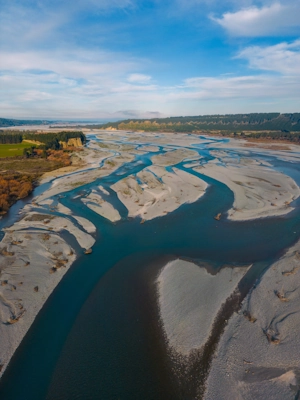
We are now living in a time of overshoot, when humanity’s demand on nature exceeds Earth’s ability to regenerate. Scientists tracking the health of our planet tell us that we have pushed beyond most of the safe boundaries that keep the Earth system stable. These pressures may sound abstract, but they often show up close to home – in shifting weather patterns, food insecurity, and rising social strains.
Across the sciences and in everyday life, evidence is mounting that humanity has entered a new phase of planetary risk. The latest Planetary Health Check 2025 confirms that seven of nine planetary boundaries have now been breached, marking what scientists describe as an emerging age of overshoot. Climate change, biodiversity loss, and land-system degradation are no longer isolated crises but interconnected signals that our Earth system’s integrity is under sustained pressure.
As global boundaries are crossed, so too are social and institutional thresholds. The question is no longer whether we can avoid disruption but how we will adapt in and through it. This is where insights from resilience theory, systems thinking, and collective learning become most valuable, helping us sense, respond, and reorganise as living systems do.
The term overshoot refers to the condition in which human activity exceeds the planet’s capacity to regenerate — when we go beyond safe operating limits such as the 1.5 °C climate target or the boundaries for biodiversity and land use. It’s not a single tipping point, but a dynamic and complex condition that demands new ways of thinking and acting.
Through recent LfS posts, I’ve been exploring how systems learning and adaptive practice can help us navigate complexity – learning together, acting collectively, and reflecting purposefully as conditions shift around us. The work of adaptation, at every scale, is less about controlling outcomes and more about staying responsive as the world becomes more complex and uncertain, finding patterns of renewal when old systems reach their limits.
The age of overshoot: living beyond safe operating limits
In climate science, overshoot pathways describe futures where global warming rises above a critical limit, such as 1.5 °C, before (hopefully) later being brought down through emission cuts and carbon removal. However, the return, where it occurs, is neither immediate nor symmetrical. Once systems exceed a threshold, they rarely come back the same way. Forests, glaciers, and oceans don’t simply bounce back; they reorganise into new states.
At its heart, overshoot reflects a deeper imbalance in human systems. Economies and institutions have long drawn more from nature than can be renewed, assuming tomorrow will absorb today’s costs – an assumption the Earth Overshoot Day campaign tracks each year. The question now is not only how to pull back but how to adapt and regenerate within changed conditions. Resilience thinking offers guidance, not as reassurance but as a practical lens for understanding how living systems reorganise when old equilibriums no longer apply.
Embracing uncertainty: beyond the illusion of control
For much of the last century, our societies built management systems to eliminate uncertainty, predicting, controlling, and stabilising change. More data, tighter forecasts, finer control. Yet the world keeps reminding us that uncertainty is part of how living systems behave.
It’s not that our systems are inherently more complex than before; rather, they’ve become far more tightly interconnected and less insulated. Where past challenges such as acid rain or ozone loss were largely local or sectoral, climate change effects are now braided across sectors and continents. With greater interconnection has come a loss of buffer – the slack and separation that once contained shocks. As a result, outcomes have grown less predictable, with ripple effects spanning the globe in ways we could not anticipate.
Even if global temperatures eventually stabilise or begin to decline in some overshoot scenarios, some impacts (e.g., glacier melt, species loss) cannot be undone. The conditions we face will remain fluid and unpredictable. The challenge is to keep learning and adapting within this living, complex system rather than trying to banish unpredictability altogether.
Trying to control complexity through prediction gives a false sense of safety. When change is nonlinear, feedback and adaptation – not prediction alone – become central. Those living and working in complex local settings know the value of staying attentive, listening, testing, and adjusting as conditions evolve.
Seen this way, unpredictability becomes an invitation to learn. It asks us to slow down, value multiple perspectives, and approach decision-making as shared sense-making. Accepting dynamic change opens space for creativity and collaboration. Adaptation begins with humility – a readiness to keep learning and adjusting as the world shifts.
Rethinking resilience: it’s about ‘bouncing forward’
Resilience is often described as the ability to bounce back after disruption. It’s a comforting idea, but not always a realistic one. In many cases, returning to how things were is neither possible nor desirable. Recovery after overshoot isn’t about restoration; it’s about reconfiguration – finding new ways for systems to function under changed conditions.
Bouncing forward means adapting, learning, and sometimes letting go. In ecological terms, resilience is not about resisting change but about maintaining function and coherence through it. Forests regrow after fire; communities rebuild with new values and connections. The form may change, but the underlying purpose – to sustain life and wellbeing – continues.
Social resilience is strengthened through dialogue and shared reflection. When people come together to make sense of what’s happening, they often find new ways of acting that weren’t visible before. Resilience grows through connection, trust, and a willingness to experiment. These are social qualities as much as technical ones. They remind us that adaptation depends on relationships of trust and inclusion – people learning together across boundaries and perspectives.
Adaptive cycles: reflections on learning and transformation
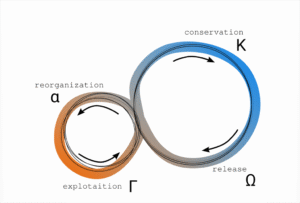
Every living system moves through cycles of growth, release, and renewal. Ecologist Buzz Holling described this as the adaptive cycle, a rhythm that applies to ecosystems, organisations, and societies alike. There are times of expansion and accumulation, followed by disturbance and collapse, which in turn create space for reorganisation and innovation.
Seen this way, the current age of overshoot marks a release phase at planetary scale. Systems that once maintained balance are reaching their limits, and the strain is showing. Yet times of breakdown can also be times of possibility. When structures loosen, new relationships and ideas can take root. Overshoot makes adaptation a matter of navigation: there is no single route back to safety, only a continual process of steering and adjusting.
Learning works much the same way. We act, observe, reflect, and adapt — deepening our understanding with each loop. In facilitation and evaluation, this means creating spaces where people can learn together from experience. Transformation rarely happens through grand design; it grows from many small cycles of noticing and responding. The art lies in keeping those cycles open, reflective, and connected.
A more recent LfS post, How will we know if climate adaptation is working?, takes this learning cycle into the practical territory of monitoring and evaluation. It looks at why intended outcomes need to be clear before useful indicators and other evidence can show whether adaptation is moving in the desired direction.
The essential role of mitigation
Adaptation and transformation are necessary responses, but they can’t substitute for prevention. Returning within planetary boundaries requires rapid and ambitious cuts in greenhouse gas emissions, alongside shifts in land use, food systems, and material consumption. Ambitious policies such as decarbonising energy, halving food waste, restoring ecosystems, and increasing resource efficiency can substantially reduce overshoot and keep the possibility of a “safe and just” operating space alive.
Yet even with strong mitigation, many planetary boundaries will take decades or longer to recover. That is why adaptation, regeneration, and resilience need to be developed in tandem with efforts to bend the curve on emissions and resource use. Living and learning within limits is inseparable from the commitment to sustained collective action on mitigation – locally, nationally, and globally.
Living within limits
Living within limits is not about constraint or retreat; it is about re-imagining what thriving means in a full world. The Planetary Boundaries framework reminds us that stability and justice are deeply intertwined. A safe and just operating space must protect both ecological integrity and human wellbeing. The Planetary Health Check 2025 shows that seven of nine boundaries are now breached, including those for climate, biodiversity, and land use. The message is clear: regeneration, not extraction, must define the next era of human progress.
Seen not as constraint but as invitation, working within limits can spark creativity and connection. It encourages new kinds of economy, design, and partnership that regenerate rather than deplete what we depend on. Many communities are already exploring this path—restoring wetlands, localising food systems, co-managing forests, and sharing knowledge across cultures to restore balance between people and planet. These stories of renewal echo the insights of the Earth Commission and the Doughnut Economics model, which link planetary limits with social foundations for equitable wellbeing.
Much of this transformation happens before crisis peaks. Renewal also relies on relationships: the trust, inclusion, and shared purpose that allow people to act together over time. Strengthening capacity now – in communities, institutions, and relationships – gives us the flexibility to reorganise later as conditions change. In this light, resilience is not primarily about endurance but about the capacity for regeneration. It calls for alignment with the rhythms of living systems: to take only what can be replenished, to foster continuous learning, and to act with generosity and care for future generations.
As the age of overshoot unfolds, living well within limits may be the deepest form of adaptation we can offer. Resilience begins by noticing what is alive and worth carrying forward. It is, ultimately, a practice of recognition, renewal, and relationship – the quiet foundations of sustainability. Living well within limits begins with how we relate: to each other, to place, and to the living systems that sustain us.
For an overview and links across this topic, visit the Climate adaptation – overview and resources page. Related posts include How will we know if climate adaptation is working?, while Managing adaptation in a changing world and Futures, foresight, scenarios and visioning provide further resources. For wider context, see the Supporting change in multi-actor settings section.
[* Image – Rakaia River: Adobe / Alexandra Daryl]
[* Image – Adaptive cycle: Hernán De Angelis, CC BY-SA 4.0, via Wikimedia Commons]

