
Place-based change rarely happens in one room. It unfolds across communities, agencies, knowledge work, governance, engagement and implementation. This post explores why distributed collaborative planning needs a wider “runsheet” – a shared process design that helps those different parts of the work connect, learn and adapt over time.
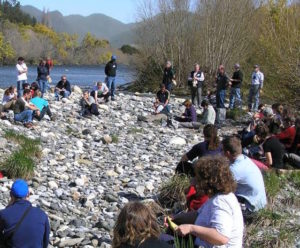
Place-based initiatives bring together community knowledge, agency responsibilities, technical work, governance and implementation over time.
In practice, collaborative planning is rarely a single workshop or meeting series. It moves through in-the-field visits, technical analysis, partner conversations, governance decisions, community engagement and implementation pathways. The challenge is to design the process so these parts do not sit in separate tracks, but keep informing each other as the work develops.
Because not everyone can be involved in every conversation, many processes create a core multi-actor group or forum. It might be called a committee, reference group, partnership table, taskforce or learning group. Such forums matter. At their best, they provide a practical place for shared inquiry, deliberation and judgement. But they cannot carry the whole collaboration on their own.
I have come to think of the wider process design as a kind of runsheet for distributed collaborative planning.
This post is written for practitioners, programme managers, policy staff, evaluators and applied researchers working in areas such as catchment initiatives, environmental restoration, climate adaptation, community development, regional planning and wider transition processes. These are settings where the work is genuinely distributed, and where no single group or organisation is likely to hold the whole picture.
It is also worth being careful about calling these simply community processes. Communities matter deeply; in many ways they are the point. But people participate in place-based work through different roles and responsibilities, often wearing more than one hat. Agencies, researchers, technical specialists, Indigenous peoples and rights-holders, funders, elected members and others all bring forms of knowledge, authority, resources and accountability that shape what can happen. Many are also part of the communities affected by the work.
The challenge is neither to make the process technocratic nor to pretend it can be wholly bottom-up. It is to design a process where different forms of knowledge, authority and experience can meet and be tested over time.
This does not mean treating all roles or knowledge systems as if they carry the same power. Some actors hold statutory authority, funding, technical legitimacy or control over implementation. Others carry lived experience, cultural responsibilities, rights, local relationships, or the consequences of decisions made elsewhere. A good process design needs to make these differences visible enough to be worked with and, where needed, challenged, rather than smoothing them into a general language of participation.
From meeting runsheet to wider process design
In facilitation, a runsheet is a practical design tool. It is not just an agenda. It sets out the intended flow of a session, the purpose of each part, who is holding which role, what inputs are needed, and how one step prepares the next.
A runsheet does not guarantee what will happen. Once people are in the room, things change. The conversation takes a different turn, something unresolved surfaces, or an activity no longer fits. A good facilitator adapts. But the runsheet still matters. It gives people a starting structure, and helps them see what they are adapting from, rather than simply improvising.
I am stretching the term here to work at a larger scale. In many place-based initiatives, the “session” is not a single workshop. It is a distributed process unfolding across organisations, communities, technical teams, governance spaces, public engagement and implementation pathways. A runsheet for that kind of work is not a minute-by-minute plan. It is a shared process design that helps people see how the wider process can learn, decide and adapt over time.
In this sense, the runsheet is not a private facilitator’s plan. It is a shared object for those stewarding the process. It makes the design discussable: what is meant to happen next, what needs to connect, what has changed, and what now needs adjusting.
This reflects a longer practice thread for me. Across facilitation, action research and participatory evaluation, I keep returning to the same lesson: a group may sit near the centre of the work, but the real design challenge is the wider process – how inquiry, technical input, engagement, partner relationships, decision points and adaptation fit together.
The illustration below offers one way of seeing this distributed process. It shows some of the people and settings involved, and the broad activity areas that need to be connected over time. The multi-actor group sits near the centre because this is often where inquiry and deliberation are convened. But the point is not that everything should revolve around the group. It is that collaborative planning depends on wider relationships between communities, organisations, knowledge work, engagement, implementation, reflection and learning.
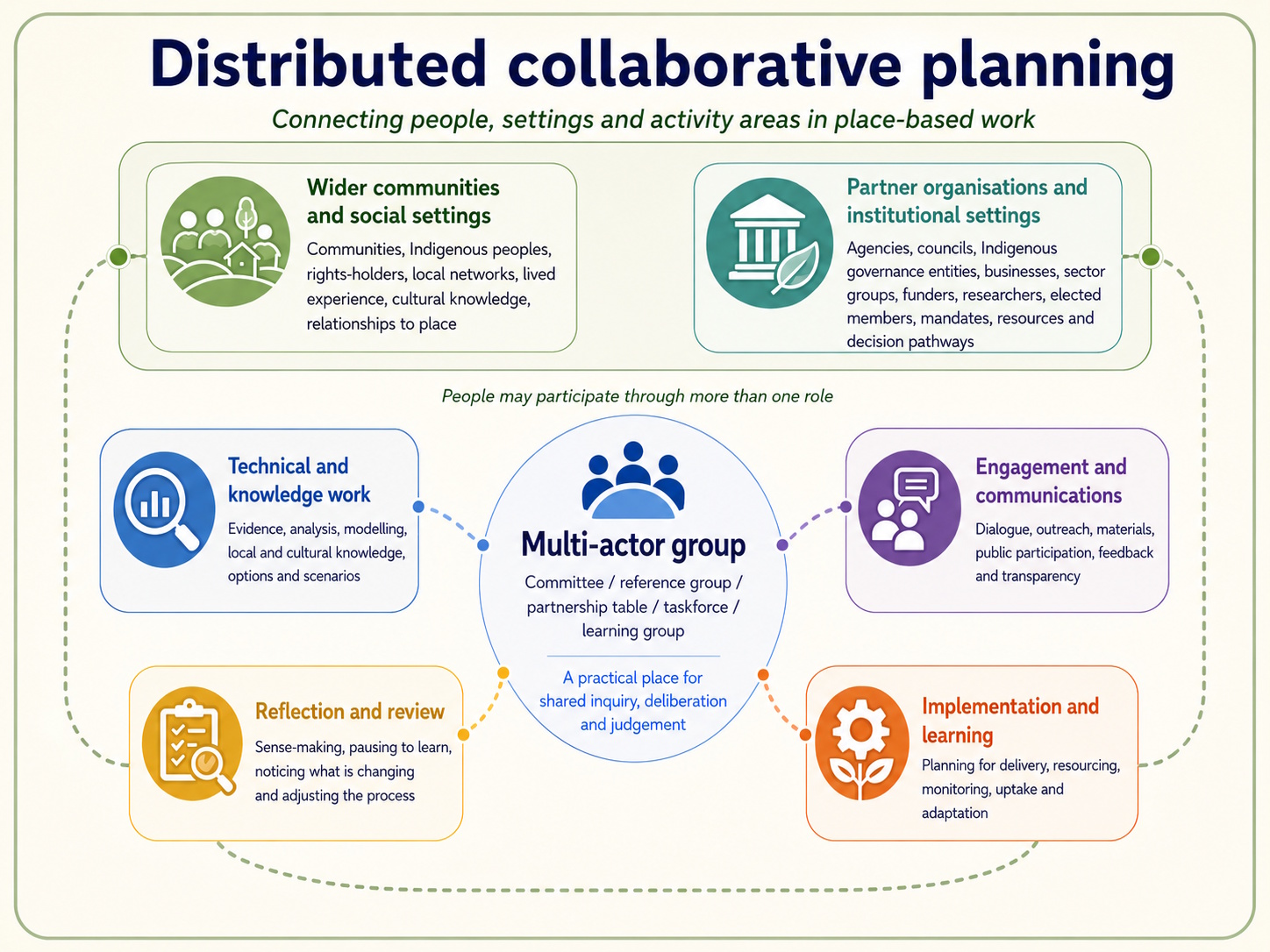
The group matters, but the process is wider
Many collaborative processes begin by establishing a group: a catchment group, committee, citizens’ panel, reference group, partnership table, taskforce or learning group. That group matters. It creates a place where people can bring different perspectives into conversation, build shared understanding and exercise judgement together.
But the group can easily be asked to carry too much: representing diverse communities, absorbing technical evidence, maintaining institutional links, communicating with wider publics, weighing trade-offs and producing recommendations others can act on.
The more useful question is not only who should be in the group. It is also: what wider process and social setting does this group sit within, and what else needs to be designed so the work can hold together?
The group matters, but the work lives in the wider process.
Time is part of the design
A skilled facilitator can sometimes move a group through the formal steps quite quickly. In the right setting, a group might build shared understanding, explore options and reach practical decisions over a few days, a fortnight, or several months. Sometimes that pace is exactly right.
But longer collaborative planning is not only about completing the steps inside the core group. Sometimes the wider process needs time for ideas to travel out from the group, be tested with others, and return changed. A representative may shift their own thinking through the process, but if the people or organisation they are connected to have not been part of that learning, apparent agreement in the room can unravel later. Time between meetings is therefore not just a pause. It is where the group’s thinking meets the wider social setting.
In some environmental and community settings, I have seen the case made for taking a year or two rather than a few months. The reason was not that the core group needed that long to work through the analysis. It was that both group members and the wider communities or organisations they were connected to needed time to take in what was being learned, test it with others, and understand what the emerging direction would ask of them.
This is especially true when the work involves different knowledge systems, contested values, or decisions with long-term consequences. People may need time to move from hearing something, to understanding it, to seeing what it might mean for their own role or community.
A fast process may look efficient and still leave too little room for that. A slower process may look inefficient and still be creating the space in which judgement, trust and shared responsibility can form. Getting through the steps is not the same as giving people time to take the work in. So the question is not only how quickly we can move, but what pace the work needs, so that people can carry the discussion seriously.
The group is not the social system
There is a related risk as well. The core group can be treated not just as a forum within the process, but as a proxy for the wider social setting the process is meant to influence. A multi-actor group stands in for something larger: a community, catchment, sector, region or social ecosystem. It brings part of that world into the room, but it is not the wider world itself.
This matters because a group can become coherent inside the room while remaining thinly connected outside it. Members may build shared understanding, work through evidence and converge around a direction, but that does not mean the wider communities, organisations or institutional settings have travelled with them.
It is common to assume that members of the group will bridge this gap informally, by reaching back into their organisations or communities. Sometimes they can. Often they cannot, at least not without time, support, clear expectations and resourcing. Left to individual goodwill, that outward work quietly falls away, and the group ends up carrying both the deliberation and the engagement that was meant to sit around it.
There is another side to this as well. Many communities are already tired of being asked what they want, again and again, without seeing much happen. Engagement fatigue is not only caused by too much engagement. It is also caused by engagement that is poorly connected to decisions, resourcing, implementation and feedback.
So the connection with the wider setting needs to be designed into the process: structured ways to test, refine and reconnect the group’s thinking, and to bring what is heard back in time to shape the next stage.
The group is a place to start making sense of the work, not a substitute for the wider social setting in which the work has to matter.
Streams of work need to meet at the right moments
In distributed collaborative planning, several streams of work usually happen at once. Technical analysis, engagement, communications, governance and policy, deliberation and implementation planning each have their own pace and pressures. If these streams are not actively connected, they drift.
Technical work may answer questions the group is not yet ready to ask. Engagement may surface views, commitments and concerns that sit beside the process rather than shaping the choices being made. Policy and governance may stay distant until recommendations are almost complete. Implementation planning may start too late. A distributed runsheet helps show where these streams need to connect, when they need to meet, and what each phase needs to carry forward.
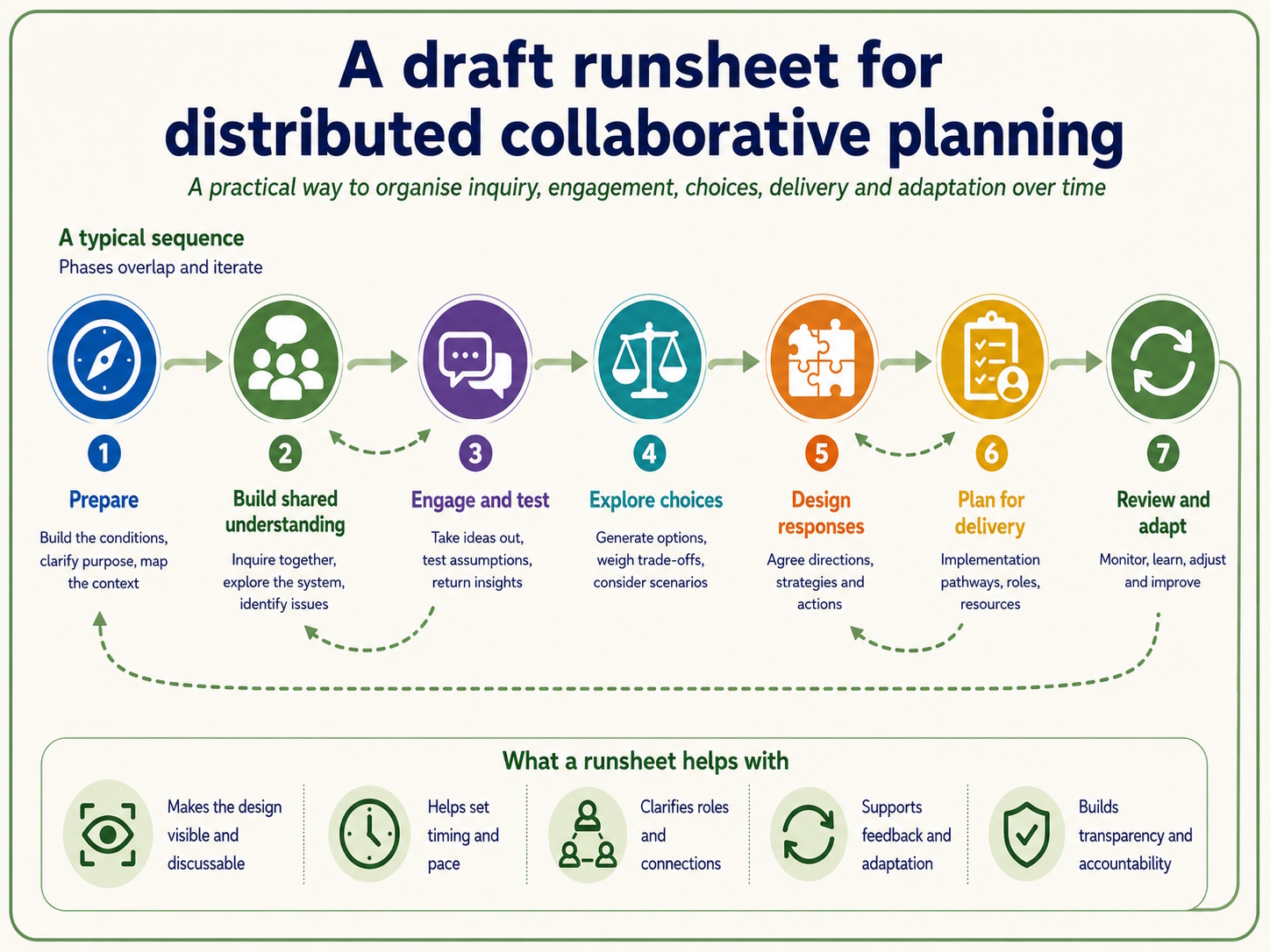
The draft runsheet below sketches one possible sequence of phases, from preparation and shared understanding through engagement, choices, delivery planning and adaptation. It also points to what a runsheet can help with: making the design visible, setting timing and pace, clarifying roles and connections, and supporting feedback, accountability and adjustment.
Technical work provides a good example of why this timing matters. It is often treated as a separate input, handed over for the group to receive. In practice, technical work is also partial. It has to be timed, questioned and translated into the rhythm of the process: what questions is it answering, what assumptions and uncertainties sit behind it, and how does it meet local, cultural and practical knowledge? The same is true of partnership, policy and governance, which are not just links to keep warm but part of the operating environment for the process. Without that footing, even a well-functioning group can struggle to influence action.
In distributed collaborative planning, timing is part of facilitation.
Iteration needs discipline
Long collaborative processes are often most useful when they are adaptive. The phases in a runsheet are not fixed steps, but they still need enough shape to guide the work: preparing the ground, building shared understanding, testing ideas with wider communities, exploring choices, designing responses, planning for delivery, and reviewing and adapting along the way.
Calling a process adaptive does not remove the need for design discipline. These processes ask a lot of people’s time, trust and attention. Each phase needs enough care and enough temporary closure to give the next stage something solid to work from.
Part of that discipline is building in reflection while the work is still moving. At the close of a phase, those involved can pause and ask what is working, what is not, and what needs adjusting before the next stage. This is not evaluation as a final judgement. It is reflection as part of how the process steers itself, and its usefulness depends on timing. Reflection is most useful while there is still time to act on what is being noticed.
A clear sequence also leaves a trail: how inquiry became options, options became choices, and choices moved toward implementation. That can matter for transparency, accountability, and later review.
Prepare the ground and plan the transition
Many collaborative processes focus heavily on producing recommendations. But recommendations only matter if there is a pathway for uptake, implementation and continued learning.
This means paying attention to both ends of the process. Before the first meeting, there is design work to do: clarifying purpose, expectations, roles, relationships and the conditions that will help the process function. Near the end, there needs to be a deliberate transition into delivery, uptake or the next cycle of learning. Who will act on the work? What decisions, resources or authorisations are needed? What relationships need to continue after the core group’s formal role has ended?
A good process does not begin with the first meeting or end with the last. Without this attention to preparation and transition, collaboration can finish just as the work needs to move into action.
A runsheet for distributed collaborative planning is not a script. It does not remove uncertainty or pretend that complex work can be controlled from the outset. Its value is that it makes the process discussable. It turns the design from something held in one person’s head into something those guiding the process can see, question and adjust together.
It helps those involved see how the work is meant to hold together: what stage they are in, what pace the work needs, how inquiry, engagement, governance and implementation need to connect, and where adaptation should occur.
Multi-actor groups should not be expected to carry all of the work of change. They can provide a forum for shared inquiry and deliberation, but they need to sit within a wider process that has been deliberately designed.
Before we ask a group to collaborate, we need to design enough of the process for collaboration to have a fair chance.
The group matters, but the process is the work.
For related material, see my earlier post on facilitation beyond the workshop, which explores facilitation as the design of conditions for shared work over time. The broader Learning for Sustainability sections on multi-actor processes, facilitating multi-actor processes, and systemic design offer further resources for designing and supporting longer collaborative processes.
[*1 Photo: ICM Motueka programme fieldtrip]
[*2 Graphic: Will Allen, with ChatGPT assistance, 2026]
