
Facilitation is often thought of as the craft of running good meetings and workshops. That craft matters. But in longer collaborative processes, facilitation also involves designing the conditions through which people can keep learning, deciding and acting together over time. This post reflects on seven patterns I have seen across collaborative, place-based and multi-actor work.
Meetings, workshops and group activities are where facilitation is most visible, and those skills matter. A well-designed gathering can help people listen, think together, make sense of information and agree on next steps.
But in longer collaborative processes, facilitation is less about managing a single event and more about helping to design the conditions for shared work over time. This includes shaping phases of inquiry and decision-making, linking different forms of knowledge with shared judgement, supporting relationships between partners, and building in moments for reflection and adaptation.
The task is not simply to help a group have a good conversation, but to help people move through a sequence of conversations, decisions and learning cycles that can support action in a complex setting. The following patterns are ones I keep returning to when thinking about facilitation as process design, rather than simply as meeting design.
A sequence, not just an agenda
A single workshop has an agenda. A collaborative process that runs for months, or sometimes years, needs something more like a sequence. It needs a sense of where a group is heading and what each stage is for.
This means designing phases: a period for understanding a situation, another for weighing choices, another for deciding, and one for moving toward action. The work is not to script the conversations in advance, but to give people a shape they can move through, return to, and adapt as their understanding grows.
This matters because long-term collaborative work can otherwise become either too loose or too rigid. Without enough structure, people can lose sight of where the process is going. With too much structure, the process can close down learning before people have understood enough to make useful choices.
Good facilitation helps hold the middle ground. It gives enough direction for people to keep moving, while leaving enough space for new understanding to reshape the work.
The diagram below shows workshops recurring within a longer cycle of inquiry, decision, action and adaptation. It also identifies four connected conditions that influence how well that process works.
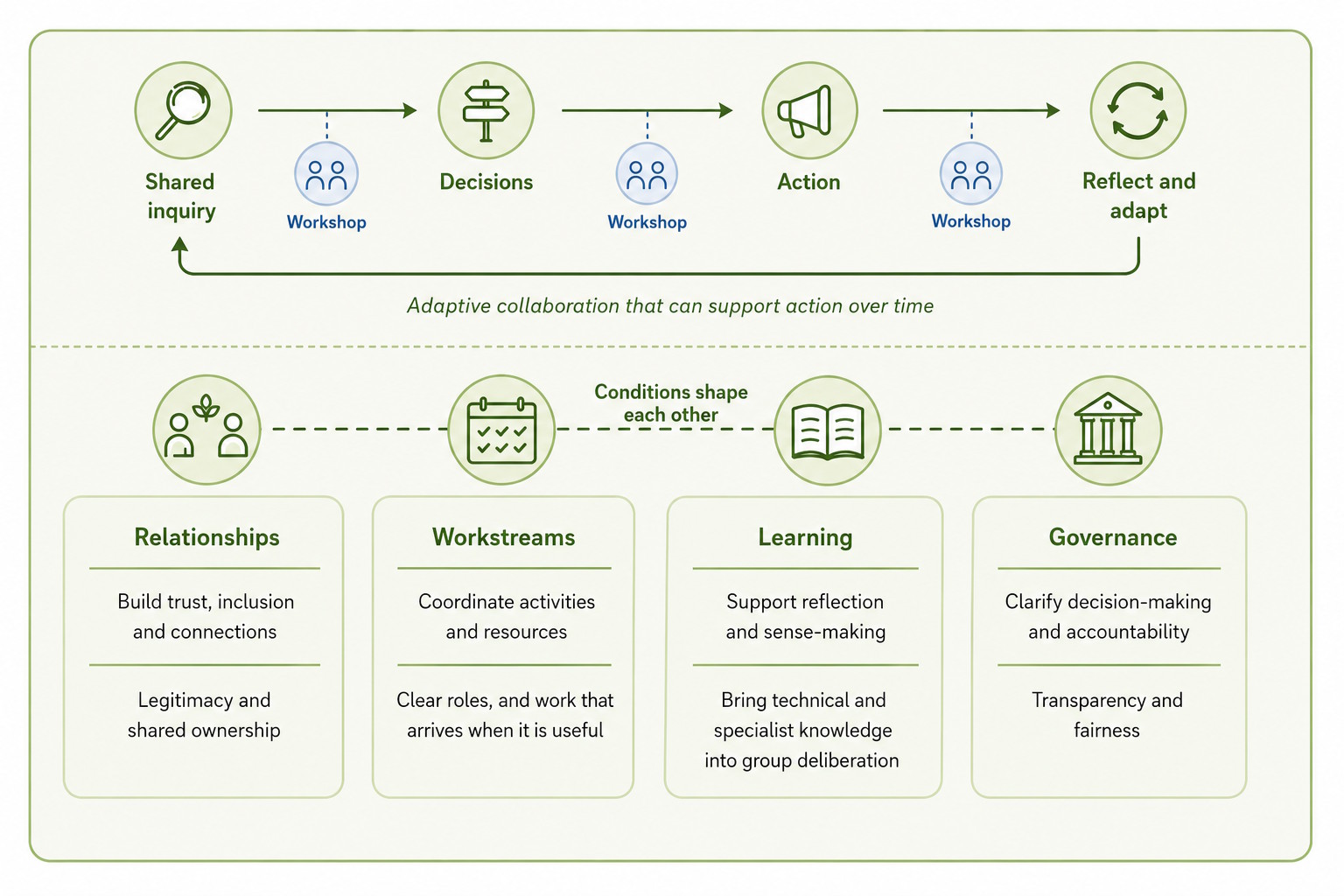
The conditions beneath the cycle are not separate stages. Relationships, coordinated workstreams, learning and governance interact throughout the process, shaping whose knowledge is heard, how work is connected, how decisions are made and whether the group can respond constructively as new understanding emerges.
Connecting workstreams
In most complex initiatives, the group in the room is only part of the picture. Alongside it sit other streams of work: technical analysis, community engagement, communications, governance, monitoring and implementation planning.
These streams rarely move at the same pace. They can easily drift apart. Technical work may answer questions no one is yet asking. Engagement may happen too early to inform decisions, or too late to shape them. Governance may sit at a distance from the practical learning taking place in the process.
Part of facilitation, then, is helping these streams stay in step. It is making sure that what one group is doing arrives in time to be useful to another, and that the connections between them are deliberate rather than left to chance.
This is facilitation as connective work. It is not only about what happens in a workshop. It is also about how different parts of a collaborative system inform and support each other over time.
Different levels of collaboration
If workstreams are about the different kinds of activity that need to be connected, levels are about where collaboration is happening and who needs to be involved.
Collaboration is not one thing happening in one place. In a place-based partnership or a multi-actor programme, there may be a working group doing the visible deliberation, but also a wider set of relationships between organisations, across roles, and among people who never sit at the same table.
These levels call for different kinds of attention. Strategy and policy work need one kind of collaboration. Operational partnerships need another. Wider public engagement needs another again. A small strategic group, a cross-agency partnership, a community network and a public campaign are not the same facilitation challenge.
A process can run good meetings and still falter if the conditions around it are unsettled, or if the relationships meant to support the work are themselves left unsupported.
Part of the facilitator’s role is to notice these different levels and help design forms of participation that fit the work being asked of people. Not everyone needs to be involved in everything, but the right people need to be involved in the right ways at the right points.
Preparation as design
It is tempting to treat preparation as logistics: booking, scheduling, circulating papers, checking the room or setting up the online link. Those things matter, but they are only one part of the work.
In longer processes, preparation is also ongoing. Each meeting, workshop or exchange helps set the context for the next one. What has already been discussed, what remains unresolved, what people now expect, and how relationships have shifted all shape the conditions for the next stage of work.
Much of what makes a process work is therefore settled before any particular meeting begins. Who is involved and why? What is this stage genuinely for? What can people reasonably expect of each other? What is open for discussion, and what is constrained by mandate, timing, law, funding or institutional responsibility?
When this groundwork is thin, no amount of skilled facilitation in the moment will fully recover it. People may arrive with different expectations, unclear roles or unspoken assumptions about what the process is meant to do.
I have learned to treat preparation as design work in its own right, and to give it the same care as the sessions it makes possible. Good preparation creates a better starting point for trust, participation and shared judgement.
Facilitating technical knowledge needs facilitation too
This is a point I have come to hold strongly. In environmental and other technically demanding settings, specialist knowledge, including modelling, analysis and expert assessment, is often treated as something that simply enters a process and informs it. In practice, it rarely behaves that simply.
Technical information can arrive too early or too late, in a form people struggle to use, or with a weight that begins to steer the conversation rather than support it. It can also be misunderstood, over-relied on, resisted, or separated from the values and practical choices that give it meaning.
Facilitating this well means treating the relationship between technical work and group deliberation as something to be actively designed. What does the group need to understand, and when? What questions should technical specialists be helping people explore? What assumptions sit behind different models or forms of analysis? How can expert knowledge be brought into the process without displacing the judgement of those who have to make decisions?
The aim is not to reduce technical complexity to something simple. Nor is it to make every participant an expert. It is to help people use technical knowledge well, alongside other forms of knowledge, experience and responsibility.
Done poorly, technical inputs can dominate a process. Done well, they help a group bring evidence, experience and judgement together around the choices it needs to make.
Reflection and adaptation
Long processes drift if no one stops to ask how they are going. Yet reflection is easy to defer when there is always a next decision waiting.
I have found it more reliable to build moments of review into the design itself: modest, regular points where those involved pause to consider what is working, what is not, what has changed, and what should be adjusted.
The aim is not evaluation for its own sake. It is to keep a process honest and able to adapt while there is still time to act on what is noticed.
This is especially important in complex settings, where the process itself changes the situation. People learn. Relationships shift. New information emerges. Some questions become clearer, while others become more contested. A design that cannot adapt to these changes is unlikely to support useful collective action.
Facilitation, in this sense, supports learning while the work is still underway.
Capacity for future action
A collaborative process is not only meant to produce a decision. It leaves something behind.
People develop relationships, shared language, practical skills, confidence and a better sense of how to work together. They may also gain a clearer understanding of the wider system they are part of, and of the roles they can play within it.
If facilitation attends only to the immediate task, that wider capacity can be squandered at the very point it might matter most: when a group moves from deciding to acting.
Part of the work, then, is to notice what is being built along the way, and to help carry it into whatever comes next. A process that strengthens relationships and learning capacity can support future work long after the formal meetings have ended.
Beyond running the meeting
Facilitation in complex settings is both practical and strategic. It includes the craft of hosting good conversations, but it also involves designing the wider conditions in which shared work can continue.
This is where facilitation connects with social learning, systems thinking, collaborative governance, monitoring and evaluation, and adaptive practice.
This reflection sits alongside earlier Learning for Sustainability posts on co-design in complex settings and working with place over time, and a runsheet for distributed collaborative planning. Together, they explore a recurring concern in collaborative sustainability practice: how people create the conditions for shared inquiry, decision-making, learning and action in complex settings.
The deeper question is not only how to run any particular meeting well, but how to create the conditions for people to keep learning, deciding and acting together over time.
For readers who want to explore these ideas further, the Facilitation hub gives a broader overview of facilitation as a practice for supporting collaboration, learning and change. The companion pages on Facilitation guides and frameworks and Facilitation tools and techniques provide open-access resources for process design and practical methods. The wider argument also connects with Learning for Sustainability material on Social learning, Monitoring, evaluation and learning, Reflective and reflexive practice, and Systemic co-design.
[*1 Photo by BullRun / Adobe Stock]
[*2 Graphic: Will Allen, with ChatGPT assistance, 2026]
