
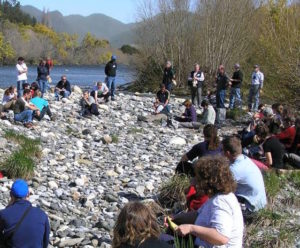
Adaptive management is a structured, iterative approach to managing complex environmental and social systems. It emphasises learning through action, integrating science, management, and policy at an ecosystem level.
Because it supports shared learning and flexible decision making, adaptive management also plays an important role in strengthening resilience across multi-actor settings. At its core, adaptive management is a search for effective ways to:
- Experiment and innovate through management-based approaches.
- Address natural resource challenges at scales beyond individual enterprises and communities.
- Build capacity for action among multiple agencies and stakeholders, often with differing perspectives and interests.
- Strengthen the social processes and organisational capacity required to implement sustainable management practices.
Adaptive management fosters learning through collaboration between managers, scientists, and stakeholders. It supports decision-making by maintaining flexibility and recognising uncertainties, enabling adjustments to improve outcomes over time. These practices also contribute to resilience, helping groups respond to changing conditions, test ideas safely, and build the shared understanding that supports longer-term adaptation.
More information on related approaches can be found on the adaptation and governance pages in this section, as well as the social learning section.
Enhancing climate change planning and adaptive management in marine protected areas
This 2024 paper by Kaia Bryce and Karen L. Hunter examines how climate change considerations are integrated into adaptive management in marine protected areas (MPAs). Using the Climate Robustness Index (CRI), the study assesses how well MPA monitoring plans incorporate climate adaptation principles, including targets, thresholds, and social-ecological objectives. The findings highlight gaps in actionable decision criteria and emphasise the importance of completing the adaptive management cycle to improve resilience and conservation outcomes.
Adaptive management in New Zealand’s aid programme: Phase 2 report
This 2021 report by the New Zealand Ministry of Foreign Affairs and Trade (MFAT) explores how adaptive management is applied within New Zealand’s aid programme. It examines the challenges and opportunities of integrating flexible, learning-based approaches in international development, highlighting key lessons from case studies. The report provides practical recommendations for embedding adaptive management principles in policy and programme design.
Adaptive management in international development library
This resource, developed through the Global Learning for Adaptive Management (GLAM) initiative, provides a collection of tools, case studies, and insights on adaptive management. Funded by the UK Department for International Development (DFID) and USAID, GLAM supported policymakers and practitioners by identifying and promoting evidence-based approaches to adaptive management. Although the initiative ended in 2020, its library remains a valuable resource for learning about monitoring, evaluation, and learning (MEL) for adaptive management.
Complexity fosters learning in collaborative adaptive management
This 2019 paper by María Fernández-Giménez and colleagues examines how learning occurs in collaborative adaptive management (CAM). It highlights challenges such as time lags, trade-offs, and differing knowledge systems, which shape decision-making and stakeholder relationships.
Double-Loop Learning in Adaptive Management: The Need, the Challenge, and the Opportunity
This 2018 paper by Byron Williams and Eleanor Brown explores double-loop learning in adaptive management. It discusses how organisations can challenge underlying assumptions and integrate new insights to refine decision-making processes. These insights include ways to recognize when the decision elements should be revisited, which elements should be adjusted, and how alternatives can be identified and incorporated based on experience and management performance.
Social Learning in the Anthropocene: Novel Challenges, Shadow Networks, and Ethical Practices
This 2017 paper by Jeremy Schmidt examines how adaptive management can address emerging challenges in the Anthropocene. It highlights the role of informal ‘shadow networks’ in expanding learning and addressing ethical concerns in knowledge exchange.
Technical challenges in the application of adaptive management
This 2016 paper by Byron Williams and Eleanor Brown outlines key technical issues in adaptive management, including uncertainty management, long-term environmental trends, and the need for models that support learning. It also discusses institutional learning and adaptive decision-making.
Adaptive institutions in social-ecological systems governance: A synthesis framework
This 2015 paper by Tomas Koontz and colleagues synthesises research on adaptive institutions and identifies key factors that enhance governance, including polycentric decision-making and knowledge-sharing networks. They highlight how social science can play an important role in identifying factors that foster adaptability in different contexts, so that policy makers can promote such adaptability
Learning about the social elements of adaptive management in the South Island tussock grasslands of New Zealand
This 2009 book chapter by Will Allen and Chris Jacobson uses a New Zealand case study to explore the social dimensions of adaptive management. It emphasises the role of stakeholder dialogue, knowledge-sharing, and evaluation tools in supporting learning processes.
Quick answers to common questions
What is adaptive management?
Adaptive management is a learning by doing approach for complex work. Teams agree aims and assumptions, test practical actions, monitor a few signals, then meet to make sense of results and adjust. It suits programmes with uncertainty and many stakeholders because it values collaboration, transparency and timely feedback. The aim is steady improvement, not a perfect plan, while documenting what is learned so others can build on it.
What are the steps in the adaptive management cycle?
A simple cycle most teams can use: clarify goals and success signals; set assumptions and risks; co-design actions and roles; implement; monitor a few indicators and stories; reflect with stakeholders and agree changes; adapt plans, budgets and governance, then repeat. Keep the cycle light, schedule regular reviews, and link to MEL so learning informs decisions.
How can teams work together to make adaptive management successful?
Create clear working agreements, roles and a regular review rhythm. Use short feedback loops such as after-action reviews, learning reviews and decision logs so insights are captured and acted on. Facilitate inclusive sessions where people can raise concerns, compare trade-offs and agree next steps. Keep information visible with simple dashboards and notes, and pair quantitative indicators with lived experience to guide changes.
For an overview and links across this topic, visit the Climate adaptation – overview and resources page. See Managing adaptation in a changing world, and Working with resilience for frameworks and policy context. You may find these related pages helpful: Tools and approaches for collaborative adaptation practice and Climate adaptation metrics and resilience. For wider context, you might also like the Monitoring, evaluation and learning (MEL) section.