
The DPSIR framework – Drivers, Pressures, State, Impact, Response – offers a structured way to understand and communicate the relationships between human activities and environmental change. Widely used in sustainability science and policy, it helps researchers, planners, and decision-makers identify causal pathways, assess ecological and social impacts, and design effective responses.
In practice, DPSIR frameworks are often used to structure indicator systems, linking drivers, pressures, and impacts to measurable changes over time. The Developing indicators and metrics page explores how these connections are used in real-world monitoring and evaluation. The accompanying figure is an extended DPSIR model developed for the related post, Using a DPSIR framework to support natural resource management and policy. It shows how societal responses may act at different points in the system, through prevention, mitigation, restoration and adaptation.
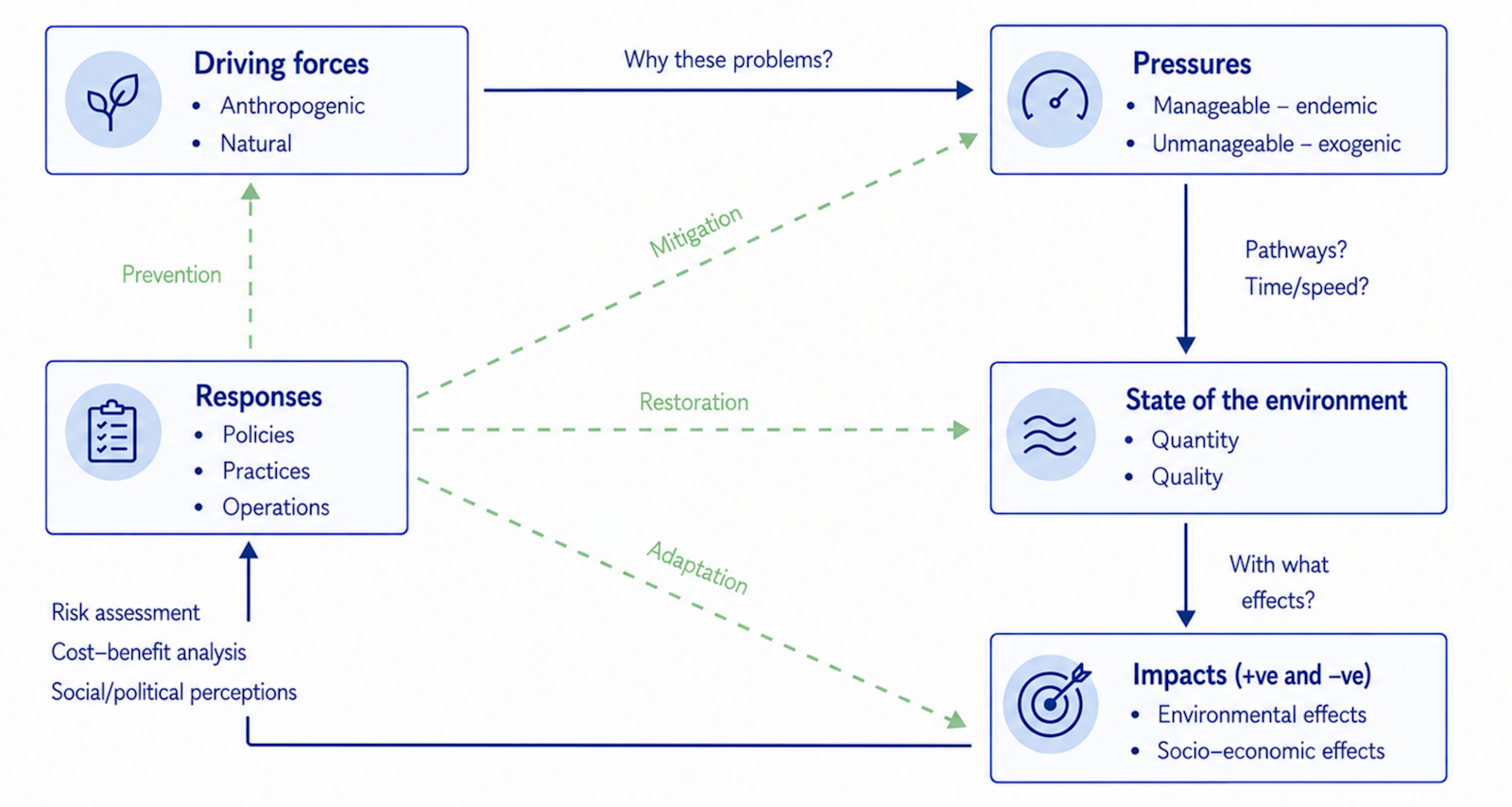
As sustainability challenges grow more interconnected, the DPSIR model continues to evolve. It informs environmental assessment, supports cross-sector dialogue, and helps link evidence to decision-making. Its flexible structure also aligns well with systems thinking, adaptive management, and collaborative approaches that span disciplines and scales.
Explore DPSIR resources
The resources below explore how DPSIR is used in practice and how it can support integrated environmental analysis and decision-making.
Using a DPSIR framework to support natural resource management and policy
This related Learning for Sustainability post introduces an extended DPSIR framework and shows how it can help connect social and natural science perspectives in complex environmental settings. It considers how DPSIR can support policy thinking, structure problem analysis, and bring equity and transition questions into natural resource management discussions.
Next generation application of DPSIR for sustainable policy development
This 2023 article proposes enhancements to the traditional DPSIR framework by introducing five key elements aimed at supporting sustainable policy development and implementation: iteration; risk, uncertainty, and analytical bias; stakeholder engagement; integration across scales; and adaptive management. Shane Carnohan and co-authors argue that these additions can make the DPSIR framework more robust and applicable to complex environmental policy challenges.
Introducing a temporal DPSIR (tDPSIR) framework
This 2023 study by Tal Hocherman and colleagues introduces the temporal DPSIR (tDPSIR) framework, which incorporates temporal dynamics into the traditional DPSIR model. By accounting for time lags between environmental pressures and policy responses, the tDPSIR framework aims to improve the timing and effectiveness of environmental governance. The authors demonstrate its application through a case study on marine plastic pollution, highlighting how earlier interventions could mitigate long-term environmental impacts..
Re-imagining the driver–pressure–state–impact–response framework from an equity and inclusive development perspective
This 2020 paper by Gupta et al. highlights how DPSIR frameworks often overlook social justice and equity concerns. It proposes a structured approach to integrating equity and gender considerations, demonstrating how environmental policies that ignore justice aspects risk being exclusive and unsustainable. By embedding equity within DPSIR, the study reveals the necessity of an integrated approach for achieving sustainable development.
Expanding DPSIR: The “Butterfly” model
This 2020 chapter by Michael Elliott and Timothy O’Higgins (see Chapter 4) reworks DPSIR into D(A)PSI(W)R(M), expanding its applicability in ecosystem-based management. The authors introduce the “Butterfly” model, which integrates socio-ecological complexities and ecosystem services into a more holistic assessment tool for sustainable decision-making.
DPSIR—two decades of trying to develop a unifying framework for marine environmental management?
This 2016 paper by Joana Patricio and colleagues reviews how DPSIR has been applied in marine and coastal ecosystems, highlighting challenges in interpreting and simplifying environmental issues. The authors emphasise the need for improved clarity and integration between social and natural sciences to strengthen policy relevance.
How the DPSIR framework can be used for structuring problems
A 2016 structured literature review by Rebecca L. Lewison and colleagues on DPSIR applications in coastal systems, showing its potential to connect scientific research with policy and stakeholder engagement. The study identifies a gap in participatory use of DPSIR and suggests ways to improve collaboration between decision-makers and researchers.
Effective indicators for freshwater management: attributes and frameworks for development
This 2012 report by Will Allen and colleagues is a useful resource for getting ideas for identifying and selecting appropriate indicators. It introduces how indicators can be used in catchment land and water management. It also goes over nicely two common frameworks used in environmental Management and Evaluation systems, Programme-based models and the Pressure-State-Response approaches. You can also explore a wider collection of approaches on the Developing indicators and metrics page.
Using the DPSIR framework for transdisciplinary training and knowledge elicitation
This cross-border, socio-ecological systems case study in Thailand and Cambodia looks at the suitability of DPSIR as a tool for analysis and communication, and how it can promote discussion across disciplines and knowledge systems.
Drivers and pressures: Untangling the terms commonly used in marine science and policy
Several of the resources above point to the need for clearer and more consistent definitions across DPSIR-related frameworks. This article proposes definitions compatible with DPSIR, with a particular focus on marine science and policy.
You can also explore a wider collection of approaches on the Developing indicators and metrics page, which shows how DPSIR and related frameworks are used to design and interpret indicators in practice. Related pages include Monitoring, evaluation and learning (MEL) hub; Theory of Change page; and Rubrics.
If you’re applying DPSIR in a real-world policy, planning, or evaluation context and would value short, well-defined advisory or reflection support, you’re welcome to get in touch. If you’ve found this page helpful, consider sharing it with others who might benefit too.