
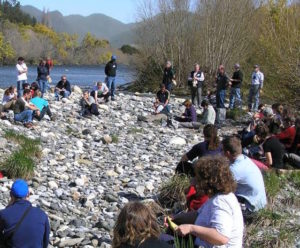
Social learning has long provided one of the foundations for Learning for Sustainability. It sits behind much of the site’s interest in systems thinking, collaboration, dialogue, co-production, evaluation and adaptive practice. While people may now arrive through different terms, such as complexity-aware practice, MEL, co-design or climate adaptation, the central concern remains the same: how people make sense of change together and learn their way into more constructive action.
At its heart, social learning is about building shared understanding, strengthening relationships and creating spaces where different perspectives can be heard and worked with. It depends on inclusive settings where diverse actors can share ideas, question assumptions and co-create responses that feel meaningful and grounded.
This also means paying attention to three recurring perspectives: participation, planet and power. They draw attention to who is involved and whose knowledge and wellbeing count, how learning is connected to wider social and ecological systems, and how power and influence shape whose voices are heard, which knowledge is valued and what decisions become possible. Keeping these three perspectives in view is particularly important where social learning is intended to contribute to transformative change.
As a connecting hub across this site, this section draws on insights from systems thinking, dialogue, organisational learning and participatory practice, particularly where no single perspective holds all the answers.
If you’re new to this topic or want to see what social learning looks like in practice, a useful starting point is Social learning in action: working together on complex challenges. This short reflection introduces the idea in plain language and outlines seven key elements that support social learning in real-world settings.
Social learning is not a single method or model. It is a broad and evolving field. For this reason, the section is organised around six interconnected strands that underpin social learning in practice. Each strand links to pages that bring together curated and annotated links to tools, framings and approaches that support reflection, learning and adaptive change in complex settings.
Explore social learning resources
Use this section to find the most relevant starting point, whether you are new to social learning, working with systems and complexity, building collaboration, supporting dialogue, co-producing knowledge, strengthening MEL, or creating the conditions for shared learning.
- If you are new to social learning
Start with Social learning in action: working together on complex challenges for a plain-language introduction to what social learning looks like in practice. - If you are working with systems and complexity
Explore Systems thinking resources and Complexity-aware MEL for resources on interconnections, feedback, uncertainty and adaptation. - If you are building collaboration across groups or organisations
Go to Team building, communities of practice, and learning groups and Cross-sector partnerships and collaborations for resources on sustaining relationships and shared learning over time. - If you are facilitating dialogue or working with difference
See Deliberation and dialogue, Values and behaviours in collaboration, and Managing conflict for resources on shared sense-making and constructive group processes. - If you are co-producing knowledge and understanding
Explore Conceptual modelling, Participatory model building, Co-producing knowledge, and Engaging with Indigenous lenses for approaches that help people work across perspectives and knowledge systems. - If you are strengthening learning and adaptation over time
Visit the Monitoring, evaluation and learning and Reflective and reflexive practice hubs for resources on evaluative thinking, reflection, learning questions and adaptive practice.
Browse the social learning strands
The starting points above help visitors move quickly into the part of the social learning material that best matches their current task. The hub and resource pages below provide a fuller map of the social learning strands on this site.
1. Systems thinking and complexity in practice
Systems thinking and complexity-aware approaches work together in most real-world settings. Systems thinking helps teams explore interconnections, make sense of change, and develop more adaptive strategies for working across boundaries. Complexity-aware practice complements this by emphasising learning, feedback, and adaptation when outcomes are uncertain and cause-and-effect relationships are unclear. Together they support both coherence and responsiveness in collaborative work. Related pages include:
- Systems thinking resources – frameworks, tools and approaches
- Systemic co-design – explores participatory design in complex settings.
- Is the system complicated or complex? – Curates key resources to help practitioners recognise complexity and apply adaptive, systems-based approaches in planning, evaluation, and policy.
- Complicated or complex? Knowing the difference matters – This post helps distinguish between problems that are complicated and those that are complex and explains why that distinction matters.
- Complexity-aware MEL – This page introduces complexity-aware monitoring, evaluation and learning and why it matters in dynamic, multi-actor systems.
2. Building networks for collaboration
Social learning is often sustained through networks, partnerships, communities of practice and other collaborative structures. These pages focus on how relationships and shared learning arrangements can help people work across organisational and sectoral boundaries over time.
- Team building, communities of practice, and learning groups – explores how internal networks and shared learning structures support adaptive practice.
- Cross-sector partnerships and collaborations – looks at how to design and sustain partnerships across organisations and sectors.
3. Deliberation and dialogue
These pages focus on creating constructive spaces for open conversation, shared sense-making and collective decision-making. The main page explores how dialogue and deliberation support learning in diverse groups, especially when working across values, knowledge systems and worldviews.
- Values and behaviours in collaboration – considers how values, attitudes, and behaviours shape the quality of shared inquiry.
- Managing conflict – offers strategies for recognising, understanding, and working through tensions in group processes.
4. Co-producing knowledge and understanding
This strand of social learning focuses on supporting the sharing, co-creation, and practical use of knowledge across groups, organisations, and knowledge systems. The main page explores how knowledge management can help bridge perspectives, surface insights, and inform decision-making in collaborative work. Other pages cover related topics:
- Conceptual modelling – introduces tools to map and clarify shared mental models.
- Participatory model building – explores collaborative approaches to systems mapping and simulation.
- Co-production of knowledge – highlights processes for working across boundaries to generate usable knowledge.
- Engaging with Indigenous lenses – discusses the importance of recognising and valuing Indigenous knowledge systems.
- Organisational learning – looks at how institutions can better support learning and adaptation from within.
- Knowledge management – connecting data, information, and knowledge to support shared understanding, learning, and action.
5. Monitoring, evaluation and learning (MEL)
This page introduces a range of approaches and resources for monitoring, evaluation, and learning (MEL), with a particular focus on complexity-aware practice. It highlights how evaluative thinking can support adaptive practice, deepen reflexivity, and create space for strategic learning across a system. Linked pages explore tools such as Theory of Change, rubrics, and participatory evaluation — all designed to support reflection, sense-making, and action in complex settings.
6. Creating enabling environments
These pages look at how we can support the conditions that enable people and organisations to collaborate, learn and drive systems change more effectively.
- Reflective and reflexive practice – explores how structured reflection and critical self-awareness can strengthen learning, relationships and adaptive action.
- Asking good questions – a key skill for learning and collaboration – explores how thoughtful questions can spark deeper dialogue, strengthen collaboration and support learning in complex settings.
- Capacity building, social capital and empowerment – looks at how building skills, relationships and confidence can help individuals and groups work together more effectively over time.
These elements do not stand alone. They often come together in different ways, depending on the context. Social learning provides a connecting thread across these areas by focusing on how people learn together. It supports groups to make sense of what is happening, test assumptions, strengthen relationships and adapt their practice over time.
For practitioners, this means thinking with both systems and complexity in mind. Systems thinking offers coherence and structure, helping us see patterns and design joined-up approaches. Complexity-aware practice complements this by keeping us attentive to emergence, feedback and surprise. Together they support the adaptive, relational work that social learning depends on.
Putting social learning into practice
If you’d like to see how social learning unfolds and is sustained over time in real-world contexts, the following pieces highlight examples and reflections from practice:
- Social learning in action: working together on complex challenges – introduces the concept in plain language and explores how collaboration, systems thinking, and reflection interact in practice.
- Social learning in practice: strengthening collaboration amid complexity – reflects on lessons from facilitating collective learning and decision-making across sectors and disciplines.
- Social learning in practice – resource page – curates key articles, frameworks, and examples showing how shared learning and reflection can drive adaptive, inclusive action.
- Evaluation, design and continuity in long-term, multi-actor settings – explores how evaluation, facilitation, and systemic design work together over time to sustain learning, judgement, and institutional memory in place-based collaborations.
Quick answers to common questions
What is social learning?
Social learning is about how people learn with and from each other when navigating complexity and uncertainty. Rather than focusing on information transfer, social learning creates space for reflection, shared dialogue, and relationship-building. Through these ongoing interactions, people develop new insights, build trust, and act collectively in ways that would not be possible alone.
How is social learning different from information sharing?
While information sharing is often one-way and transactional, social learning unfolds through interaction and collective sense-making. It recognises that people co-create knowledge as they reflect together on complex issues. This process can lead to changes in understanding, stronger connections, and more adaptive, collaborative action—especially when facing situations with no single right answer.
Where does social learning apply in practice?
Social learning is valuable wherever people need to work together across different perspectives, especially in complex environments. It supports collaboration in areas like sustainability transitions, freshwater management, urban planning, and public health. By making space for ongoing learning, it helps groups bridge knowledge systems, move beyond silos, and find practical ways forward when certainty is elusive.
If you’ve found this social learning section useful, consider sharing it with others who might benefit.. You can also sign up for occasional site updates to hear about new curated resources, tools and guides.
[* Photo: ICM-Motueka fieldtrip]