

Long-term, place-based initiatives rarely unfold within neat programme cycles. They move across landscapes, institutions, mandates, and generations. Funding arrangements change. Staff move on. Governance groups evolve. Yet the places and relationships at the heart of the work continue.
In these settings, three strands of practice repeatedly intersect: evaluation, design, and facilitation. Together, they form a practical triad that shapes how systems learn, decide, and adapt over time.
- Evaluation shapes how learning is stabilised and interpreted.
- Design shapes how direction, structure, and adaptation are intentionally framed.
- Facilitation shapes how people come together, work through difference, and build shared meaning.
In practice, these strands are not separate. They overlap, inform one another, and often occur simultaneously. A strategic review may also be a design intervention. A facilitated workshop may surface evaluative judgement. An evaluation report may shape future institutional direction. Over time, what matters is not which label we apply, but how coherent these practices are across transitions.
This page brings together reflections that explore this triad in long-term, multi-actor settings. Rather than treating evaluation as an external activity, or design as a front-end exercise, or facilitation as event management, the aim is to articulate how these roles contribute to a continuing learning architecture in complex systems.
The focus is not on technique alone. It is on continuity, responsibility, and the practical question of how learning travels across programme cycles without closing down emergence or diversity of perspective.
Long-term collaboration as the terrain
The reflections gathered here sit within a broader understanding of place-based, multi-actor collaboration.
In Working with place over time: lessons for long-term, multi-actor practice I identify recurring patterns that underpin durable collaboration across years and institutional shifts. These include planning for collaboration to grow over time, revisiting shared purpose, designing learning with structure and rhythm, surfacing relationships and power, shaping institutional settings to support adaptation, and caring for institutional memory.
These lessons describe the terrain within which evaluation, design, and facilitation operate. They remind us that practice is embedded in governance arrangements, funding regimes, partnership dynamics, and cultural contexts. Without attention to these foundations, even well-chosen tools struggle to remain relevant or usable.
Related reflections on relational foundations reinforce the importance of trust, dialogue, and power awareness in shaping what becomes possible over time. None of the three strands – evaluation, design, or facilitation – sit outside these dynamics. Each participates in shaping them.
A four-part reflective series on evaluation as design
Within that wider terrain, a sequence of recent reflections explores how evaluation functions as part of long-term design and learning over time.
Evaluation in complex settings: reflections on practice and evaluator roles
Introduces five recurring practice patterns that support complexity-aware monitoring, evaluation, and learning. It frames evaluation as reflective, adaptive work grounded in disciplined judgement and plurality rather than compliance alone.
When evaluation is also design: complexity, place, and continuity in multi-actor work
Moves beyond method choice to consider how evaluation is intentionally designed within real institutional settings. It introduces the idea of evaluation as punctuation in long-term work – moments where learning is consolidated sufficiently to travel across organisational boundaries and time.
When programmes end: places and relationships continue
Shifts attention to responsibility beyond formal mandates. Evaluative artefacts – reports, diagrams, rubrics, narratives – are treated as carriers of value and interpretation. Decisions about framing, voice, and emphasis shape what future actors inherit and how they understand what mattered.
When design and evaluation overlap in long-term place-based work
Draws the threads together, recognising that in practice design, evaluation, and facilitation overlap. It introduces the idea of layered rigour – methodological, process, and relational – and positions evaluation as part of an ongoing learning architecture rather than a discrete, external judgement.
Read together, these reflections trace a progression:
- from complexity-aware evaluation as reflective practice
- to evaluation as intentional design for continuity,
- to responsibility and artefacts beyond programme boundaries,
- to an integrated view of design, evaluation, and facilitation as interdependent practices in long-term systems stewardship.
Evaluation, design, and facilitation as continuity work
Across these reflections, several themes recur. Practice in complex settings begins with context rather than tools. Questions of timing, framing, audience, governance, and accountability shape what evaluation, design, or facilitation can realistically achieve. These conditions are not background details; they influence what can be stabilised, what remains open, and whose perspectives are carried forward.
Rigour, in this terrain, unfolds over time. It involves making boundaries explicit, holding multiple domains of value together, resisting premature closure, and stabilising learning without implying finality. Judgement is exercised repeatedly rather than once, and coherence emerges through disciplined attention across phases rather than through a single methodological choice.
Artefacts also matter. Reports, diagrams, frameworks, rubrics, and process records influence how future readers interpret the past and imagine what comes next. They shape institutional memory. Designing these artefacts with care is therefore both a practical and an ethical task.
Roles inevitably overlap. Evaluators contribute to design decisions. Facilitators surface evaluative insight. Designers structure learning processes. In long-term, multi-actor initiatives, coherence across these roles often matters more than professional labels, yet each role is also exercised from a particular institutional and relational position.
Seen in this way, evaluation, design, and facilitation are forms of continuity work. Together, they shape how systems remember, adapt, and remain accountable across institutional transition.
Practice habits across roles
These themes show up not only in evaluation moments, but across everyday design and facilitation work.
In Working well in complexity: seven foundational patterns for evaluation, design, and leadership I outline recurring habits that support grounded practice across roles. These include holding shared purpose, surfacing assumptions, working relationally, using diverse evidence, and keeping strategies open and iterative without losing coherence.
Designing together: reflections on co-design in complex settings explores how facilitation and co-design processes can be structured to hold difference, enable shared inquiry, and support adaptive action over time.
Another reflection, Indicators, judgement, and adaptation: making sense of change in complex settings, examines how indicators function in practice – not as definitive measures of success, but as partial stabilisations that require interpretation and ongoing adjustment.
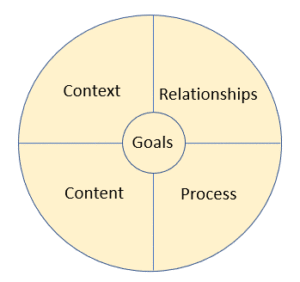
Unlocking collaboration: how effective facilitation drives meaningful outcomes approaches facilitation as structured practice rather than event management. It introduces five dimensions – goals, context, relationships, process, and content – and shows how careful process design supports shared judgement, learning, and adaptive action in complex, multi-actor settings.
Co-design and facilitation: keys to sustainable change examines how systemic design and facilitation work together to surface power, enable inclusive participation, and support adaptive responses to environmental and governance challenges. It situates co-design within longer-term collaborative processes rather than treating it as a one-off technique.
Together, these pieces suggest that evaluation, design, and facilitation are not parallel domains in long-term work. They are overlapping practices that contribute to a shared learning architecture.
Connecting to wider strands on this site
This page sits at the intersection of several hub sections across Learning for Sustainability:
-
- Social learning – reflection, dialogue, and knowledge co-production.
- Managing collaborations – actor mapping, facilitation, cross-sector partnerships, and participation.
- Supporting change in multi-actor settings – systemic design, strategic direction-setting, and adaptation.
- Monitoring, evaluation and learning (MEL) – linking planning, monitoring, and evaluation in complexity-aware ways.
The reflections gathered here do not replace those hubs. Instead, they clarify how these strands intersect over time in real-world, place-based practice.
An ongoing conversation
Many practitioners working in long-term, multi-actor settings will recognise these concerns, even if they use different language. Evaluation as design, facilitation as structural work, continuity across transitions, layered accountability, and care for institutional memory are rarely treated as central topics, yet they shape the durability and integrity of collaborative initiatives.
The intention here is not to offer a definitive model. It is to make explicit a practice orientation that connects evaluation, governance, facilitation, and systemic design in contexts where no single actor is in control and where responsibility extends beyond formal programme boundaries.
In long-term, multi-actor settings, evaluation, design, and facilitation are not parallel professions. They are interdependent practices that shape how systems learn, remember, and adapt over time.
If you are working in similar terrain and would find it useful to explore how these ideas might apply in your setting – whether through facilitation, MEL design, strategic writing, or reflective support – you are welcome to get in touch.