
Shaping effective practice change means going beyond rules, incentives, or awareness campaigns. It requires understanding the deeper motivations, barriers, and social contexts that influence behaviour, and drawing on a mix of models and strategies to design change that lasts.
Human behaviours, at a range of decision-making levels, play a key role in the many complex sustainability and development problems facing public sector policy staff. Challenges include issues such as climate change, public health, catchment (watershed) management, biodiversity and conservation management, and social inequities such as income inequality and poverty. A deeper understanding of how individuals, communities and organisations make decisions can help policy makers and others identify the underlying motivations and barriers for behaviour and behaviour change and incorporate these insights into their work.
I was recently invited to present on the application of current behaviour change theory in practice, and this posting expands on that discussion. The key message is that if we don’t understand the key determinants of behaviour – it becomes difficult to create effective change strategies. Below is a summary of the presentation’s key points, and for those interested, a downloadable PDF version is available at the end of this post.
Rethinking behaviour change: beyond traditional approaches
In the past three key strategies have been used to drive behaviour change:
- Legislation and regulation – establishing rules and enforcement mechanisms.
- Market forces and material incentives – using pricing, subsidies, and financial levers to encourage or discourage behaviours.
- Communication and education programmes – largely one-way efforts to raise awareness and provide information.
While these approaches remain valuable, research highlights the need for a broader perspective that accounts for both conscious and non-conscious drivers of behaviour. People do not make decisions solely based on rational, deliberate thought; they are influenced by emotions, social networks, norms, and how choices are framed. As Toby Park and colleagues (2019) emphasise, new behavioural insights remind us to focus on both non-conscious and conscious influences, the settings in which behaviours occur, and actual behaviours rather than just attitudes or intentions.
Understanding behaviour change: Key models and frameworks
Behaviour change is complex, and no single model fully explains why people act as they do. However, several well-established frameworks offer valuable insights into designing interventions.
- The COM-B model Developed a decade ago by Susan Michie, Lou Atkins and Robert West is widely used to identify what needs to change in order for a behaviour change intervention to be effective. It identifies 3 factors that need to be present for any behaviour to occur – capability, opportunity and motivation. These three factors interact over time so behaviour can be seen as part of a dynamic system with positive and negative feedback loops. If we try a new behaviour and it works – then we gain confidence and skills that make the behaviour easier to do and maintain – and even improve.
- Kenneth Mcleroy and colleagues in the 1980s expanded on the socio-ecological model which emphasizes that health promotion should focus not only on the individual – but also on different social level groupings that influence the specific behavior in question. So, an individual can be seen to be influenced by family and friends at an interpersonal level, but also by the wider community or organization they are embedded in, and beyond that by public policy. Moreover, influence can occur in any direction among these levels. And fostering change at any of those levels with communication and engagement strategies still requires consideration of relevant capabilities, opportunity and motivation.
- Another well-known approach to change is the Stages of Change or Transtheoretical Model, introduced in the late 1970s by researchers James Prochaska and Carlo DiClemente. In this model, change occurs gradually and relapses are an inevitable part of the process. People are often unwilling or resistant to change during the early stages, but they eventually develop a proactive and committed approach to changing a behavior. This model acknowledges that change is often not easy, and often requires a gradual progression of small steps toward a goal.
- And Icek Azjen’s work in the mid 1980s on the Theory of Planned Behaviour points out a range of factors that influence our thoughts around programmes and technologies that ask us to change our practices. The model indicates that an individual’s intention to act is influenced by: i) how important they think the action is; ii) how easy or difficult the action is; and iii) the social pressure on them to do it.
The 6 E’s policy design framework
There are a range of policy choice tools that aim to link theory and practice, and in general these encourage policy makers to use a mix of options – taking the context and stakeholder characteristics into account. In a previous posting I looked at the UK Defra-developed 6Es policy framework as one such tool which provides a framework to help policy makers develop a mix of interventions across four broad categories of policy tools – Enable, Engage, Encourage and Exemplify (the inner circle). Two additional “E”s (see Figure 1 – outside circle), explore and evaluate, round out a process of informed policy design and results measurement. Using this tool as a checklist can help agencies to more effectively influence behaviour by combining approaches across these six broad categories.
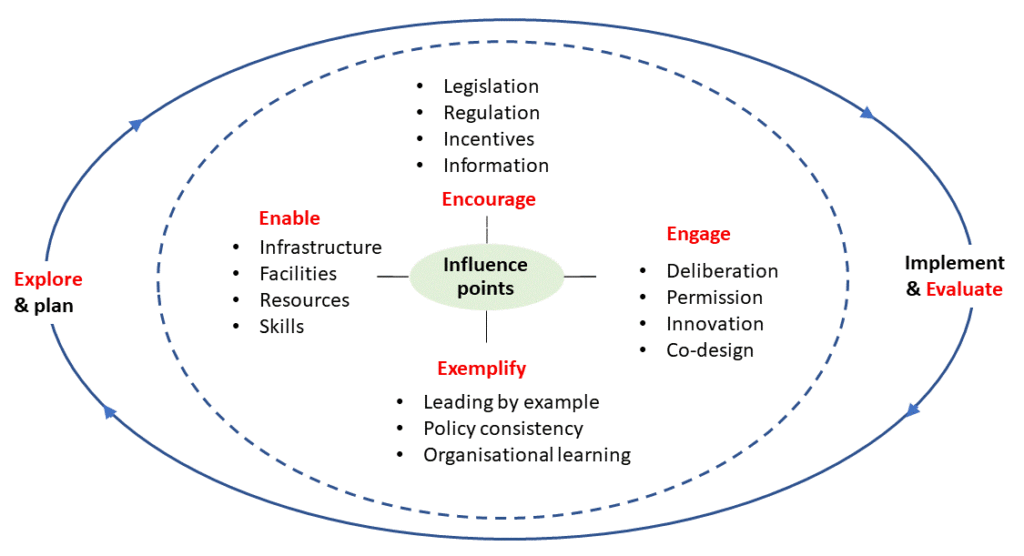
Collectively, the approach and the mix of measures drawn from across the 6Es need to address the core motivations and barriers of the broader range of stakeholders involved – including agencies themselves. For example, it’s likely including measures that engage and enable will lead to “change” through those most willing and able to act. It’s also feasible that some other groups may act if agencies demonstrate their own willingness to “walk the talk” and model the collaborative behaviours they would like to encourage. For others there is a role for regulation, or the development of minimum or voluntary standards before behaviour is influenced.
Theories of Change
The final presentation section looks at Theory of Change as a tool to set out, and communicate complex goals and intended outcomes, as well as the underlying activity strategies that include not only technical and operational workstreams – but also our social (communication, education and engagement) initiatives. The strength of a Theory of Change approach is that it invites us to clarify what outcomes and change that we want from different groups of people (individuals, communities, organizations, etc.) – and then to use our knowledge of past experience and behaviour models to plan pathways that really lead to change.
The approach here recognises the need for participation in these endeavours to influence practice change. All too many of our current societal challenges —such as the environment, health care, and poverty—are complex, whether on a local, national, or international scale. Yet all too often we approach these issues with linear and even siloed solutions that aren’t sufficient to address the problems at the scale at which they exist. Successful outcomes from addressing these ‘wicked problems’ increasingly depend on the coordinated actions of decision-makers at different levels. This is where cross-sector partnerships and collaborations come into play. By sharing information, resources, activities, and capabilities we can achieve desired outcomes by working together that we could never achieve alone.
Would love to hear your thoughts—how are you using systems thinking in your own work?
Links to a range of related material can be found on the Learning for Sustainability behaviour change resource page. Related areas include adaptive management, and the social learning, and planning, monitoring and evaluation sections directly avaialble from the top menu bar. As part of this resource collection, you can also access the accompanying slide deck: https://learningforsustainability.net/pubs/practicechange-intro.pdf.
