
A rubric is an easily applicable form of assessment. They are most commonly used in education, and offer a process for defining and describing the important components of work being assessed. They can help us plan and assess complex tasks (e.g. essays or projects) or behaviors (e.g. collaboration, team work). Increasingly rubrics are being used to help develop assessments in other areas such as community development and natural resource management.
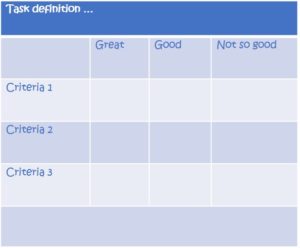
In a recent report we describe how rubrics can be used to assess complex tasks and behaviours such as engagement and partnerships. More resources on rubrics can be found from the main Learning for Sustainability rubrics page – Rubrics as a learning and assessment tool for project planning and evaluation. Rubrics are both an instructional tool and a performance assessment tool. They act as a guide to help practitioners clarify and understand both the objectives required to complete any particular initiative and the qualities required for achieving high standards in those objectives.
Although the format of a rubric can vary, they all have two key components:
- A list of criteria – or what counts in an activity or task
- Graduations of quality – to provide an evaluative range or scale.
Developing rubrics helps clarify the expectations that people have for different aspects of task or behavior performance by providing detailed descriptions of collectively agreed upon expectations. Well designed rubrics used for assessment increase the reliability and validity and ensure that the information gathered can be used to help people assess their management efforts, and improve them. It is different than a simple checklist since it also describes the gradations of quality (levels) for each dimension of the performance to be evaluated. It is important to involve program participants in developing rubrics and helping define and agree on the criteria and assessment. This broad involvement increase the likelihood that different evaluation efforts can provide comparable ratings. As a result, the assessments based on these rubrics will be more effective and efficient.
While the structure and purpose of rubrics can be helpful across many fields, the term itself doesn’t always resonate—particularly outside education or evaluation. In natural resource management, policy, or science settings, I’ve seen more neutral phrases like multi-criteria assessment frameworks used instead, often with better uptake and engagement. Regardless of the label, the underlying value lies in supporting clear, transparent, and shared reasoning. The language we choose matters—not just for understanding, but for uptake and engagement.
Comparing different types of rubrics
Rubrics can take different forms depending on their purpose. Understanding their distinctions can help teams choose or design a format that suits their context. There’s no single way to design a rubric. Different forms suit different purposes—and each brings advantages depending on the context:
Generic rubrics outline broad criteria and standardised performance levels (e.g. from poor to excellent). These are flexible and easy to apply across multiple settings, but can feel too general when detailed feedback or contextual nuance is needed.
Analytic rubrics break down multiple criteria and define levels for each. These support detailed, transparent assessment—especially where systematic analysis and comparability matter. However, they can be time-consuming to co-develop and may feel overly rigid in settings where the work is evolving.
Holistic rubrics group criteria together and provide an overall description at each level. These are useful for making quick, summative judgments, though they may not offer the specificity needed for formative feedback or reflective learning.
All three types are widely used across fields such as education, performance assessment, and programme evaluation—particularly where accountability, benchmarking, or standardisation are priorities.
In more complex or emergent situations—such as place-based partnerships, climate adaptation programmes, or collaborative systems change efforts—goals and contexts are rarely fixed. Outcomes emerge over time, and stakeholders often bring different values, perspectives, and ways of knowing. In these settings, conventional performance tools can feel limiting: they often assume predefined criteria, linear progress, and relatively stable conditions.
A fourth type—single-point rubrics—offers an alternative approach. Rather than mapping multiple levels of performance, they indicate a single reference point: an example or description of what ‘good enough’ might look like for each criterion. This prompt is not fixed, but open to interpretation. It encourages reflection and dialogue, allowing teams to explore both strengths and areas for development as they learn and adapt together.
This structure makes single-point rubrics especially useful in complex, real-world settings. They are easier to co-create, evolve with the work, and support meaningful conversations. Rather than closing down judgement, they invite shared inquiry—helping teams stay close to what matters, even as conditions shift.
Different types of rubrics serve different purposes. The table below outlines four common forms—highlighting their typical use and the potential trade-offs when applied in complex, real-world settings.
| Rubric type | Best for | Potential limitations in complex settings |
|---|---|---|
| Generic | Broad, repeatable use across settings | May lack relevance or depth for local or emergent issues |
| Analytic | Detailed, systematic assessment and transparency | Can be rigid; time-consuming to co-develop and update |
| Holistic | Quick, summative judgments | May obscure nuance or reduce opportunity for formative insight |
| Single-point | Reflection, dialogue, and adaptive learning | Needs facilitation; more open-ended and less prescriptive |
Involving people in developing rubrics involves a number of steps.
- Defining the task to be rated. This can include consideration of both outputs (things completed) and processes (level of participation, required behaviors, etc.).
- Defining criteria to be assessed. These should represent the component elements that are required for successful achievement of the task to be rated. The different parts of the task need to be set out simply and completely. This can often be started by asking participants to brainstorm what they might expect to see where/when the task is done very well … and very poorly.
- Developing scales which describe how well any given task or process has been performed. This usually involves selecting 3-5 levels. Scales can use different language such as:
– Advanced, intermediate, fair, poor
– Exemplary, proficient, marginal, unacceptable
– Well-developed, developing, under-developed
Co-developing rubrics in this way helps groups and teams clarify and negotiate the expectations that members people may have for different aspects of project performance. It is important to involve key stakeholders in developing the final versions of rubrics that may be used to assess their activities.By working together members can develop shared descriptions of collectively agreed-upon measures for key areas of performance. By involving stakeholders in helping define and agree on the criteria and assessment scales – as something they feel is achievable and within the limits of normal operations – the assessment is more likely to be used and acted upon by those involved.
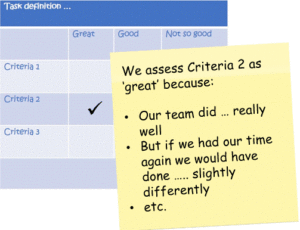
Equally, it is not just a tick-box exercise. Assessments should be evidence-based, providing an ongoing process of learning and adaptive management that continues throughout the life of the initiative. Facilitated learning debriefs and After Action Reviews support a reflective process that can be used as a basis for supporting this adaptive management approach. In this manner, the rubric development and assessement process itself can contribute towards adapting key project tasks and behaviours in a way that grows and strengthens performance over time.
More resources on rubrics can be found from the main Learning for Sustainability rubrics page –Rubrics – as a learning and assessment tool for project planning and evaluation. More material can also be found from the indicators page. Other related PM&E resources can be found from the Theory of Change and Logic Modelling pages.
More information on my own use of rubrics can be found through recent research papers. One 2016 paper looks at the use of rubrics to support collaboration in an integrated research programme – Bridging disciplines, knowledge systems and cultures in pest management. Another recent book chapter (2018) looks at the Use of Rubrics to Improve Integration and Engagement Between Biosecurity Agencies and Their Key Partners and Stakeholders: A Surveillance Example.
[Note: This post is an update of an earlier 2016 version with the original title – Using rubrics to assess complex tasks and behaviors.]
