
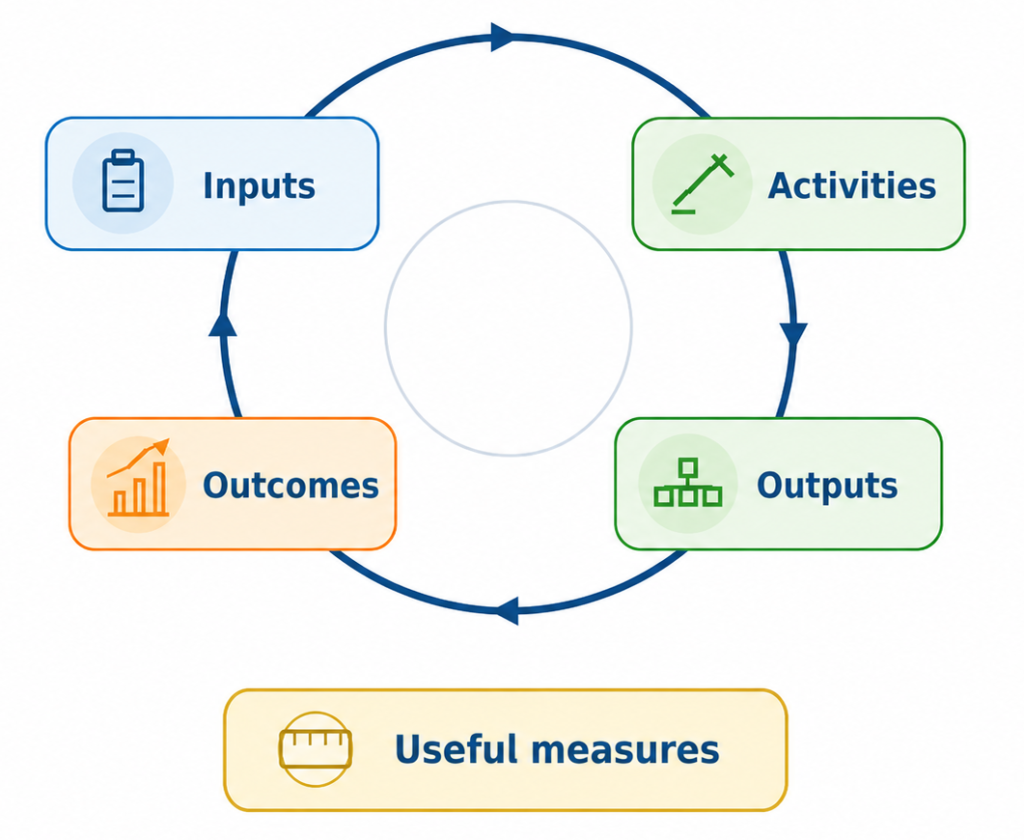
Logic models help teams describe the pathway towards a desired result and identify the measures that matter most. I find them most useful as aids to thinking, conversation and learning, rather than as fixed representations of how change will unfold. They are especially helpful when programmes cut across multiple work areas and need a simple way to set out goals, activities and expected outcomes. Many managers find them a practical tool for clarifying intent, communicating plans and keeping a shared focus on results.
A logic model offers a structured way to map how resources, activities and outputs are expected to contribute to short-, medium- and longer-term outcomes. The links shown in the diagram rest on assumptions about how change is expected to happen, as well as external factors that may support, disrupt or redirect progress. These assumptions and contextual influences need to be revisited as part of monitoring, evaluation and learning. Used well, a logic model is not a claim that change will follow a simple line. It is a way to make the working logic visible so it can be tested, discussed and adapted.
Logic models are sometimes called outcomes models, causal chains or intervention logic models, and they often sit within a broader theory of change. While people sometimes use the terms interchangeably, a theory of change usually covers wider conditions for success. It looks beyond activities and outputs to include things such as partnerships, forums, technical assistance and collaborative processes that help change take root. A logic model can be seen as a focused part of that wider picture, offering enough structure to plan and assess progress without losing sight of the broader intent.
Explore logic model resources
Explore practical resources for using logic models to clarify intent, test assumptions and connect planning with evaluation and learning.
Development of a ‘Real-World’ Logic Model: Reconciling scalability and context-sensitivity
This 2022 study by Thomas Mills and colleagues examines the development of a ‘real-world’ logic model for a complex healthcare intervention aimed at improving hospital-to-home transitions for older patients. It explores the challenge of balancing scalability with sensitivity to different contexts, providing practitioners with a framework to adapt logic models to diverse and evolving environments.
Using logic models
This 2021 chapter by Dylan Kneale and colleagues highlights the role of logic models in conceptualising how interventions function within Health Emergency and Disaster Risk Management (Health EDRM). It introduces a 13-step framework for developing and maintaining logic models, offering detailed guidance for researchers and evaluators. While focused on health interventions, the principles outlined are widely applicable.
Impact evaluation of natural resource management research programs: a broader view
In this report, John Mayne and Elliot Stern outline evaluation strategies that acknowledge natural resource management research (NRMR) as a contributory cause rather than the sole driver of programme outcomes. They argue that impact evaluation should be seen as part of an adaptive learning process that supports innovation. The report emphasises the role of intermediate outcomes and theories of change in evaluating programme contributions within complex systems.
Developing and using program logic in natural resource management
Alice Roughley’s guide provides a step-by-step approach to developing programme logic in Natural Resource Management (NRM). Aimed at first-time users, it offers exercises, templates, and checklists to support programme design and evaluation. Key steps include defining programme boundaries, developing an outcomes hierarchy, articulating assumptions and theories of change, and formulating evaluation questions.
Handbook on planning, monitoring and evaluating for development results
The UNDP’s 2009 Handbook on Planning, Monitoring and Evaluating for Development Results integrates planning, monitoring, and evaluation into a single guide. It emphasises the importance of results-focused planning for effective programme implementation. The handbook also includes a chapter on evaluation design, providing quality assurance guidance for development practitioners.
Introducing program teams to logic models: Facilitating the learning process
A good introduction to developing a logic model from Nancy Porteous and colleagues. This Research and Practice Note provides the key content, step-by-step facilitation tips, and case study exercises for a half-day logic model workshop for managers, staff, and volunteers. Included are definitions, explanations, and examples of the logic model and its elements, and an articulation of the benefits of the logic model for various planning and evaluation purposes for different audiences.
A Guide to Developing Public Health Programmes: A generic programme logic model. Occasional Bulletin No. 35
This 2006 guide by John Wren is to help people design and implement comprehensive, effective and measurable public health programmes that will deliver improved public health outcomes. The guide describes a generic programme logic model and checklist that are designed to guide people through the steps of developing a thorough public health programme.
CES Planning Triangle
The CES Planning Triangle highlights impact, outcomes and outputs. In this way it seems similar to a logic model and can be a useful tool to help you picture what you do and why. The CES Planning Triangle does this by helping an organisation or project to organise its aims and objectives. It helps you to see how what your organisation does (your objectives) can lead to changes (your aims) by showing how they relate to the impact, outcomes and outputs of your work.
Outcome Mapping and Outcome Harvesting
Logic models are useful when a programme can describe an intended pathway of change. In more complex settings, however, evaluators may also need approaches that can track behavioural change, identify unexpected outcomes, or work backwards from changes that have already occurred. Outcome Mapping and Outcome Harvesting offer two distinct but complementary ways to do this.
- Outcome Mapping focuses on behavioural changes in individuals, groups and organisations that a programme directly engages with. Rather than trying to measure broad development impacts, it helps programmes track shifts in roles, relationships and practices, supporting learning and adaptation.
- Outcome Harvesting works in a different way. It identifies and assesses outcomes that have already occurred, then gathers evidence to understand how a programme may have contributed to those changes. This can be particularly useful when causal relationships are unclear, outcomes are emergent, or change does not follow a predefined pathway.
Both approaches can strengthen evaluation and learning in complex settings. The links below provide key resources on each method.
It’s all about change: Is outcome harvesting all that new?
This reflective piece by Malene Sønderskov explores outcome harvesting (OH) as both a practical monitoring tool and an alternative narrative about how change happens in complex development settings. It contrasts OH with theory of change (ToC), highlighting how both approaches—when used together—can support more grounded learning, reflection, and adaptive planning. Drawing on decades of experience, the paper invites practitioners to move beyond logframes and embrace complexity, working with evidence of real-world outcomes rather than assumptions of linear change.
Outcome Mapping: Building learning and reflection into development programs
This manual by Sarah Earl, Fred Carden, and Terry Smutylo introduces the theory and practice of Outcome Mapping. It explains how this approach differs from traditional monitoring and evaluation methods, such as logic models, by focusing on behavioural changes rather than predetermined impacts. The manual outlines a structured workshop process, detailing participant selection, facilitation techniques, and step-by-step guidance for implementing Outcome Mapping in development programmes.
Outcome Harvesting
This foundational report by Ricardo Wilson-Grau and Heather Britt, originally developed for the Ford Foundation, provides an introduction to Outcome Harvesting. It explains how this method enables evaluators, grant makers, and programme managers to document and verify outcomes even in dynamic, unpredictable environments. The report outlines key principles and practical applications, helping practitioners determine if and how Outcome Harvesting fits their context.
Retrospective ‘Outcome Harvesting’: Generating robust insights about a global voluntary environmental network
This 2013 article by Kornelia Rassmann, Richard Smith, John Mauremootoo, and Ricardo Wilson-Grau explores how Outcome Harvesting was used to evaluate an extensive environmental network. It discusses three key aspects of evaluation practice: how the approach helped identify both expected and unexpected outcomes, how credibility and validity were ensured, and how time constraints were managed in applying this intensive methodology.
You can return to the Theory of change hub page for an overview of how these approaches come together in practice. If you are interested in complementary tools, the page on Theory of change offers a practical way to explore pathways and assumptions in more detail, while the social learning section highlights how groups make sense of change together in complex settings. You may also find the related pages on indicator development and on developing conceptual models helpful.