
The recent Global Justice Report offers one possible picture of a fairer and more sustainable future. What interests me is not only the future it describes, but how we work with ambitious futures once they have been made thinkable. A scenario can give us a shared direction, but real change is rarely made through one pathway. It usually emerges through many people, places and institutions trying different things, learning as they go, and finding ways to connect their efforts.
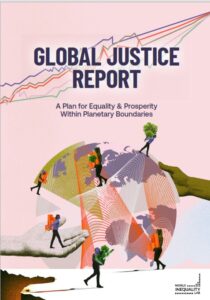
The recent Global Justice Report from the World Inequality Lab has attracted plenty of attention. Some have welcomed it as an ambitious vision of a fairer and more sustainable future. Others have argued that it is politically unrealistic, economically unworkable, or that it works mainly within a climate frame while wider planetary boundaries, such as biodiversity, water and materials, need further attention.
Those are all reasonable responses. The report asks big questions and proposes big changes. It deserves to be debated. For me, the discussion around the report raised a wider question: how should we respond when an ambitious future is made visible? Do we dismiss it as unrealistic, debate its assumptions, improve what is missing, or use it to ask what different people and institutions might begin to do?
The report brings together many different ideas into one picture of what the future might look like. It is carefully modelled because it has to be. But the authors are also clear that this is not a finished answer. They describe it as a contribution to an ongoing conversation. They acknowledge its limitations, point to areas that need more work, and invite others to build on it.
Some longer responses have taken up that invitation directly. Rather than asking simply whether the report is right or wrong, they have explored what might strengthen it, questioned some of its assumptions, and asked what else would be needed to make such a future more plausible. A thoughtful AI-assisted reflection by Duncan Green and Claude AI on the political strategy behind the report, and Timothée Parrique’s response from a degrowth and ecological limits perspective, are useful examples of this more exploratory engagement.
By contrast, many brief public reactions looked quite different. In short articles, social-media threads and comment sections, the focus often returned to a simpler question: could this ever happen? Those quick reactions are understandable. Speed and space push us towards headline judgements, but they also tend to pull us back towards treating the report as a single blueprint to accept or reject, rather than as one possible future that many different pathways might contribute to in different ways.
Perhaps we ask too much of a single scenario.
The blueprint trap
I said earlier that the report holds together because it has to. That is what makes it useful. It may also be what makes it easy to misread. When a picture of the future is this carefully drawn, the way through the model can start to look like the way change itself must happen. The clarity that helps the scenario make its case can quietly turn into a stronger claim than the authors are making.
Part of this comes from us as readers, not from the report. A clear picture of where we might end up is reassuring, and it is tempting to read it as a route as well as a destination, as though knowing the goal told us the way.
But that path is an analytical pathway within the modelling, not a forecast of how change will unfold in the world. A scenario has to trace one possible way forward. Real change does not have to follow that line. Change rarely happens that way. It comes instead through many people, places and institutions trying different things, learning as they go, and sometimes finding ways to connect their efforts.
The risk is that the discussion becomes all-or-nothing. If the full pathway looks unlikely, we set the whole future aside. Yet a scenario may still mark out useful starting points, missing pieces, early experiments, and questions that different actors are well placed to explore. It may not tell anyone exactly what to do next, but it can help different actors see where their own next step might sit within a larger picture.
This is why I find the idea of many pathways more useful than asking only whether one pathway is feasible.
Many pathways for change
Think about almost any large transition. Countries are reducing emissions in different ways. Cities are redesigning transport. Communities are restoring rivers and wetlands. Businesses are experimenting with new technologies and new forms of ownership. Governments are trying different approaches to wellbeing, taxation and public services. Researchers continue to improve the evidence, while citizens, campaigners and community groups keep shifting what becomes politically possible.
None of these efforts, on their own, delivers the future described in the Global Justice Report, nor do they need to. Each contributes in its own way to a broader direction of change.
Ambitious futures give us a shared direction without pretending there is only one road to follow. They encourage us to ask different questions. What parts of this future already seem to be emerging? What assumptions deserve closer examination? Where are the biggest gaps? What could our own organisation, community or country contribute? What can we learn from others who are trying different approaches?
These questions do not make disagreement disappear. Nor should they. The report itself is an invitation to debate, challenge and improve the ideas it puts forward. Perhaps that is its greatest strength.
This does not mean that any action counts, or that everything automatically adds up. Many pathways still need a shared sense of direction, ways to compare experience, and enough connection for learning to travel between places. They also need a clear view of power, trade-offs and uneven capacity. Some actors have more room to move than others. Some changes will be resisted because they threaten existing interests. And some pathways will matter more than others because they shift the conditions in which local action becomes possible.
Without that, good local efforts can remain isolated, and larger ambitions can stay abstract. The work is in holding both together: a broad future that gives orientation, and many grounded efforts that test, adapt and reshape what that future might mean in practice.
Reframing the question
The Global Justice Report will almost certainly never be realised exactly as written. Few ambitious futures are. But that does not make them failures. Their value may lie in helping us imagine a direction of travel, while recognising that the journey will be made through many pathways, shaped by different people and places, learning from one another as they go.
This also means widening the kinds of expertise we listen to. If the question is whether a future fits within current economic and political assumptions, one group of experts will give one kind of answer. If the question is how a fairer, lower-carbon and more ecologically grounded future could become possible, then we also need ecological and biophysical insight, political economy, institutional thinking, Indigenous and place-based practice, and the experience of people working with change in communities, organisations and institutions.
That is the shift I have been describing. The question worth asking is not only “will this future arrive?”, but “what could different people, places and institutions help bring about?” One future can still invite many pathways.
Related resources on Learning for Sustainability explore these themes further, including strategic planning and direction setting, futures, foresight, scenarios and visioning, and systems thinking and complexity-aware approaches in practice.
