
Sustainable development is often described as development that meets present needs without compromising the ability of future generations to meet their own. That remains a useful starting point. But for practice, it is not enough on its own.
On this site, I use the term sustainable development to describe work that helps people, organisations and communities make better long-term decisions about social, ecological, cultural and economic change.
In this sense, sustainable development is not simply a goal to be reached. It is an ongoing process of learning, collaboration and adaptation. It involves paying attention to the relationships between people, and between people and the environments they depend on.
“Sustainability is better seen as a measure of the relationship between the community as learners and their environments rather than an externally designed goal to be achieved” (Sriskandarajah et al, 1991).
This view has a long history. Agenda 21 highlighted information, integration and participation as central to sustainable development. It recognised that everyone is both a user and a provider of information, and that progress depends on moving beyond narrow, sector-based ways of working. Later work on human development, social learning, governance, resilience and adaptation has carried many of these ideas forward.
For me, the term ‘sustainable development’ is useful because it holds several concerns together. It asks how we can meet present needs while also strengthening the conditions for future wellbeing. It also reminds us that technical solutions are rarely enough on their own. People need ways to share knowledge, work across boundaries, test ideas, reflect on evidence, and adjust course as conditions change.
This is the space explored across many of the resources on this site: supporting collaboration, learning, evaluation and adaptive practice in complex settings.
A practice focus
On this site, sustainable development is explored less as a policy slogan and more as a field of practice. That practice includes:
- helping people understand complex social and environmental issues from more than one perspective
- supporting collaboration across organisations, disciplines, sectors and communities
- developing shared goals, actions and indicators
- linking planning with monitoring, evaluation and learning
- strengthening the capacity for adaptation, reflection and informed decision making
- working with both short-term action and longer-term change
These practices matter because sustainability issues are rarely only technical. They also involve values, power, relationships, uncertainty, institutions, histories and different ways of knowing.
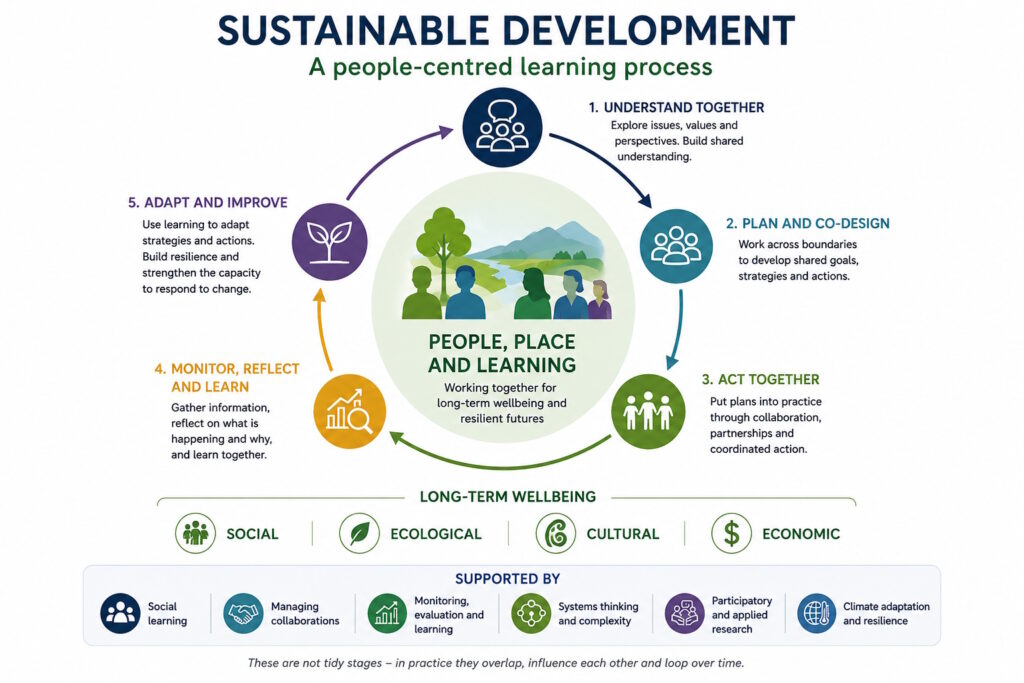
The graphic below* offers one way of showing this as an overlapping cycle of shared learning, action and adaptation, rather than a tidy sequence of steps.
Related resources
The following sections of this site explore sustainable development as a practical, learning-centred field of work. Together they focus on how people, organisations and communities can work across boundaries, build shared understanding, and adapt their actions over time.
Social learning
Social learning is central to sustainable development because many sustainability issues cannot be solved by one organisation, discipline or perspective alone. This section looks at how people learn with and from one another, build trust, make sense of uncertainty, and act together in complex social and environmental settings.
Managing collaborations
Sustainable development often depends on the quality of collaboration between communities, agencies, organisations, researchers and decision makers. These resources focus on multi-actor processes, engagement planning, partnerships, participation, resilience and working across cultures.
Supporting change
This section brings together resources on strategic planning, facilitation, behaviour and practice change, systemic co-design, climate adaptation and adaptive management. These are all part of the practical work of moving from shared concern to coordinated action.
Monitoring, evaluation and learning
Sustainable development needs more than good intentions. Monitoring, evaluation and learning help people test assumptions, track what is changing, reflect on evidence, and adjust direction as conditions change. This section includes resources on theory of change, indicators, rubrics, complexity-aware evaluation and reflective practice.
Systems thinking and complexity
Sustainability issues are shaped by relationships, feedbacks, delays, trade-offs and unintended consequences. Systems thinking and complexity-aware approaches can help groups explore these interconnections and develop more adaptive ways of working.
Participatory and applied research
Applied and participatory research can support sustainable development by bringing different forms of knowledge into practical decision making. This section includes resources on participatory action research, interdisciplinary work, ethics, co-production of knowledge and working with Indigenous lenses.
Climate adaptation and resilience
Climate adaptation is one of the clearest areas where sustainable development needs to be understood as an ongoing process of learning and adjustment. These resources focus on adaptation frameworks, tools, metrics, learning and adaptive management.
For readers wanting the wider international policy framing, the United Nations Sustainable Development Goals provide the current global reference point. The focus of this page, however, is on the practice of sustainable development: how people learn, collaborate, evaluate and adapt in complex settings.
[* Graphic: Will Allen, with ChatGPT assistance, 2026]