
This post looks more specifically at outcomes, and how they can be developed and written. It highlights the benefits of focusing on outcomes for project planning, implementation and evaluation. It also provides some practical questions for involving programme staff, partners and other stakeholders in developing and working with outcome statements.
Until recently, the performance of many public sector programmes was judged largely on inputs, activities and outputs. Over time, this approach has been increasingly questioned. While it can tell us something about efficiency, it does not always tell us much about the benefits arising from programme funding and activities.
This has led to a stronger focus on outcomes: the changes that programmes contribute to through their work. A focus on outcomes helps us look beyond what was done, towards what changed, for whom, and why that matters.
Outputs are the goods and services that result from activities. Outcomes are the changes, benefits, learning or other effects that happen as a result of what a programme offers or provides.
In the past, planning and evaluation often focused on outputs, or on how we keep ourselves busy: what we do, who we work with, and what we produce. This enables us to tell partners, funders and stakeholders about what the programme does, the services it provides, how it is distinctive, and who it serves. We can describe and count our activities and the different goods and services we produce.
Increasingly, however, we are also asked: what difference does it make? That is a question about outcomes.
Outcomes are usually described in terms of either:
- Social and organisational capacities, such as learning, understanding, perceptions, attitudes, behaviours, relationships or institutional capability.
- State conditions, such as biophysical, ecological, social, cultural or economic changes in a system.
A simple logic model can help show the relationship between what a programme invests, does and produces, and the changes it hopes to support. In this sense, it helps distinguish questions of efficiency, whether activities and outputs are delivered well, from questions of effectiveness, whether the work contributes to useful outcomes.
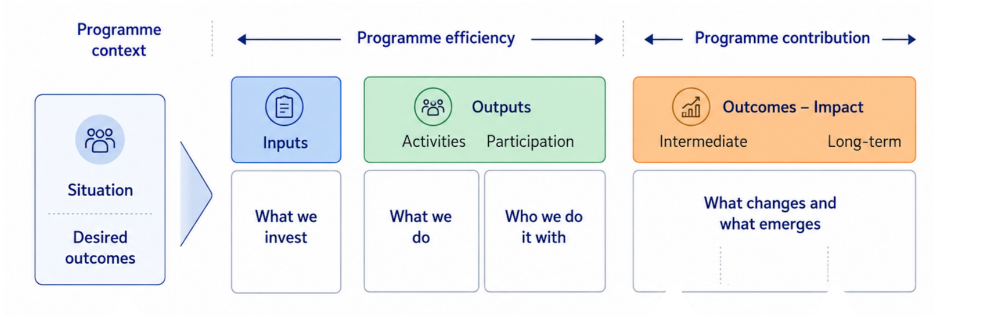
One useful way of thinking about early outcomes in social settings is through changes in knowledge, attitudes, skills and aspirations, often shortened to KASA. These kinds of changes can draw attention to the learning, confidence and motivation that sit between programme activities and longer-term changes in practice, relationships, capability or wider conditions.
While most people intuitively understand the difference between outputs and outcomes, turning that understanding into practice can take time. In results-oriented planning and evaluation workshops, programme staff often find that they are used to describing activities, needs or services, rather than the changes they hope to see.
An outcome statement describes a result, or a change that has taken place. It is not a needs statement, nor is it an activity still in progress. Outputs are the products, services and activities delivered by a programme. Outcomes are what we see as a result of those outputs.
A simple test is to ask two questions of each statement:
- Is it written as an outcome?
- Does it describe a change that the programme can plausibly enable, support or contribute to in people, groups, institutions or environments?
Outcomes may be specified in different ways. A common distinction is between short-term, intermediate and long-term outcomes.
Short-term outcomes describe the more immediate differences a programme may make. Intermediate outcomes describe changes that sit close to the work being done, and may include changes in knowledge, attitudes, skills, aspirations, relationships or practice. They are often especially useful where there are long time lags before wider social, ecological or economic changes can be measured.
Long-term outcomes describe the broader changes to which the programme seeks to contribute. Together, these outcomes should connect to the wider vision or purpose underpinning the programme.
Programme outcomes and intermediate outcomes are often structured in a logical sequence. A useful way of doing this is to take each outcome and ask:
If we achieve this, what will it lead to, and how will it contribute to the longer-term outcome?
It is also useful to look for gaps, starting from the highest-level outcome and working backwards through the outcomes model. A helpful test is whether you can read an outcome and say:
Yes, this is likely to be achieved if these earlier outcomes and related outputs are achieved.
The answers to these questions can help you draft a clear and succinct statement for each outcome.
Each outcome statement should define what will change as a result of the programme, and where possible, by how much or in what direction. This then provides a basis for identifying useful indicators. The more clearly an outcome statement describes a desired change, the easier it is to define an appropriate indicator or set of indicators.
It is not always easy to identify outcomes, and harder still to clarify them. However, a few practical questions can help:
- What will be different as a result of this initiative?
- For whom?
- What will be changed or improved?
- What do beneficiaries, partners and other stakeholders see as the value of the programme?
- What changes would tell us that the work is making a useful contribution?
For an existing programme, it can help to start with the major activities. For each activity, ask: why are we doing this? Often, the answer to that question points towards an outcome.
It is also important to seek ideas and input from others. Different people will see different forms of value, risk and change. Their perspectives can help build a broader understanding of the programme and the benefits it may contribute to. This process can also help build shared ownership of the outcomes being developed.
When writing outcomes, describe the desired change as clearly as possible. In many planning settings it is useful to check whether outcomes are specific, measurable, achievable, relevant and time-limited. This does not mean that all outcomes need to be reduced to narrow targets, but it does mean they should be clear enough to guide action, discussion and assessment. This does not mean that all outcomes need to be reduced to narrow targets. In complex settings, some outcomes may need to be revisited as learning develops. However, outcome statements should still be clear enough to guide action, discussion and assessment.
A useful rule of thumb is to say what is expected to change, rather than how it will be achieved. The means of achieving the outcome, and the plausibility of the pathway, can then be explored through a logic model, theory of change or other planning process.
Table 1 Examples of outcome statement structure from a range of sectors
| Who or what | Change or desired effect | In what | By when |
|---|---|---|---|
| Agricultural production | Increase | Dollar value | Over x years |
| Biodiversity, species | Increase | Trend | Over x years |
| Public awareness of an issue | Increase | Extent | Over x years |
| Community participation | Increase | Level or quality of involvement | Over x years |
| Organisational capability | Strengthen | Skills, systems or confidence | Over x years |
| Water quality | Improve | Selected indicators | Over x years |
The structure in the table is only a starting point. In practice, outcome statements often need to be refined through discussion. Some may focus on measurable change in a condition, such as water quality or production value. Others may focus on changes in capability, relationships, understanding or practice. These can be harder to measure, but they are often central to whether longer-term change becomes possible.
The main value of outcome statements is not that they produce perfect wording. Their value lies in the conversations they support. Clear outcome statements help groups test assumptions, identify what matters, choose useful indicators, and keep monitoring and evaluation connected to learning and decision-making.
[Note: This post is the third of a three-part introductory series on Theory of Change, logic models and outcomes. It was first published in 2016 and has been lightly updated to reflect current Learning for Sustainability resources on planning, monitoring, evaluation and learning.]
For more on this topic, see the Learning for Sustainability pages on Managing for outcomes: using logic modelling and Linking planning with monitoring & evaluation. These sit within the wider Monitoring, evaluation and learning (MEL) section, which brings together resources on theory of change, indicators, rubrics and complexity-aware evaluation practice.
