
The previous post looked at the benefits of using a Theory of Change (TOC) to better understand your programme or initiative. This post looks at how an expanded logic model can help groups begin developing that bigger picture.
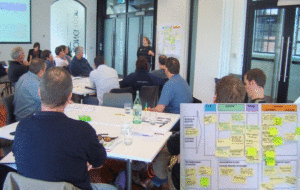
Bringing participants together around the development of a visual logic model can be a useful place to begin Theory of Change work. A set of key headings can provide enough structure for people to sketch early ideas, test assumptions, and develop shared understanding. This can support planning while also building confidence in outcomes-based and Theory of Change approaches.
Logic models are narrative or graphical depictions of real-world processes. They help communicate the assumptions behind how an activity is expected to contribute to a specific result. Four components are commonly included: inputs, activities, outputs and outcomes. These are the primary elements of the work itself.
An expanded logic model can also prompt people to think more carefully about the wider Theory of Change they are developing. These prompts include: i) outlining the current situation and desired vision; ii) identifying who should be involved in model development; iii) documenting the assumptions that sit behind the model; and iv) noting internal and external factors, including related activities, that may influence outcomes.
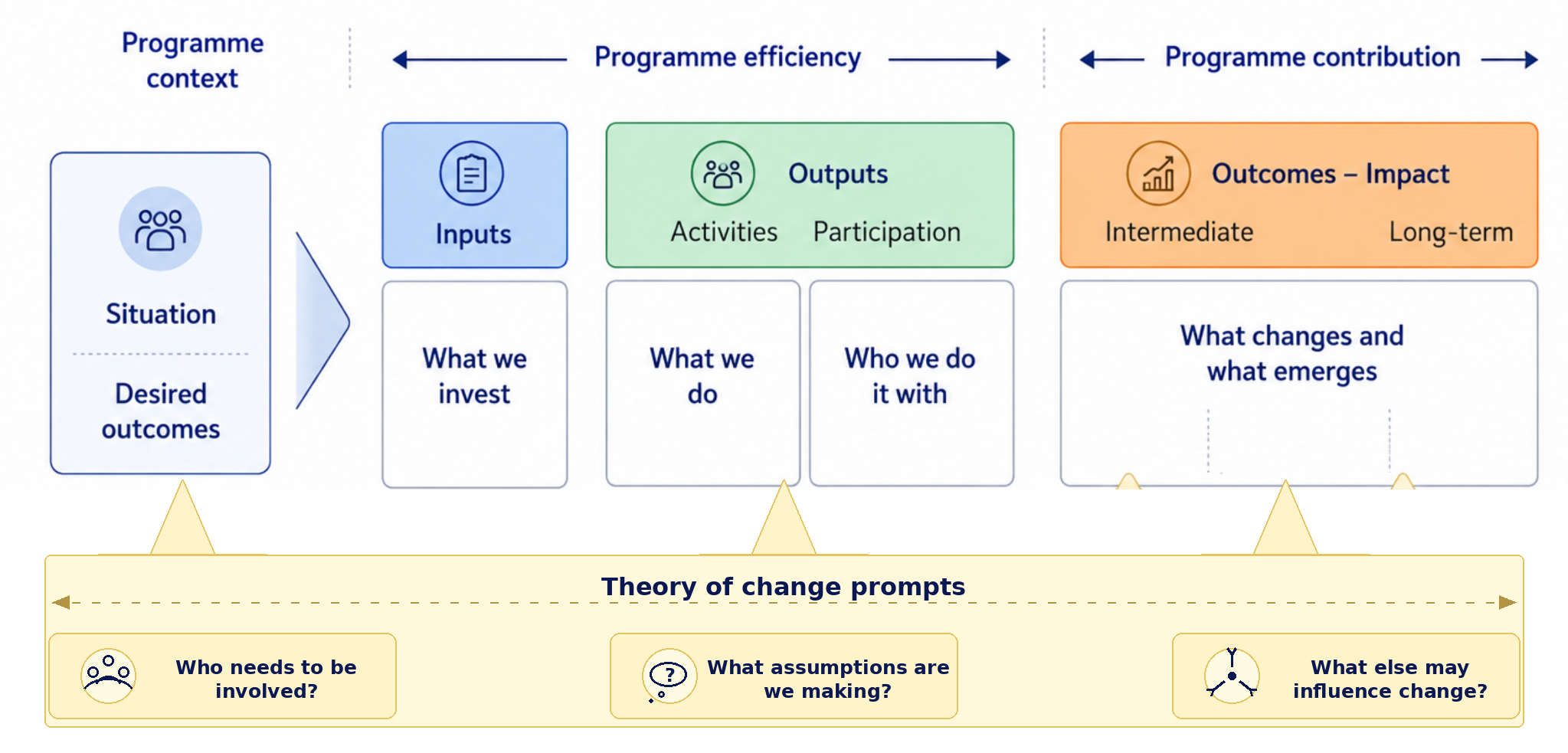
Fig. 2. A programme logic model adapted for Theory of Change development, showing how activities and outcomes can be explored alongside prompts about involvement, assumptions and wider influences.
There is no single correct way to draw a logic model. It can be drawn horizontally, as in Fig. 2, vertically, or in a more free-form way. Ideally, a logic model should be able to fit on a single page with enough detail that it can be explained clearly and understood by others.
Much of the value of a logic model is that it provides a visual expression of the underlying beliefs about why an initiative is likely to contribute to change. Each step between an activity and an output, or between an output and an outcome, can be thought of as an “if this happens, then that is likely to happen” statement. For large or complex initiatives, the model may be divided into more detailed sections or sub-models. These can then be brought together and summarised by a less detailed overview model that shows how the parts fit together.
As an example, Fig. 2 illustrates the main logic model elements set out in a horizontal form. Inputs are the resources used to support activities, produce outputs, and ultimately contribute towards desired outcomes. Inputs typically include things such as funding, staff time, equipment, infrastructure, or other forms of support. They are often measured as counts, such as hours of staff time or dollars spent.
Activities are the actions undertaken to achieve specified outputs. They can range from writing a memo, to holding workshops, to creating infrastructure. Activities are usually measured in terms of the number or type of things done, such as meetings held with communities.
Outputs are the tangible results of the major activities, often described as the goods and services produced. They are usually measured by number, such as reports produced, newsletters published, or field days held. Collectively, inputs, activities and outputs help describe what the initiative does and how efficiently those elements are being managed.
Outcomes represent the changes the work is intended to contribute to. They may relate to people, organisations, communities, ecosystems, production systems, or other areas of interest. Outcomes may be described as short-term, intermediate or long-term. A long-term outcome will usually depend on a number of intermediate outcomes that together contribute to its achievement.
The diagram also shows the supporting information and activities that help the model be understood in its wider context. Starting with the current situation and desired outcomes helps participants clarify the problem, need or opportunity being addressed. An issue statement can help explain what needs to change, why there is a need for intervention, and what the work is intended to influence. This requires attention to questions such as who, what, why, where, when and how.
The overall purpose then needs to be defined. What are you trying to accomplish over the life of the initiative and beyond? The answer to this question helps establish the desired direction or vision. This vision provides a reference point for the other elements of the logic model.
Involving key participants in developing the model provides an opportunity to explore different understandings of the work, its purpose, and what matters most. This can include staff, partners, participants, funders, affected groups, and others with relevant knowledge or experience.
The link between activities, outputs and desired outcomes is based on the assumptions that are built into the Theory of Change. These assumptions may be explicit or implicit. They set out why people believe that delivering particular activities and outputs will contribute to the intended changes. It is important to document the rationale behind the model, drawing on research, experience, local knowledge or practice-based judgement. It is also useful to identify where uncertainty remains.
A final discussion can help participants consider the risks and opportunities facing the work. These may arise from internal or external factors. Initiatives operating in complex environments cannot control all the factors that influence how, when, or whether they reach their goals. It is therefore important to be aware of related initiatives, wider drivers, institutional constraints, and other contextual influences that may affect outcomes. This also helps when considering contribution: how much of the observed change can reasonably be linked to this work, and what else may have played a role?
There are three key reasons for using logic models in design and planning. They can help people understand why and how something is expected to work; they can guide useful monitoring and evaluation; and they can help tell the story of an initiative quickly and visually.
Logic models are often most useful when developed early. They can help coordinate resources, shape strategy, and set realistic expectations about outcomes, especially where longer-term changes may take many years to emerge. They also support later evaluation. Once the work has been described through a logic model, it becomes easier to identify meaningful performance indicators and useful evaluation questions. Finally, a simple visual representation can support communication and provide a basis for developing a fuller Theory of Change.
Some tips for working with logic models
- It is important to know where you are and where you are trying to get to: These may already be expressed in existing documents, strategies or mission statements. The key task is to develop enough shared understanding among those involved about the problem, purpose and desired outcomes.
- Involve the right people: A strong focus on the process of developing a logic or outcomes model (rather than seeing it as just a task to complete) can increase engagement. Building the model provides an opportunity to involve people in a discussion about what is most meaningful and what needs to be understood.
- Keep the model simple: Focus on the most important activities and outcomes, and avoid unnecessary detail. Describe activities and outcomes in language that can be understood by a wide range of participants. A clear overview model can be used as a communication aid, with more detail added behind it where needed.
- Minimise the use of arrows: In complex situations there are always many links and potential feedback loops between the boxes on the page. It is often enough to indicate the general movement of time and direction of the model.
- Avoid siloed thinking: Do not include only the steps and outcomes that are easiest to measure or most directly attributable. These may not be the most important parts of the work. Similarly, do not force lower-level steps to contribute to only one higher-level outcome. In the real world, most elements influence several things at once.
- Work constructively with disagreement: Keep key participants involved, even where there are different views. Take time to explore why people disagree about what should be included in the model. Look for the assumptions beneath those differences, identify where the uncertainties are, and use the process to build a stronger shared understanding.
People often talk about logic models and theory of change processes as if they are interchangeable. They are related, but not the same. Logic models typically connect activities and outputs to intended outcomes. A Theory of Change usually goes further, exploring the wider conditions that help change take root. These may include partnerships, forums, technical assistance, relationships, collaborative processes, and other factors that help people work together and stay focused on results.
[Note: This post is the second of a three-part introductory series on Theory of Change, logic models and outcomes. It was first published in 2016 and has been lightly updated to reflect current Learning for Sustainability resources on planning, monitoring, evaluation and learning.]
