
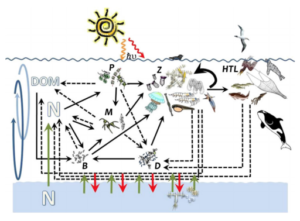
Conceptual modelling uses simplified visual representations to help people understand and engage with real-world systems. In collaborative settings, these models are often less about producing an accurate representation of the whole system and more about creating a shared basis for inquiry. They help stakeholders frame issues, identify key components, explore relationships, and discuss possible ways forward.
Developing a conceptual model requires decisions about scope, level of detail, boundaries and assumptions. These decisions are best made with the people who will use the model for discussion, planning or decision-making. In this sense, conceptual models often sit somewhere between models and frameworks: they represent selected aspects of a situation, while also helping groups orient attention, generate questions and make judgements in conditions of uncertainty.
Beyond individual models, conceptual modelling supports participatory and collaborative approaches by helping groups develop a shared language for problem-framing, planning, evaluation and learning. Related approaches, such as systems thinking, systemic design and systems thinking tools enhance this process, ensuring models are adaptable and aligned with real-world complexities. Conceptual models have many uses in collaborative decision-making, including supporting the development of detailed computer models and decision-support systems.
The resources below explore how conceptual models can be applied across different contexts, from stakeholder engagement to simulation modelling, providing insights into their benefits, challenges, and best practices.
Conceptual models – What are they and how can you use them?
This 2017 post by Andrew Powell-Morse provides a good introduction to these models. He explores what conceptual models are, how they are most commonly implemented, and touches on a few advantages and disadvantages of using conceptual models in the realm of software development.
Universal conceptual modelling: Principles, benefits, and future directions
This 2024 open-access paper by Roman Lukyanenko et al. introduces the concept of universal conceptual modelling (UCM)—an approach that aims to make conceptual modelling as general-purpose and accessible as possible for both professionals and non-experts. The authors outline six key principles that support UCM: flexibility, accessibility, ubiquity, minimalism, primitivism, and modularity.
Conceptual modelling: Knowledge acquisition and model abstraction
In this paper, Kathy Kotiadis and Stewart Robinson examine the processes of knowledge acquisition and model abstraction in conceptual modelling. Knowledge acquisition focuses on understanding the problem and creating a system description, while model abstraction simplifies this description into a conceptual model. The paper also references See also the related systems thinking tools page which provides more detail on the use of rich pictures and SSM.
Choosing the right model: conceptual modeling for simulation
Stewart Robinson explores the balance between complexity and simplicity in simulation models. Too much detail can make a model unmanageable, while too little can compromise its accuracy. Using an example from healthcare, Robinson defines conceptual modelling artefacts and outlines a framework to guide modellers in determining what to include or exclude.
Conceptual modelling: framework, principles, and future research
Roger Brooks discusses the challenges of conceptual modelling, often seen as more art than science. He provides a framework and suggests a creative optimisation process for developing models. The paper outlines 17 principles of conceptual modelling, offering practical advice for choosing the best model for a project and predicting its performance throughout.
Conceptual modelling is also integral to developing indicators for sustainable and performance-based management. For guidance on developing programme-based outcomes or intervention logic models, visit the related page on developing programme-based outcomes models. Additionally, see pages on systems thinking, systemic design and systems thinking tools for more resources on problem sructuring and framing.
[* Image: Wikimedia Commons, CC BY 4.0 ]
