
Developing effective partnerships and other forms of collaboration is an important intermediate outcome in many initiatives seeking wider environmental and social change. Yet assessing progress in developing these relationships and collective capabilities is often seen as a difficult aspect of monitoring and evaluation. How can partners assess how well they are working together, learn from their different experiences and identify what needs attention? This post shares a practical approach using single-point rubrics and facilitated reflection to support both assessment and the development of more effective partnerships.

Many environmental and social initiatives depend on people and organisations working across established boundaries. Catchment restoration, biodiversity management and climate adaptation, for example, involve different responsibilities, knowledge, relationships and opportunities to influence what happens. Progress often depends on how well these different contributions can be brought together.
While the importance of these developments is widely recognised, assessing progress can be more challenging. It is relatively straightforward to document who is involved, how often partners meet and what activities they undertake together. Assessing changes in the quality of relationships, shared understanding and collective ways of working is less straightforward. Different partners may also have quite different experiences and expectations of how the partnership is working.
Here I share an approach that I have developed and adapted through work with partnerships in different settings, including freshwater management, biosecurity, agriculture and fisheries. It combines a single-point rubric with individual reflection, facilitated discussion and a simple way of identifying priorities for action.
Why partnership quality matters
From a Theory of Change perspective, developing effective partnerships is often an important intermediate outcome in place-based and multi-actor initiatives. The relationships, shared understanding and collective capabilities that partners develop help create the conditions for wider changes in behaviour and practice.
Working in partnership can also challenge established ways of thinking and operating. What makes sense within one organisation may not work as well when addressing a shared problem. Partners may need to reconsider how they make decisions, share responsibilities and resources, draw on different sources of knowledge, involve others or support collective activities.
Over time, changes in how partners work together can contribute to wider changes in organisational practice, institutional arrangements and relationships across sectors. These changes are often important elements of longer-term sustainability transitions.
Reflecting on partnership practice can therefore serve two purposes: assessing progress towards these intermediate outcomes and contributing to their achievement.
Using a single-point rubric to explore good practice
A rubric sets out criteria and descriptions that help people make judgements about practice. While many rubrics describe several levels of performance, a single-point rubric provides an indicative description of good practice for each criterion. It leaves open the ways in which practice might fall short of, meet or exceed that description.
Their simpler format makes them easier to develop, understand and adapt. Rather than spending time trying to describe several levels of performance for each aspect of partnership practice, participants can concentrate on developing a shared understanding of what good practice would look like in their setting.
Importantly, single-point rubrics do not require us to anticipate all the ways in which a partnership might encounter difficulties or work particularly well. This is especially useful in complex settings, where effective practices may emerge through experience and take different forms across cultural, organisational and local contexts.
The descriptions provide a shared reference for discussion rather than a fixed standard. Developing them together can help partners clarify expectations, explore different perspectives and take greater ownership of the assessment process.
In workshops I helped facilitate with a research partnership in Solomon Islands, for example, developing shared descriptions of good practice helped partners explore how their different skills, resources and activities could complement one another. In catchment management initiatives in Aotearoa New Zealand, similar discussions have encouraged partners to consider what working collaboratively means for their respective organisational roles, responsibilities and ways of working.
The simpler format places greater emphasis on participants drawing on evidence and experience to explain their judgements. Used regularly, this approach can help partners develop their own capacity for critical reflection and assessment.
For a wider discussion of the approach, see the earlier LfS post Single-point rubrics: supporting reflection and learning in complex settings and the accompanying rubrics resource page.
An illustrative partnership rubric
The following rubric brings together six aspects of partnership practice that I have found useful across different settings.
| Aspect | Indicative good practice |
| Shared purpose and direction | Partners understand the purpose of working together, recognise their different interests and contributions, and can connect their collective activities to the changes they hope to achieve. |
| Relationships and trust | Partners build respectful working relationships, recognise different perspectives and can raise and work through difficulties constructively. |
| Inclusive decision-making and joint action | Relevant partners have meaningful opportunities to influence decisions. Responsibilities and resources are managed fairly, and agreed activities are carried out collaboratively. |
| Communication and engagement | Partners share relevant information, listen to one another and maintain effective connections with their organisations, communities and others involved in or affected by the work. |
| Organisational commitment and support | Participating organisations provide the authority, resources and support needed for collaboration, and are willing to consider what their involvement means for established organisational practices. |
| Collective learning and adaptation | Partners regularly reflect on their experiences, use evidence and different perspectives to inform decisions, and adapt their ways of working as circumstances change. |
These descriptions are a starting point for discussion. Do they reflect what good practice would look like in this setting? Is anything missing or unclear? Are there other aspects that need consideration?
These discussions also provide an opportunity to explore differences in expectations and perspectives. Partners may, for example, have different views about how resources and influence should be shared, whose knowledge informs decisions or who needs to be involved. Cultural and institutional contexts matter here too. Where Indigenous peoples are partners, questions of authority, self-determination and whose knowledge frameworks shape the descriptions themselves need explicit consideration.
A useful starting question is: If we were working well together in this area, what would we expect to see happening?
From individual judgements to collective learning and action
Once partners have agreed on useful descriptions of good practice, they can use them to reflect on how things are going.
I usually begin with individual assessments. For each aspect being reviewed, participants consider their own experience and place a mark on a blank continuum running from Developing to Well developed. They are also asked to think of examples that support their judgement.
The individual assessments are then displayed together (the blue dots in the figure below). This makes the range of perspectives visible and provides a starting point for discussion.
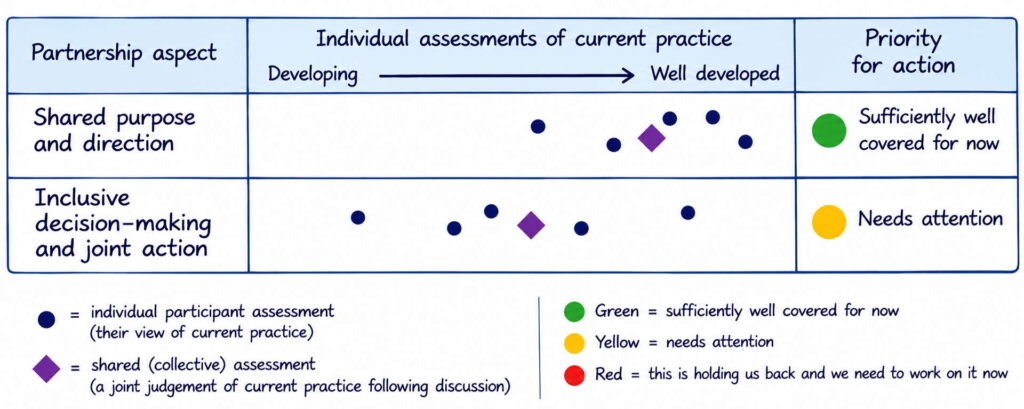
Figure: Illustrative partnership assessment showing individual and shared judgements of current practice, alongside collectively identified priorities for action.
Participants are invited to explain the reasoning and experiences behind their assessments. For example, some partners may consider decision-making to be inclusive because everyone attends regular planning meetings. Others may feel they have little influence because important decisions are effectively made outside those meetings.
Exploring these differences can reveal overlooked strengths, gaps in understanding and aspects of the partnership that need attention.
Following discussion, I usually invite partners to agree on a shared assessment for each aspect being reviewed (shown by the purple diamonds). This is a collective judgement, not an average of individual assessments, and there is no need to force agreement. Its meaning is grounded in the experiences and discussions of those who developed it, rather than providing a standardised measure for comparison across partnerships.
A simple traffic-light approach can then help partners collectively identify priorities for action:
- Green: Sufficiently well covered for now.
- Yellow: Needs attention.
- Red: This is holding us back and we need to work on it now.
In the illustrative example, partners have identified inclusive decision-making and joint action as needing attention, while shared purpose and direction is considered sufficiently well covered for now. The shared assessments inform, but do not determine, priorities for action. An aspect of practice may be relatively well developed yet still warrant attention, while other aspects may be less developed but not an immediate priority.
The discussion can then move towards identifying one or two priorities, considering what might help and agreeing on next steps.
Making the review useful
The value of this approach depends less on the assessments themselves than on the quality of the discussion they support.
Use appreciative language without avoiding difficult issues. Describing partnership practice as developing, rather than poor or failing, can encourage openness. However, a strengths-based approach should not prevent partners from identifying serious problems or barriers to progress.
Explore the different judgements. Facilitators can help by asking participants to explain their assessments, draw on actual examples and consider experiences different from their own. Positive assessments deserve as much examination as critical ones.
Encourage openness before turning to reporting. This reflects a wider tension between evaluation for learning and evaluation for accountability. My initial focus is on helping partners reflect honestly. We can then consider how best to communicate the findings, particularly to funders, presenting difficulties alongside their context, what has been learned and what partners intend to do about them. An honest, self-critical assessment should not automatically be interpreted as evidence of poor partnership performance.
I have facilitated reviews where partners were remarkably open about their difficulties. These were often partnerships with a strong capacity to learn and adapt, whose assessments could appear less favourable to an outside reader precisely because they could see how much more they might achieve. Conversely, I have encountered groups that assessed everything positively without seriously questioning their practice.
Pay attention to power and organisational relationships. Partners may have different levels of authority, resources and influence. These differences can shape whose views are heard and what can be discussed openly. Individual reflection, smaller-group discussions or anonymous assessments may help bring different perspectives into view. It is also worth considering whose voices may be missing altogether.
Keep the process in the hands of the partners. A facilitator can encourage critical reflection but cannot ensure that participants will learn or change their practice. The review needs to be undertaken by partners and for partners.
Adapt the approach to suit the setting. A partnership might undertake a facilitated workshop across several aspects of practice, or use one or two descriptions as part of a regular planning or reflection meeting. The rubric can also be used when establishing a partnership, helping participants discuss the ways of working they want to develop.
The opportunity lies in using these conversations to strengthen the partnership itself, alongside the wider changes partners are working towards.
The Learning for Sustainability website provides further resources on rubrics as tools for reflection, learning and evaluation, including guidance on developing and using single-point rubrics, examples from different sectors and links to the wider literature.
[* Image: Deposit Photos / alphaspirit]
