
The first part of this two-part reflection mapped the wider ethical terrain around AI. This second post asks what those concerns might mean for the way AI is designed, developed and deployed, drawing on six principles that put purpose, human agency, fairness, planetary limits, wider system effects and accountability at the centre.

In Part 1, seeing the wider ethical picture around AI development and use, I looked at ethical concerns around AI at three connected levels: the wider structures within which AI is developed, the organisational choices through which it enters our work, and the everyday practices through which people use it.
That wider view matters because many concerns about AI cannot be resolved simply by asking individuals to use it more carefully. Questions about energy and water use, labour, ownership, concentrated power, changing employment, and effects on education and public information are shaped much further upstream.
Looking upstream brings a different set of questions into view. Rather than beginning with what the technology can do, we can start with what we are trying to achieve, for whom, and within what wider social and ecological setting.
We already know quite a lot about good design
Many of the ideas that might guide better AI development are not new or unique to AI. Participatory development, systems thinking, sustainable design, action research and adaptive management have all had to grapple with a similar problem: what happens when we introduce a technology or other intervention into a setting that is already complex and changing? Across these traditions there is plenty of accumulated experience to draw on. Technologies have purposes, different people experience their benefits and costs differently, knowledge is distributed, and consequences often unfold in ways that could not have been fully predicted at the outset.
These traditions also encourage us to question the boundaries around a design problem. It is easy to define the relevant system narrowly around a developer, customer or immediate user. But people live and work in places. We have neighbours and communities. We are linked to people elsewhere through supply chains, labour, information and economic systems. And all of this takes place within ecological systems on which we depend.
So asking whether an AI system works is only part of the question. What is it actually intended to improve? Who gets to decide what improvement means? Who is likely to gain or lose? What else may change around it? We also need to ask whether the resources involved are justified by the value being created.
Participation is part of this. It is not necessary, or possible, for everyone to participate in every design decision. But good design should ask who needs to be involved, in what, at what stage, and with what influence. This is partly about fairness, but also about knowledge. Designers rarely possess all the knowledge needed to understand how a technology will interact with the situations into which it is introduced.
Six principles for good design
Against that background, I find six principles useful for thinking about better AI design and development. They are not new, and I am not claiming them as a new framework. Rather, they bring together practical expectations that have emerged across different fields and traditions. I think they are relevant not only to people designing, developing, deploying and governing AI, but also to those working with other technological innovations.
They are not intended as a comprehensive framework for ethical AI. Their role is more modest: to help us ask better questions about purpose, people, resources, wider consequences and responsibility. Participation is not a separate seventh principle because it runs through the others. It can help shape purpose, bring different knowledge and perspectives into design, make consequences more visible and strengthen accountability.
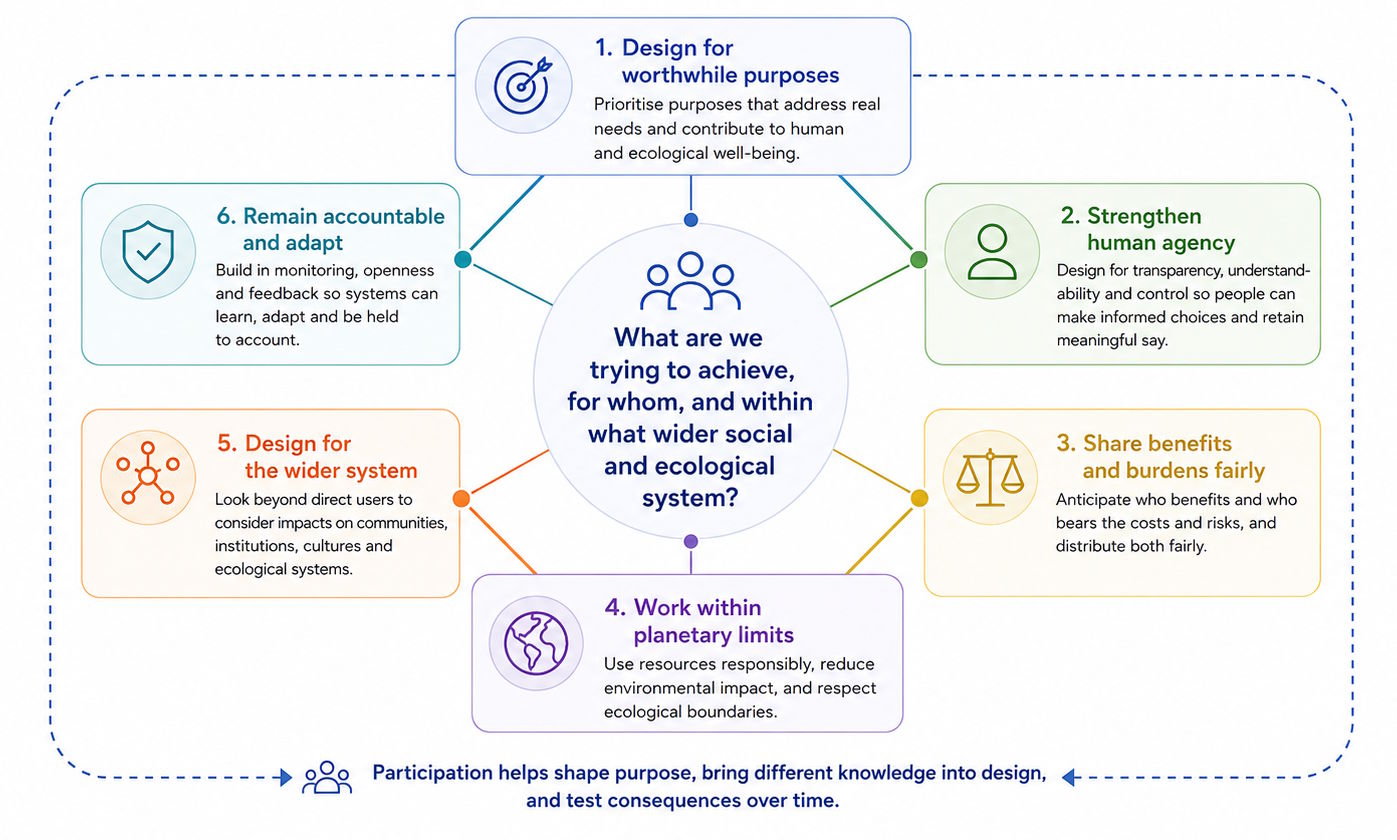
The six principles overlap rather than operating as separate tests. Questions about jobs, for example, can involve purpose, human agency, fairness and wider system effects. Energy and water use raise questions about planetary limits, but also about whether the value being created justifies the resources involved. The sections that follow look at each principle in turn.
1. Design for worthwhile purposes
The starting question should be what we are trying to achieve, rather than what the technology is capable of doing. Technical capability, novelty, market opportunity and productivity can all be relevant, but they are not purposes in themselves. A system may work extremely well at doing something without making the activity particularly worthwhile.
Some fairly basic questions follow. What problem are we trying to address? Who sees it as a problem? Who is expected to benefit? Are there other ways of achieving the same outcome? And what might be displaced or weakened in the process? These questions become particularly important when growing technical capability itself starts to be treated as sufficient reason to automate an activity.
2. Strengthen human agency
Technology can extend human capability. It can help people gain access to information, explore alternatives, communicate more easily and carry out tasks that would otherwise take considerable time. But it can also create dependency, narrow opportunities to learn, reduce professional discretion and quietly shift decisions towards systems that people do not fully understand or control.
Human agency is not only individual. AI-supported systems should also preserve the capacity of teams and organisations to question, deliberate and exercise judgement together.
So better design should aim to strengthen people’s capacity to understand, decide, learn and act. Keeping a human formally “in the loop” is not enough if that person’s role has been reduced to accepting recommendations they have little capacity or time to question. The more useful question is whether a system supports human judgement and capability over time, or gradually substitutes for them.
3. Share benefits and burdens fairly
AI systems create benefits, costs and risks, and these are rarely shared evenly. Organisations receiving productivity gains may not be the same people whose jobs are changed or lost. People whose creative or intellectual work contributes to AI systems may have little influence over how that work is used. Environmental or infrastructure costs may fall on communities far removed from the users receiving the benefits.
So fairness involves more than checking whether an algorithm treats individual users consistently. It also means asking who gains, who pays, who carries the risks and who has a meaningful say. Those questions need to be considered across the development chain, including data, labour, infrastructure, ownership and deployment. Ownership and control matter here because those able to set the terms of development and deployment may also be better placed to capture the benefits and shift some of the costs elsewhere.
Participation is especially important where those making design choices are not the people most likely to experience their consequences.
4. Work within planetary limits
The material demands of AI were part of the wider ethical picture considered in Part 1. Here the design question is what follows from recognising them. Improvements in the efficiency of AI systems matter, but so does the overall scale at which they are being developed and used.
Environmental costs need to be part of the design brief rather than treated as something outside it. This does not mean expecting technologies to have no environmental footprint. It does mean making resource use visible, asking where it can be reduced, and considering whether it is proportionate to the value being created. This brings purpose back into the discussion: what kinds of value justify resource-intensive uses of AI, and who should be involved in making that judgement?
5. Design for the wider system
Technologies do not simply enter an existing setting and leave everything else unchanged. People and organisations adapt around them. Practices change, expectations shift, new dependencies develop and activities that were previously valuable may become less visible.
This makes it important to look beyond the immediate user and intended function. How might widespread use affect education, professional practice, employment, communities, information systems or democratic institutions? What behaviours might the system encourage? What might it displace? And what happens if millions of people and organisations respond to the same incentives?
Looking at the wider system will not tell us everything that is going to happen. Complex systems do not work like that. But it can help us notice effects and relationships that are reasonably foreseeable, and make it harder to dismiss them as somebody else’s problem. The remaining uncertainty is one reason why continuing learning and adaptation matter.
6. Remain accountable and adapt
No design process will identify every consequence in advance. Complex technologies interact with changing social systems, and effects that seem minor during testing can become significant when systems are widely adopted. Responsible design therefore cannot finish when a product is released.
That means developers and organisations need ways of noticing what happens in practice, learning from unexpected effects, responding to challenge and changing course. People affected by a system need meaningful routes for questioning decisions and seeking redress. Monitoring needs to look beyond technical failure to changes in behaviour, capability, relationships and wider system effects. And accountability needs to remain identifiable. If responsibility is spread so widely that nobody has the authority or obligation to act, it is difficult to call it accountability at all.
These principles work together
The principles overlap. Jobs, for example, raise questions about human agency, fairness and wider system effects. Water and energy use connect planetary limits back to purpose: is this use of resources justified by what the system is helping us achieve? Misinformation brings in the wider information system as well as accountability. Concentrated control over powerful AI systems raises questions about fairness, agency and whose purposes are being served.
The principles can also pull in different directions. A socially valuable use of AI may require significant resources. Wider access may create new risks. Protecting people from harm can conflict with autonomy. Good design will not remove these tensions, but it should make them visible enough to be discussed.
Locating these principles
These principles also reflect the way I have come to think about design and intervention through work in environmental management, participatory practice, systems thinking, evaluation and adaptive management. Across these fields, I have repeatedly run into the limits of approaches that define a problem too narrowly, treat expert knowledge as sufficient, or assume that an intervention will work as intended once it is introduced.
I find the six useful because they bring some of that accumulated learning into the questions now being raised by AI. I offer them in that spirit: not as a new framework, but as a set of expectations that may help us think about what better AI development and use could look like.
Concluding comments
There is no shortage of principles and standards for responsible AI. These six are not another attempt to capture everything that ethical AI requires. Their purpose is simpler: to shift the starting point from what can we make AI do? towards what are we trying to achieve, with whom, and what kind of social and ecological system are we helping to create?
These questions are not unique to AI. They arise in many other fields whenever we introduce technologies or other interventions into situations where knowledge is incomplete, people value different things, and consequences unfold over time.
Responsibility does not rest only with technology developers. Governments, organisations, professions, communities and users all help shape how technologies are introduced and what becomes normal practice. But responsibility is not shared equally. Those with greater power to shape AI systems, determine their purposes and influence the conditions under which they are used carry greater responsibility for what follows.
Better individual and organisational use of AI still matters. But it sits within this wider picture. We should also expect better from the technologies themselves, and from those designing and developing them.
For the wider ethical framing behind this post, see Part 1: Seeing the wider ethical picture around AI development and use. Related thinking about purpose, participation and design in complex settings is explored in Designing together: reflections on co-design in complex settings.You can also explore the wider collection of reflections and resources on AI for reflective practice, research and collaboration.
[*1 Image by Jintana / Adobe Stock]
[*2 Graphic: Will Allen, with ChatGPT assistance, 2026]
