
Debates about AI often sound polarised, but much of the disagreement comes from people focusing on different parts of the system. This post maps three overlapping levels of concern: the wider systems AI depends on and is beginning to reshape, the organisational choices through which it enters our work, and the practice-level tensions that surface when people use it.

This is Part 1 of a two-part reflection on the wider ethical terrain of AI. [Part 2: Designing AI for the wider world] considers six principles for better AI design and development.
Ethical questions about AI arise at structural, organisational and practice levels. Distinguishing between them helps explain why people can reach very different positions on AI. Often they are worrying about different things, and those concerns need different kinds of response.
Earlier posts in this series have focused on how AI is being used in reflective, collaborative and collective work. They have explored AI as a thought partner, and as something that can sit, carefully, within group processes.
This piece steps back from those particular uses to look at the wider conditions within which AI is developed, introduced and used.
The structural level
The first set of concerns relates to the wider systems within which AI is developed and used, and the ways AI may in turn reshape them. These are not mainly questions about individual behaviour. They concern infrastructure, labour, knowledge and power.
AI as environmental and material infrastructure
AI is often discussed as though it were abstract software. In practice, it depends on data centres, energy supply, water use, mineral extraction and global supply chains. Recent analyses have highlighted pressures on electricity grids and freshwater supplies in some regions. Hardware and model efficiency continue to improve, but overall demand is also growing.
Not all AI systems operate at the scale of large foundation models. Some run locally or use smaller infrastructures. But the generative systems shaping public debate and organisational practice depend heavily on substantial centralised computing resources. Ethical questions therefore concern what resources are used, where the costs fall and what infrastructure societies choose to support.
AI as appropriation of labour and knowledge
A second set of concerns focuses on what AI systems draw upon. Training practices range from fully licensed datasets to highly contested forms of large-scale scraping. This variation fuels much of the debate. For many critics, it raises questions about the appropriation of labour, knowledge and creative work. Labour here means more than the creative and intellectual work drawn into training data. It also includes the conditions of the work involved in building and maintaining these systems, where critics point to outsourced and low-paid data labelling and content moderation.
Ethical attention here centres on authorship, consent, intellectual property and responsibility for interpretation. Whose work is being used? How was it gathered? Did creators, communities or researchers have meaningful agency in the process?
Public debates over scraped web text, artists’ work and open-source code have made these concerns more visible. In research and evaluation, related questions arise about how AI is used in analysis and where responsibility for meaning sits. Setting limits on acceptable use can therefore be an act of care rather than resistance to change.
AI as reinforcement of existing power structures
A third structural lens treats AI not only as a tool, but also as a form of governance. The most widely used generative systems are developed and controlled by a relatively small number of organisations. Platform decisions shape defaults, and those defaults influence behaviour. Over time, this affects how knowledge is produced, circulated and valued.
The issue is not only what individual users do. It is also who decides how systems are built, what values are embedded in them and whose interests are served. Governance therefore includes formal regulation and collective oversight, but also the quieter ways platforms shape expectations and define normal practice. Other concerns, including bias, discrimination, harmful uses and longer-horizon questions about model alignment and existential risk, are also important, but sit beyond the scope of this post.
None of these concerns can be dealt with simply by asking individuals to use AI carefully. Questions about ownership, infrastructure and concentrated power require responses at other levels, including regulation and collective oversight. Principles such as fairness, privacy, transparency, human oversight and accountability, including those set out in the UNESCO Recommendation on the Ethics of AI, provide useful orientation. The challenge is to translate them into decisions and arrangements at organisational and institutional levels.
The organisational level
The second level sits between the wider system and the individual user. Most people do not encounter AI as a general technology. They encounter it as something chosen, paid for, approved or quietly expected by the organisation they work for or alongside. Decisions at that level shape what is available, what is rewarded and what can be questioned.
Adoption without a stated purpose
Organisations introduce AI for different reasons: reducing costs, improving access to information, increasing output, speeding up analysis, supporting staff thinking or freeing time for relational and strategic work. These purposes are not equivalent. They lead to different choices about tools, capability, oversight and acceptable risk.
Yet AI is often introduced before its purpose has been made clear. Adoption may follow from procurement, a platform update or a general sense that others are already using it. The technology then begins to shape workflows and expectations without a shared view of what it is meant to improve.
Where this happens, success is easily judged by uptake, speed or volume rather than by any change in the quality of the work. Questions about who benefits, what may be lost and what other conditions are needed can remain unasked.
I would rather start by asking what we are actually trying to improve and what, specifically, we expect AI to contribute. From there come questions about who benefits, what else needs to be in place, and how we will notice if something unexpected is happening. A Theory of Change can help make these assumptions visible and open to challenge.
Making room for judgement
Organisations may expect people to check AI outputs carefully and apply professional judgement, while also asking them to produce more work in less time. They may encourage experimentation without creating enough space to compare experience, examine mistakes or reflect on what is being learned.
This creates a gap between the responsibility placed on individuals and the conditions available for exercising it well.
Training is often framed around how to write prompts, but the harder capabilities lie elsewhere: assessing sources, noticing weak reasoning, understanding model limits, and recognising when relational, cultural or evaluative judgement should not be handed over. Without these capabilities, people may become confident users and inattentive reviewers.
Transparency that records use but not influence
A third concern is disclosure. Policies and approved-tool lists provide useful boundaries. They matter for privacy, security and responsibility. But a statement that AI was used tells us little on its own. It does not say when AI entered the process, what material it was given, what it helped shape, who checked or challenged it, or where responsibility for the final interpretation sits.
This matters in evaluation, research, policy and collaborative planning, where AI-generated material can influence how a situation is framed and what is treated as credible evidence. A disclosure that satisfies a policy without addressing those questions can leave everyone reassured and no one much better informed.
Responding is less about writing a longer policy than being explicit about purpose and revisiting it as experience accumulates. Organisations need to compare experience, examine failures and notice whether AI is improving the work or simply increasing speed and volume.
The practice level
The wider system matters. So do organisational choices about purpose, capability and oversight. Yet when people use AI in writing, research, evaluation, policy or facilitation, other questions appear. These concerns arise in everyday practice. Over time, they may also feed back into organisational and structural patterns.
Reliability of reasoning
Generative AI systems write in fluent, confident language. They provide summaries, numbers, examples and arguments. Often this is helpful. It can clarify structure or open up new angles.
But the same fluency can make weaknesses harder to spot. These may include:
- references that appear plausible but cannot be traced;
- statistics presented confidently without a clear source;
- arguments that move too quickly from description to conclusion.
These behaviours are often described as hallucinations or fabrication. However, the term ‘hallucination’ can mislead by implying randomness, rather than reflecting a recurring feature of how these systems generate plausible language.
When AI-generated material enters research, evaluation or policy advice, we need to ask straightforward questions. Can this be checked? Is the evidence visible? Are limits and uncertainties acknowledged?
In many settings, the risk is not dramatic failure but gradual drift. If unsupported claims are accepted because they are well written, professional standards can quietly shift.
What happens to our own thinking
Another issue concerns what happens to us when we use these tools regularly. When drafting and synthesis are readily available, it becomes easier to hand over early thinking. This can save time and help work move forward. But it may also change how we engage with difficult material. We may:
- spend less time wrestling with uncertainty;
- read more quickly and less deeply;
- move from developing an argument to editing generated text.
These subtle shifts can influence how judgement is exercised and how groups deliberate together.
The effects are not confined to individual thinking. When AI-generated drafts, themes or syntheses enter shared work, they can shape what a group notices and what appears to have been settled, giving an early synthesis more authority than it may deserve. They can provide a useful starting point, but may also narrow the space for alternative interpretations or create a convincing record of participation without people having influenced the framing, interpretation or meaning.
These issues are longstanding challenges in evaluation and collaborative practice. AI does not create them, but it can increase their speed, scale and visibility.
If these changes become widespread, they begin to affect organisational expectations and professional cultures. Workloads may increase, expectations of expertise may shift, and activities that created space for reflection may be treated as unnecessary delays.
Seeing the three levels together
Holding the three levels in view makes disagreement easier to understand. Some people focus on environmental impacts, labour and power. Others are concerned with how AI is introduced where they work, and on what terms. Others again focus on reliability, participation and the effect on human judgement.
The three levels are useful distinctions, but in practice they run into one another. Structural conditions affect what organisations can access and on what terms. Organisations then help determine which systems and uses become normal. And what people do every day can reinforce those arrangements, adapt them or sometimes push back against them.
The diagram below brings these relationships together. It shows the three levels as connected rather than separate, with influence moving in both directions. The concerns shown at each level are indicative rather than complete, and several of them cut across more than one level.
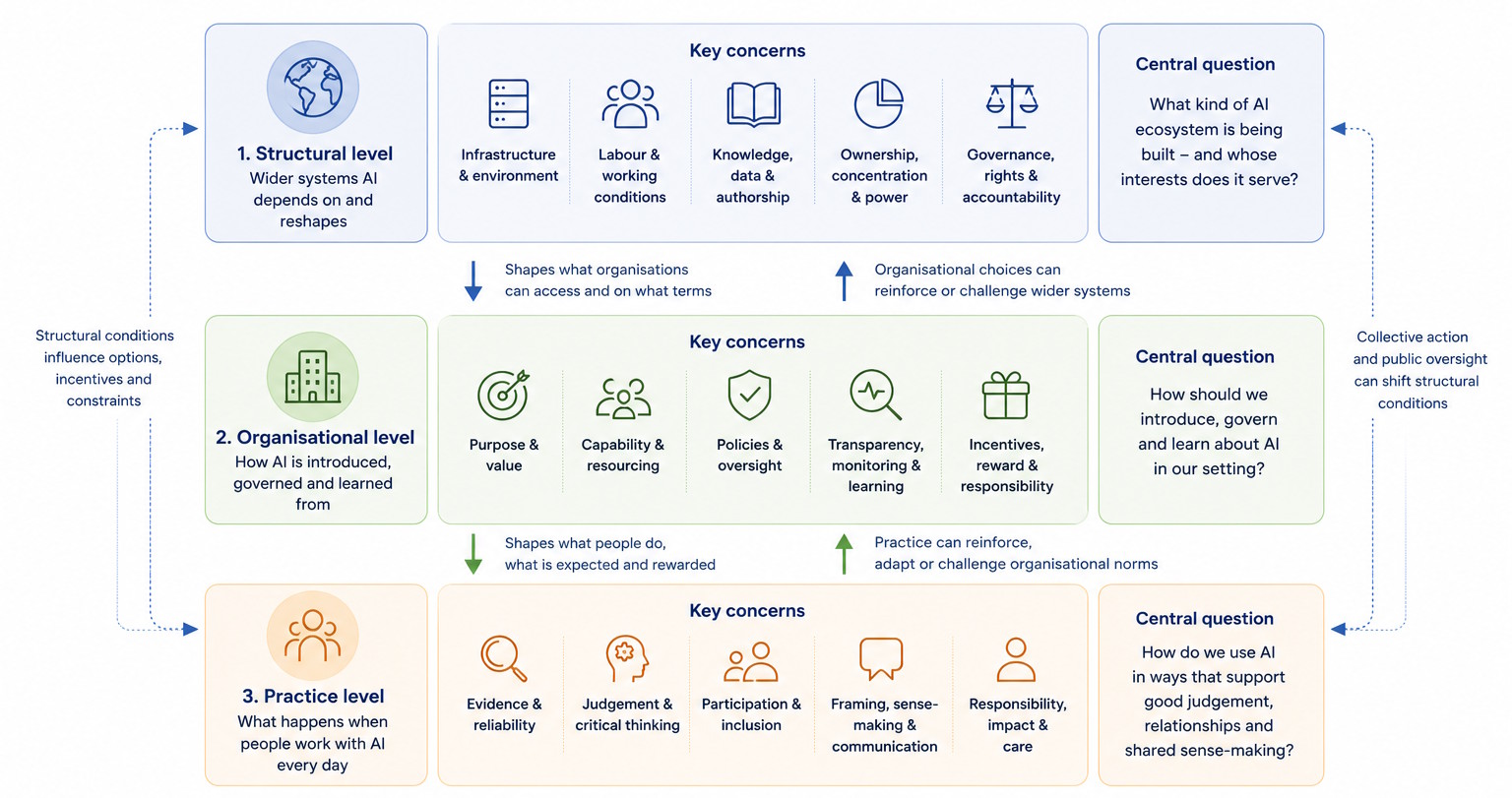
The diagram can be read from top to bottom, but not as a simple hierarchy. Structural conditions influence organisational choices and everyday practice, while organisational decisions and routine uses can also reinforce or challenge wider patterns.
A distinction between macro, meso and micro levels is widely used in work on governance, organisations and practice, and similar multi-level approaches are increasingly being explored in discussions of AI ethics. I use a broad version of that distinction here to separate the wider conditions around AI, the organisational choices through which it enters our work, and the everyday practices through which people use it.
No single level provides a sufficient response. Careful individual use does not resolve questions about ownership or environmental impact. Regulation does not give an organisation a purpose for adopting AI. An organisational policy does not ensure that a fluent draft will be read sceptically in a workshop or evaluation.
Responding responsibly therefore requires more than taking a position for or against AI. It involves asking:
- What kind of AI ecosystem are we contributing to?
- How should organisations introduce, govern and learn about AI?
- How do people use AI in ways that support good judgement, relationships and shared sense-making?
Locating my own practice
My own engagement with AI is shaped by concerns at all three levels, although the choices available to me are not the same at each. Individual working habits can help address some practice-level concerns and can contribute to conversations about how AI is introduced in the organisations and groups I work with. They cannot, on their own, resolve wider questions about infrastructure, ownership, labour or concentrated power.
What this has led me to is not a fixed position or a complete response, but a set of working habits.
- I use AI purposefully, mainly to support thinking, preparation and early analysis rather than as a substitute for judgement, relationships or craft. I am wary of practices that add speed or volume without improving sense-making.
- Source integrity remains important. When AI surfaces articles, statistics or references, I check them before drawing on them.
- Where AI is being considered in an organisational setting, I prefer to start with purpose. What are we hoping to improve? What else needs to be in place? Who should be involved, and how will we notice unintended effects?
- Questions about AI use need to remain visible in collective settings. This includes naming uncertainty, acknowledging uneven impacts and recognising where responsibility sits.
I have also become more deliberate about examining how these systems behave. I ask for sources, check numbers, test alternative framings and probe the assumptions behind a claim. This is less about catching dramatic failure than understanding recurring patterns of instability and influence.
These practices are, of course, only partial responses. They help keep judgement, evidence and responsibility visible in my own work, and provide a basis for conversations with others. They do not resolve the structural conditions within which AI systems are developed, or replace the need for organisational choices, public governance and collective action.
Before asking how to use AI well, it helps to understand what people are worried about and where those concerns arise. Some things we can address through our own practice. Others require organisational choices, regulation or wider collective action. Being clearer about that distinction seems a better starting point than treating AI ethics as a simple choice between acceptance and rejection.
This post was substantially updated in July 2026 to distinguish three connected levels of concern: structural, organisational and practice. It now forms Part 1 of a two-part reflection on the wider ethical terrain of AI. [Part 2: Designing AI for the wider world] moves from mapping these concerns to considering six principles for better AI design and development. You can explore the full set on the AI for reflective practice, research, and collaboration hub. A few related posts from that collection include:
- AI as a thought partner: reflections on collaborative practice and systems work
- AI prompts for shared thinking: a light framework for purposeful prompting
- Working with AI in the room: authorship, responsibility, and collective judgement
- AI in place-based practice: what is shifting
- What would better work with AI look like?
For guidance on ethical judgement in research, evaluation and collaborative inquiry, see Human ethics for independent research and evaluation.
[* Image by Jintana / Adobe Stock]
