
Much discussion about AI focuses on models, governance and regulation. This post looks instead at what happens to professional practice when AI becomes part of everyday work. It considers how practitioners, teams and smaller organisations can decide what better work would mean. It explores how they can keep useful outputs connected with the inquiry, participation and judgement that make the work worth trusting, and learn where AI use should continue, change or stop.

AI use rarely begins with a strategy.
More often, someone tries a tool to help with a report, a meeting summary, an early analysis or a difficult first draft. A colleague sees the result and experiments in turn. Before long, prompts are being exchanged, parts of workflows are changing and expectations are beginning to shift. Some uses are discussed; others remain private.
By the time an organisation develops an AI policy or strategy, generative AI is often already influencing how work is framed, produced, reviewed and valued. Repeated individual choices become team habits, informal norms and management expectations. Work that once took a day begins to be expected in an afternoon. A polished first version becomes the accepted starting point.
The issue is not only that these uses can be difficult to see. AI can produce a recognisably useful report, synthesis or analysis while loosening its connection with the process that gives it value. The output can look complete even though the inquiry behind it has narrowed, important differences have not been worked through, or interpretive choices have become harder to examine.
In many settings, the practical question is what happens to professional practice when AI is already part of it. How can uses already under way contribute to better work without quietly redefining what counts as enough.
A useful first step is to make existing practice visible: where AI is being used, what it is changing, and where useful outputs risk becoming detached from the work that gives them value.
Clarify what better work would mean
AI discussions often begin with what a tool can do. A better starting point is the work itself. What are we trying to improve? For whom? What is not working well now? What would people notice if the work became better?
Better work is rarely defined by speed alone. Depending on the setting, it may mean better judgement, clearer communication, stronger analysis, more thoughtful decisions or more time for relationships, interpretation and learning. For a small organisation, it can also mean doing work that existing resources would otherwise place beyond reach.
The intended contribution differs across settings: more time to examine competing explanations in research; a clearer account of where participants agree and differ in facilitation; or faster handling of routine enquiries without losing sight of unusual or higher-risk cases in a service. These are more meaningful reference points than uptake or output volume.
AI can strengthen one part of the work while weakening another. A faster synthesis may leave less time for questioning assumptions. A clearer summary may smooth over disagreement. Consistency may be useful, but it can also discourage professional judgement.
AI may also redistribute work rather than simply reduce it. Time saved in one activity may reappear later through checking evidence, questioning interpretation, coordinating decisions or explaining how conclusions were reached. Looking only at the speed of one task can therefore give a misleading picture of whether the wider work has improved.
The question is whether the wider work becomes better.
“Better” will also be contested. Faster work may be less reflective. Wider access may introduce new errors. A more consistent process may be easier to manage but less responsive to context. The aim is not to settle on a universal definition, but to keep the intended contribution, choices and trade-offs open to discussion and review.
Notice what AI is changing around the work
AI can strengthen a process. It can help people surface overlooked material, make assumptions visible enough to question, or explore alternatives that a small team could not otherwise afford. An initial synthesis can become a useful object for collective scrutiny rather than a conclusion to accept.
The same output can also change the surrounding practice in less helpful ways.
One change concerns framing. AI can quickly produce a first account of a problem, a set of themes or an apparent synthesis. Because the result is fluent and well organised, it can become the basis for what follows. Later contributors respond to its categories rather than revisit how those categories were formed. As I describe in AI and the authority of the first synthesis, I have seen how quickly a clear early synthesis can become the document everyone works from, even when its categories were meant to be provisional.
Another change concerns participation. In AI can produce the record of participation without the participation, I considered how AI can create summaries, personas, plans and coherent accounts of what people need. The visible artefacts can be present even though the relationships, disagreement and shared learning through which understanding normally develops have not taken place. The question here is how teams can notice that separation and reconnect the output with the people and processes it represents.
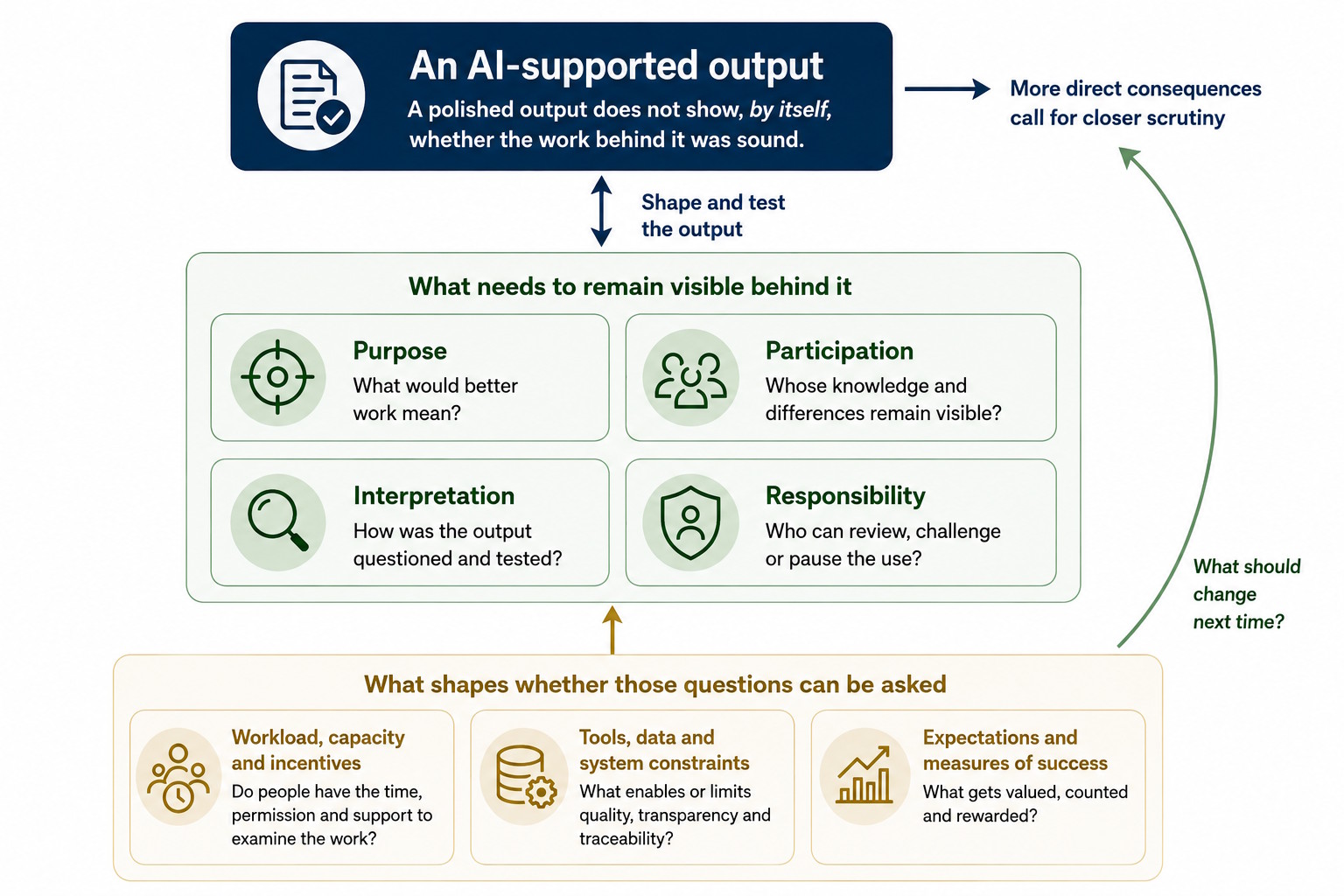
Judgement can also become harder to see. Someone may still approve the final output, but important interpretive choices have already been made through the prompt, the material supplied, the framing produced and the selection of what to retain. Human review then risks becoming a check of the polished result rather than an examination of how it came to be. Keeping a human in the loop is not enough if the process itself no longer supports questioning, challenge and shared interpretation. Human judgement may still be present, while the group’s capacity to exercise judgement together gradually weakens.
Workload adds another complication. Time saved does not automatically become time for reflection, engagement or higher-value work. It can simply reset expectations. A team that can produce five reports in the time previously needed for three may soon find that five are expected.
Across these examples, AI provides a recognisably useful result while loosening its connection with the process that gives it value. The synthesis can be ready before its framing has been tested; a complete-looking record can stand in for differences that were never worked through; time saved can disappear into the next deadline. The issue is whether the output remains connected to the inquiry, interpretation, discussion and testing needed to use it well.
A useful output is only one part of better work. The diagram below shows some of the connections that need to remain visible around it.
Pay closer attention when effects travel further
These questions become more demanding, and shortcomings harder to correct, when AI use reaches beyond an internal draft and becomes part of a product or service.
Consider a service team using AI to classify incoming enquiries. Routine cases are sorted more quickly and response times improve. But better service also depends on unusual cases remaining visible, staff being able to question the classification, and people having a clear route to human support.
If those conditions do not hold, the system can perform well against average response time while making the service worse for people whose circumstances do not fit common patterns.
When AI shapes how a service responds or decides, trust depends on reliability, transparency and clear responsibility. Uses that directly affect people therefore need closer scrutiny, clear routes for review, and a practical way to pause or withdraw them.
Build the capability and conditions to question practice
Organisational discussions about AI capability often focus on access, literacy and prompting skills. These matter, but they are not enough. People also need to recognise hidden uncertainty, trace important claims, question an output’s framing and explain how AI influenced the work. These concerns sit alongside privacy, confidentiality, security and factual reliability. They also draw attention to aspects of good work that technical and compliance checks often miss.
Capability develops through real work. Teams can examine actual examples, including weak or ambiguous ones, compare AI-assisted outputs with the underlying material and discuss what was lost, added or left unresolved. These arrangements need not be elaborate: selected case reviews, clear expectations about disclosure and additional scrutiny where errors could materially affect the work may provide a useful starting point.
The harder issue is whether people have permission to question the practice. If every discussion of AI is tied to productivity gains, staff are less likely to surface errors or admit that an experiment failed. If disclosure feels like surveillance, use remains private and unexamined. If managers reward speed and volume, careful review becomes harder even when guidance says it matters.
Some conditions are set beyond the immediate team. Tool design, commercial incentives, organisational targets, employment conditions and regulation all shape what responsible use is possible. Local practice cannot resolve all of these pressures, but it can make them visible. That helps avoid treating every problem as a matter of individual skill.
Responsibility also needs practical expression. Who decides that AI is suitable for a task? Who reviews uses carrying greater risk? Who can pause them? Who remains accountable for the interpretation?
In participatory or interpretive work, participants, facilitators and others close to the process may be better placed than those producing the output to notice that an important difference has been flattened, tentative agreement has become a firm conclusion, or the language no longer reflects what people meant.
The point is narrower than involving everyone in every decision. Judging quality sometimes requires knowledge held by the people represented in, affected by or expected to act on the work.
Learn together and adjust the practice
Experimenting with AI becomes organisational learning only when experience can be shared, compared and used to change what people do.
In one setting, a practitioner may find that AI helps generate questions during early exploration but is less useful for synthesising contested evidence. Elsewhere, a team may find that it improves a report’s structure while requiring more checking than expected. These are lessons about particular uses, materials and working arrangements, not fixed conclusions about what AI can or cannot do.
If those lessons remain with individuals, other teams may repeat the same experiments and encounter similar difficulties.
Shared review should go beyond asking whether a tool worked. As I explore in How do we know whether AI is improving the work?, evaluation needs to follow what happens around and after an output, not only whether the output itself was satisfactory.
Three questions are enough to begin:
- What became better, and for whom?
- What changed around the work that we did not anticipate?
- What should we continue, adapt, limit or stop?
These questions reconnect the intended contribution with evidence about what happened and decisions about what should change. Teams do not need a large dashboard for every use, but they do need enough evidence and shared judgement to distinguish a useful experiment from a practice that merely produces convincing outputs.
These are familiar disciplines within planning, facilitation, evaluation and organisational learning. AI does not replace them, but useful-looking outputs can make them easier to overlook.
A team may find that AI helps organise a large body of material before analysis, but is less suitable for preparing the account shared with participants or decision-makers. It may retain the earlier use, change how the output is reviewed, or involve others where interpretation remains uncertain or contested.
That is not necessarily a failed experiment. It is a more precise understanding of where the use contributes and where it does not. Learning may support wider use, but it may also lead to a narrower role, additional review, use only under particular conditions, or stopping altogether. Restraint can be evidence of learning rather than resistance to innovation.
Working well with AI
Practitioners and smaller organisations can act more deliberately without waiting for a complete strategy. AI use is already developing through ordinary choices about drafting, research, analysis, communication and decision-making. Those choices gradually establish what an organisation will accept as sufficient process behind an output. How much checking, interpretation or involvement is expected is rarely decided explicitly. More often, it is settled through practice.
The important part is to keep those choices open to question and to learn from experience before early trials quietly become established practice. The task is not to maximise adoption. It is to keep useful outputs connected to the work that makes them worth trusting.
AI will continue to evolve, and it can help people work more quickly and extend what small teams can do. The professional disciplines that help people work well together change more slowly: being clear about purpose, examining assumptions, preserving different perspectives, evaluating consequences and learning from experience. Better work requires more than useful results. It requires processes people can examine, learn from and stand behind.
This post forms part of the Learning for Sustainability resources on AI in research, professional practice and collaborative work. Visit the AI in research, practice and collaborative work page for related essays, practical guidance and curated resources.
For related material, see Planning, monitoring and evaluation for connecting intended outcomes with evidence and learning; Effective indicators for place-based initiatives for developing useful indicators and interpreting them in context; Rubrics as tools for reflection, learning and evaluation for making evaluative criteria and judgements more explicit; and Monitoring, evaluation and learning for wider resources on reflection, adaptation and learning in complex settings.
[*1 Image by tippapatt / Adobe Stock]
[*2 Graphic: Will Allen, with ChatGPT assistance, 2026]
