
This post provides an introduction to an extended DPSIR (Driving Forces-Pressures-State-Impacts-Responses) framework, and looks to show how this can be used to more closely link the social and natural sciences to better help policy makers address complex problem situations. It also offers some pointers to how the framework can be used to support the development of just and equitable transitions. For additional background and a selection of annotated resources on DPSIR applications, see the related DPSIR resource page.

A framework like DPSIR is not a solution on its own, but it offers a shared structure for making sense of complexity. By mapping the links between human activities, environmental pressures, system states, impacts, and responses, it can help diverse groups develop a common language, support collaboration, and highlight where equity and justice considerations should be brought into focus.
As pressures on the environment and our linked socio-ecological systems increase we need systems thinking and systems-based frameworks that can be used to conceptualise complex sustainability challenges. Such frameworks can help organise research that increases understanding about interacting and co-evolving ecological and societal processes, evaluate trends over time, and support the systemic co-design of constructive management interventions at multiple levels.
A systems approach to complex problem situations
Without such frameworks, research, management and policy initiatives are frequently limited to a particular issue or field of concern, and can often address a single aspect of a problem with insufficient understanding or consideration of short- and long-term consequences to the larger system. Additionally, the many stakeholders involved in today’s complex problems all too often may find themselves implementing multiple, uncoordinated management actions. While each of these actions may be successfully implemented for a particular purpose, the combined effects may not lead to improved environmental conditions.
Often too the social and biophysical sciences can be seen to operate independently of each other, and a dominant focus on technical and biophysical aspects can mean that equity and justice considerations are marginalized. Standing in contrast to such linear and reductionist thinking, systems thinking sets out to view systems in a holistic manner. A systems approach considers more than one issue and broadens the decision context. The DPSIR framework is one such systems approach designed to help structure and communicate policy and management relevant research about the environment.
From a natural resource management and policy point of view the DPSIR framework highlights the need for clear and specific information on a number of factors in an interlinked socio-economic and ecological system. It helps us define what we know about five key components. These are driving forces and their resulting environmental pressures on environmental and socio-economic states, the impacts resulting from these, and the subsequent societal responses.
Different groups use these terms in slightly different ways, dependent on their disciplinary backgrounds – and given the diverse range of uses that the framework is put to it probably does not make sense to attempt to create rigid definitions. What is important is that the different actors involved in any particular situation use the development of the model to clarify their understanding of the terms, and that it is equally important to develop an integrative and shared understanding and communication of the causal links and mechanisms involved.
DPSIR has a substantial history and has been adapted, extended and critiqued across many areas of environmental research, policy and management. Any one diagram can therefore provide only a partial representation of this wider body of work. The figure below offers a visual synthesis of the wider DPSIR literature, bringing together the main relationships in a form intended to support discussion and practical use.
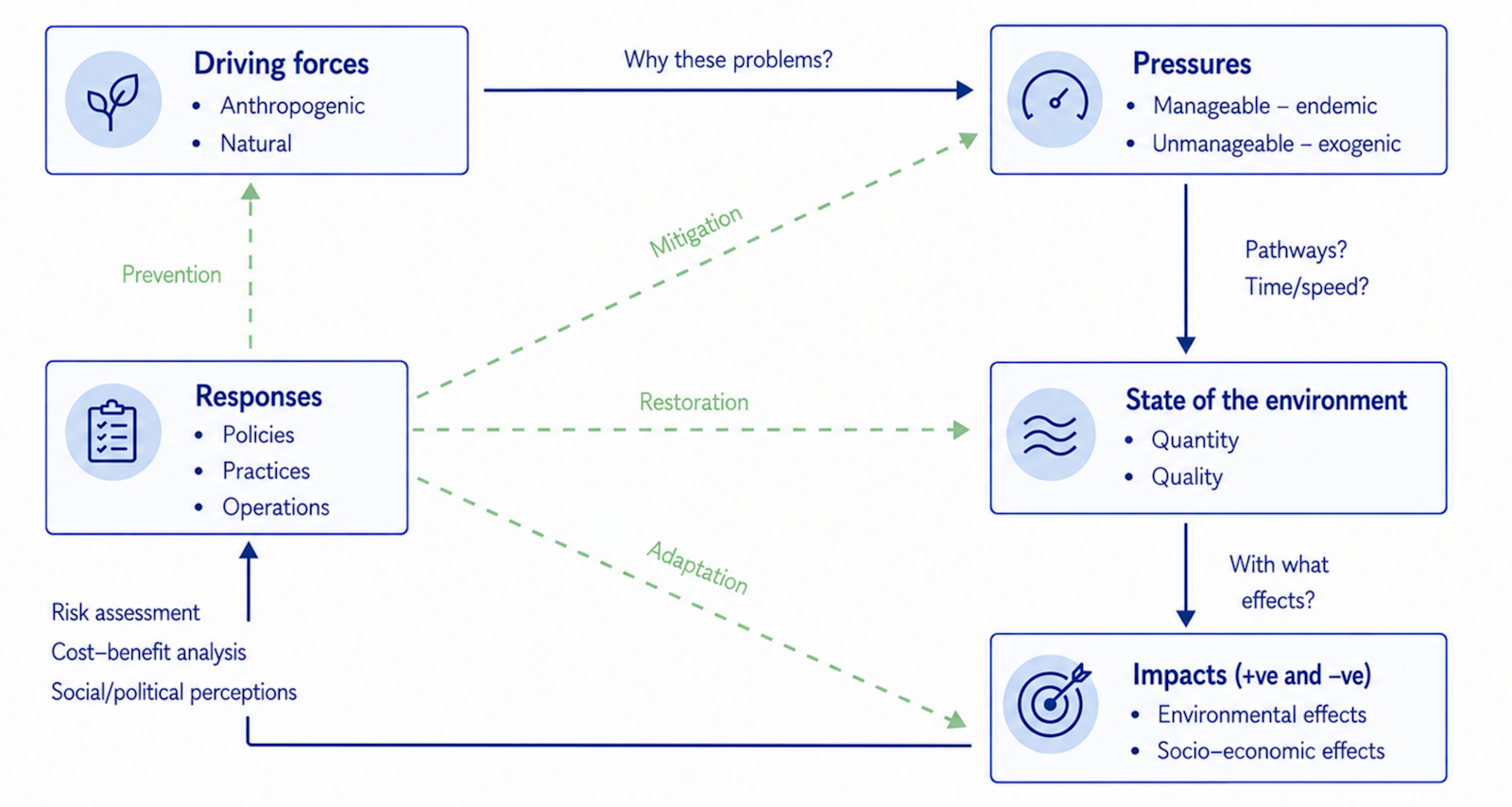
The diagram provides an overview of the DPSIR elements and their linkages. The following text explains each element in more detail, beginning with driving forces and pressures.
A driving force can be physical or socio-economic, and may be either natural or anthropogenic. In social terms, drivers include needs for food, shelter, water, employment and economic well-being, along with broader dynamics such as population growth and associated changes in the activities of individuals, communities and sectors. These drivers alter levels of production and consumption and thereby affect the environment by exerting pressures.
Driving forces exert pressures on the environment. Pressure indicators track developments such as the movement of pests and pathogens, the use of key resources, and changes in land use by human activities. These pressures are transported and transformed through natural processes, leading to changes in environmental conditions and system states. In this diagram, pressures are distinguished between those that are largely endogenic (arising within the focal system and potentially manageable through local responses) and those that are more exogenic (originating outside the system and often requiring adaptation rather than direct control).
In turn, these changes then have impacts on the functions of the environment, such as human health, resource availability, ecosystem services, and biodiversity. Impacts are consequences of environmental state change in terms of substantial natural or socio-economic effects which could be either positive or negative. Impact indicators are used to describe changes in these conditions. Response activities/indicators refer to attempts by groups (and individuals) in society, as well as government to prevent, compensate, ameliorate or adapt to changes in the state of the environment. Some societal responses may be regarded as negative driving forces, since they aim at redirecting prevailing trends in consumption and production patterns.
Other responses aim at raising the efficiency of products and processes, through stimulating the development and penetration of more effective technologies or practices. As illustrated in the figure responses may seek to control driving forces or pressures (prevention or mitigation respectively), to maintain or restore desired end states (be they socio-economic or ecological), or to help accommodate impacts (adaptation). In some cases the deliberate response may be to choose a strategy to “do nothing”, or perhaps just “wait and see”.
Although it is tempting to look at the DPSIR framework as a descriptive analysis with a specific focus on individual elements in the economic, social and environmental system, it is the relationships between the elements that introduce the dynamics into the framework and bring about changes. A focus on the links between the DPSIR elements reveals a number of processes and indicators describing these. For example, eco-efficiency indicators help determine the relationship between the driving forces and pressures. Increasing eco-efficiency may indicate that economic activities can expand without an equivalent increase in pressure (or at least the same pressure) on the environment. This kind of information contributes to answering the question: are we making technological progress? Similarly, the relationship between a pressure indicator and a corresponding state indicator speaks to pathways.
The combination of these indicators tells a story of time delay in natural processes and the corresponding ‘lags’ before environmental and socio-ecological effects fully manifest. And the relationship between environmental impacts and societal responses (such as policies and regulation) are often governed by societal perceptions (for example, that the impacts are serious). In turn assessing the magnitude of this relationship will often require gathering data on the economic costs of the impact. Policy-effectiveness indicators generally summarise the relationships between the response and targets for expected change in driving forces or pressures and sometimes in responses, state or even impacts.
The strength of these ‘in-between’ indicators is that they express, more than other indicators, the dynamics of the interactions in the DPSIR system. Sometimes the information can be used in predictions of future changes in pressures, states, impacts, and responses. The existence of these interrelationships also shows that the DPSIR framework, although often presented as a linear chain or a circle, in fact resembles a very complex web of many interacting factors some of which may represent highly non-linear dynamics.
In many cases the change in the state of the environment or impacts has several causes, some of which may be immediate and of local origin, others may be exerting their influence on a continental or even global scale. Reductions in pressures often result from a mixture of policy responses and changes in various driving forces, including practices.
Integrating equity and social justice considerations in a DPSIR framework
Common to many reviews pointing to good governance are elements of equity and social justice, stakeholder inclusion, strategic thinking, accountability and fairness. Many of these key elements are also those that support adaptive management, social learning, and that lead to the development of resilient communities. However, despite this growing scientific and policy endorsement equity and other social and justice concerns are often marginalized. As Joyeeta Gupta and colleagues (2020) remind us, this is true as well of the DPSIR framework, which has traditionally marginalized equity issues except to a limited extent in the impacts and response component. In their paper these authors offer some underlying questions which can be asked at each stage of the framework to require some thought to be given to include equity and inclusive development perspectives. These questions are shown in the table below:
| Drivers | How do drivers result from, mitigate or exacerbate inequalities? |
| Pressures | Who uses and benefits from resources and sinks? |
| States | How is exposure to risks and benefits distributed? |
| Impacts | How are impacts distributed? Who is able to adapt; who pays for residual damages? |
| Responses | How do responses redistribute rights, risks and responsibilities? |
Supporting communication and integration with a DPSIR model
As pointed out above, a DPSIR framework offers users the potential to bridge natural and socio-economic systems. It provides a structured way for stakeholders to link science with policy and management, and to think more explicitly about equity, just transitions and inclusive development. In these ways it can contribute to more sustainable and just management of natural resources, and support the development of practical and transformational pathways forward.
The framework has a number of underlying strengths. These include its communicative power as a boundary object, its illustration of cause–effect linkages underlying environmental problems, and its support for multi-actor participation. It encourages an interdisciplinary approach, and can be particularly useful in bridging the divide between the social and natural sciences. Natural scientists often may have a focus on contributing to the pressure/state side, while many social scientists may find a more natural focus on the impact/response/drivers side. Equally the framework can help to link scientific analysis more closely with policy and management.
Using a DPSIR framework therefore provides a common model and language for natural resource managers, policy makers, scientists from different disciplines and other actors. At the same time, a substantial body of work reminds us of the challenges in connecting and integrating social and natural science data and knowledge, and that there is often an ongoing disconnect in how different disciplines engage integrative frameworks such as DPSIR.
Accordingly, as we move more towards greater recognition of the imporatnce of social learning-based process of participation and dialogue is important, we also need to pay attention to ensure that processes are managed by well developed skills in systems thinking, relationship-building and facilitation. To take up these challenges as Allen et al. (2011) point out, interdisciplinary and other integrative approaches that use DPSIR and similar frameworks need to include people with complementary skills in managing participation and conflict, and in integrating biophysical and social dimensions of collaborative learning.
For additional background and a selection of annotated resources on DPSIR applications, see the DPSIR resource page. For related guidance on choosing and using indicators within such frameworks, see the Developing indicators and metrics resource page.More information on related approaches, tools and methodologies can be found through the linked LfS pages on systems thinking, design thinking and systems thinking tools.
If you’ve found this site useful, consider sharing it with others who might benefit from these resources. You can also sign up for occasional site updates to hear about new tools, guides, and key resources. And if you’d like to support the ongoing curation of these annotated collections, even a small contribution helps keep the site freely available.
