
Good design involves more than bringing people together to develop a response to a problem. It also involves judgements about what is worth pursuing, whose interests and capabilities are supported, and what wider consequences may follow. Six connected principles offer a way to examine these choices in complex social and ecological settings.

In an earlier post, Designing together: reflections on co-design in complex settings, I explored some of the practices that help people work together on complex challenges. These included developing shared grounding, allowing different perspectives to shape how problems are framed, creating meaningful opportunities for contribution, and remaining open to learning and adaptation.
Alongside questions about how we design together are questions about the choices being made. An initiative may be developed collaboratively while still overlooking important costs or consequences beyond the immediate participants. A technically effective intervention may achieve its intended outcome while creating new dependencies, reducing people’s ability to act for themselves, or shifting costs elsewhere.
These concerns are familiar across sustainable development, systems thinking, participatory practice and adaptive management. They arise whenever we introduce an intervention into a setting where people have different interests and knowledge, relationships are interconnected, and consequences cannot all be anticipated.
A recent post on designing AI for the wider world brought together six principles reflecting this accumulated learning. Their relevance extends well beyond AI, offering a way to examine design choices across a range of social and ecological settings.
Six broad principles for good design
These six broad principles bring together practical expectations about purpose, people, resources, wider consequences and responsibility. They are not intended as a new or comprehensive design framework, but as considerations that can help people examine design choices where different interests and uncertain outcomes are involved.
Participation is not listed as a separate seventh principle because it runs through all six. It can help shape purpose, bring different knowledge and perspectives into design, make consequences more visible and strengthen accountability. It is not necessary, or possible, for everyone to participate in every design decision. But good design should ask who needs to be involved, in what, at what stage, and with what influence. This is partly about fairness, but also about knowledge. Those designing an intervention rarely possess all the knowledge needed to understand how it will interact with the situations into which it is introduced.
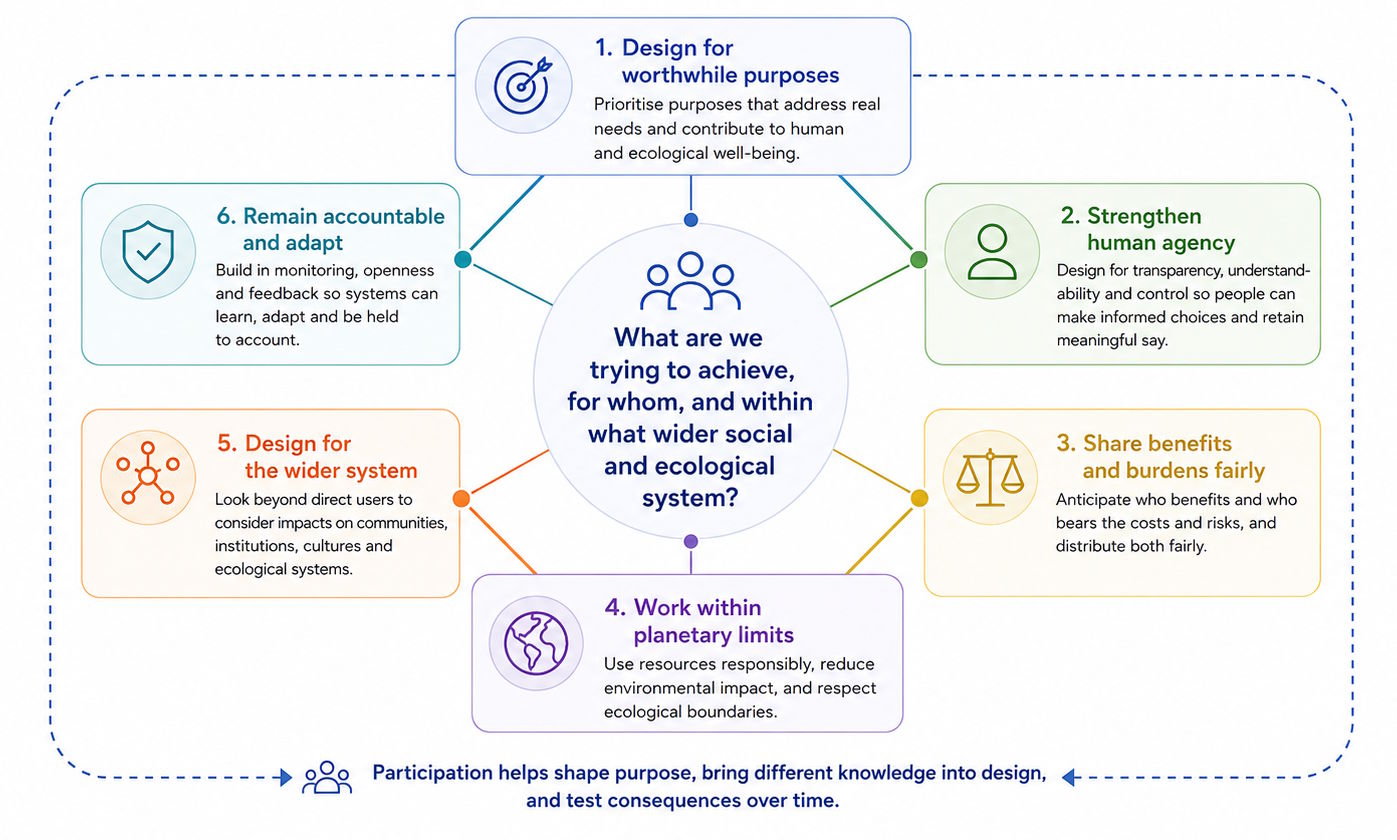
The principles overlap rather than operating as separate tests. A change in land use, for example, may raise questions about whose purposes are being served, who benefits or bears the costs, what happens to local ecosystems and how communities retain influence over future decisions. Considering the principles together can help make these connections more visible.
1. Design for worthwhile purposes
The starting question should be what we are trying to achieve, rather than which tools, methods or solutions are already on the table. Funding priorities, a promising technique, an established programme model or a policy deadline can all legitimately shape a design, but none of them is a purpose in itself. An intervention may work extremely well at doing something without making the activity particularly worthwhile.
Some fairly basic questions follow. What problem are we trying to address? Who sees it as a problem? Who is expected to benefit? Are there other ways of achieving the same outcome? And what might be displaced or weakened in the process? These questions become particularly important when the framing has been largely settled before those affected have had an opportunity to contribute.
2. Strengthen human agency
Interventions can extend what people are able to do. They can improve access to information, open up alternatives and help people develop new capabilities. But they can also create dependency, narrow opportunities to learn, reduce local or professional discretion and shift decisions away from those affected, reducing their influence over what happens.
Agency is not only individual. Good design should also strengthen the capacity of groups, communities and organisations to question, deliberate and act together. Consulting people is not enough if their role has been reduced to endorsing options they had little part in shaping.
The more useful question is whether a design builds people’s capability to understand, decide and act over time, or gradually substitutes for it.
3. Share benefits and burdens fairly
Interventions create benefits, costs and risks, and these are rarely shared evenly. Organisations reporting success may not be the same people carrying the additional work. Communities downstream may bear environmental costs that are not included in a project’s accounts. People whose knowledge contributes to an initiative may have little influence over how that knowledge is used.
Fairness involves asking who gains, who pays, who carries the risks and who has a meaningful say. Those questions need to be considered beyond the immediate participants and intended beneficiaries. Ownership and control matter because those able to set the terms of an initiative may also be better placed to capture its benefits and shift some of its costs elsewhere.
Participation is especially important where those making design choices are not the people most likely to experience their consequences.
4. Work within planetary limits
Environmental costs need to be part of the design brief rather than treated as something outside it. Interventions draw on land, water, energy and materials, and their effects can extend well beyond the immediate project area or timeframe. Improvements in efficiency matter, but so does the overall scale at which activities are pursued.
This does not mean expecting interventions to have no environmental footprint. It means making resource use visible, asking where it can be reduced, and considering whether it is proportionate to the value being created. This brings purpose back into the discussion: what kinds of value justify resource-intensive activities, and who should be involved in making that judgement?
5. Design for the wider system
Interventions do not simply enter an existing setting and leave everything else unchanged. People and organisations adapt around them. Practices change, expectations shift, new dependencies develop and activities that were previously valuable may become less visible.
This makes it important to look beyond the immediate participants and intended outcomes. How might an intervention affect relationships, institutions, incentives and other activities around it? What behaviours might it encourage? What might it displace? And what happens if many people or organisations respond to the same incentives?
Looking at the wider system will not tell us everything that is going to happen. Complex systems do not work like that. But it can help us notice effects and relationships that are reasonably foreseeable, and make it harder to dismiss them as somebody else’s problem. The remaining uncertainty is one reason why continuing learning and adaptation matter.
6. Remain accountable and adapt
No design process will identify every consequence in advance. Interventions interact with changing social and ecological systems, and effects that seem minor at the outset can become significant as circumstances change. Responsible design therefore cannot finish when a programme is launched or a plan adopted.
Those involved need ways of noticing what happens in practice, learning from unexpected effects, responding to challenge and changing course. People affected by an initiative need meaningful routes for questioning decisions and having concerns addressed. Monitoring needs to look beyond immediate outputs to changes in capability, relationships and wider system effects.
Accountability also needs to remain identifiable. If responsibility is spread so widely that nobody has the authority or obligation to act, it is difficult to call it accountability at all.
Working with the principles
The value of these principles becomes clearer when they are applied to a particular design decision, especially where looking beyond the immediate task reveals opportunities or consequences that might otherwise be missed.
A recent example comes from Vancouver General Hospital in Canada, where a team reconsidered how hospital meals could support both patient wellbeing and environmental sustainability. Chefs, dietitians, clinicians, food service staff and patient partners contributed to developing and testing new dishes that met patients’ nutritional needs while reducing the environmental impacts associated with food.
The resulting menu included more plant-rich options and greater cultural diversity. According to a 2026 study published in The Lancet Planetary Health, the redesigned menu was estimated to produce 39% fewer food-related greenhouse gas emissions and require 51% less land than the original menu. Some 84% of patients reported moderate to high satisfaction with the new dishes.
The example shows how bringing several purposes into view at once can open up different design possibilities. Providing nutritious meals remained central, but considering environmental impacts alongside patient preferences helped identify opportunities to improve the menu on several counts.
The principles also raise questions that the positive results cannot answer on their own. Making plant-based dishes the default for some meals encourages their uptake, but also raises questions about patient choice. Extending the approach to other hospitals brings in wider considerations, including differences in supply chains, kitchen capacity and staff workloads. These questions do not diminish what was achieved. They illustrate why design choices need continuing attention as an initiative develops.
Concluding reflection
The earlier co-design post considered how people work together on complex challenges. This reflection has looked more closely at the different perspectives and choices that come into focus through that work. The two are closely connected. Good co-design helps create the conditions in which questions about purpose, agency, fairness and consequences can be raised and taken seriously.
Neither good process nor sound design principles can remove uncertainty. Different interests and priorities will still need to be weighed, and some consequences will only become visible over time. Considering these principles together, and returning to them as an initiative develops, can help people make more informed judgements and adjust their approach as circumstances change.
For related resources and practical guidance, see Supporting change for approaches to designing and managing change, Managing collaborations for participation and co-design, Systems thinking and complexity-aware approaches for considering wider relationships and consequences, and Strategic planning and direction setting for making choices and adapting direction over time.
[* Photo: Frans van Heerden | Pexels ]
[*2 Graphic: Will Allen, with ChatGPT assistance, 2026]
