
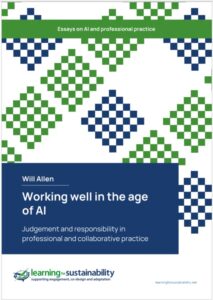
This collection brings together eleven essays exploring generative AI across professional and collaborative practice, organisational choices and wider ethical and structural concerns. It asks how judgement, participation, interpretation, learning and responsibility can remain visible as AI changes how work is done, and what we should expect of the systems being developed and deployed.
Drawing on experience in research, evaluation, facilitation and systems thinking, the essays consider both the possibilities AI offers and what can become harder to see behind convincing outputs. These include the thinking behind an interpretation, the participation behind a shared record, and the experience through which professional judgement develops.
The collection also addresses ethical concerns about AI’s environmental and material demands, the appropriation of labour and knowledge, concentrated ownership and power, and the unequal distribution of benefits, costs and responsibilities. It connects choices in everyday practice with questions requiring organisational responses, public governance or wider collective action.
At a glance: Eleven essays for practitioners, teams and organisations considering how AI is changing their work, and how those changes connect with wider questions about AI development and use.
Download the collection ( PDF, Version 1.0, September 2026 – 65 pages, 2.67 MB)
What this collection covers
The essays are organised into four Parts:
- Starting with practice and judgement
What better work with AI might mean, and reflections on AI as a thought partner in professional and collaborative practice. - AI in shared and collaborative work
Authorship, responsibility and collective judgement; the influence of early syntheses; and the distinction between participation and its documentary record. - Learning, capability and organisational practice
Evaluating whether AI improves the work, developing shared organisational approaches, rethinking education and professional learning, and noticing changes in place-based practice. - Stepping back to the wider ethical picture
Ethical concerns across practice, organisational and structural levels, and six principles for better AI design and development: worthwhile purposes, human agency, fairness, planetary limits, wider system effects, and accountability and adaptation.
The essays offer reflections and questions rather than a comprehensive framework or an argument for adopting AI. Working well may mean using AI, changing or limiting its role, or deciding not to use it.
Who this is for
The collection is intended for people whose work involves interpretation, relationships, learning and shared judgement, including:
- evaluators and applied researchers
- facilitators and advisors supporting collaborative processes
- programme managers and policy staff
- educators and people supporting professional learning
- teams and organisations developing approaches to AI use.
It is also relevant to readers considering how AI design, development and governance affect professional practice, communities and wider social and ecological systems.
How it can be used
The essays can be read individually or as a connected collection. They can support:
- reflection on how AI is entering your own practice
- team discussions about authorship, responsibility and shared work
- reviews of whether AI is improving the work and what may be changing around it
- professional learning and the development of organisational guidance
- discussion of the responsibilities of those designing, developing, deploying and governing AI.
A useful starting point is to choose an essay that connects with current work and ask: what do we recognise, what might we be overlooking, and what should we continue, change or stop?
Download the collection ( PDF, Version 1.0, September 2026 – 65 pages, 2.67 MB)
Citation and use
Allen, W. (2026). Working well in the age of AI: Judgement and responsibility in professional and collaborative practice. Learning for Sustainability. https://doi.org/10.5281/zenodo.22700603
The essays are freely available individually on the Learning for Sustainability website. The collection brings revised versions together so their connections can be read across the whole. Please see the copyright page for the author’s reuse terms.
This collection sits within the wider Learning for Sustainability Generative AI hub, alongside related resources including monitoring, evaluation and learning, supporting change and facilitation and collaboration. Together these pages connect the AI discussion with longer-standing work on learning, participation, judgement and change in complex settings.
If this is relevant to your work and you would like to explore how it might apply in your context, you are welcome to get in touch.