

Global assessments help us step back from the immediacy of projects, programmes and policy cycles. They surface longer-term patterns: accelerating climate and biodiversity risks, uneven development trajectories, widening inequalities, and institutional systems struggling to keep pace.
This page brings together selected UN and other global reports that frame the wider context for sustainable development. These assessments describe the structural conditions within which organisations and communities are working. They clarify the scale of change required and the constraints that shape what is possible.
Much of the Learning for Sustainability site focuses on process: collaboration, facilitation, systems thinking, adaptive management. It can be easy to see those as procedural or secondary concerns. These global reports are a reminder of why that work matters. When risks are systemic and transitions depend on coordinated action across sectors and scales, the quality of our processes becomes part of the outcome.
For those working in specific places or institutions, these reports offer two steady reference points. First, that local challenges are nested within larger social–ecological dynamics. Second, that meaningful change depends as much on governance, finance, accountability and learning as it does on innovation.
 Limiting Overshoot – Navigating exceedance of 1.5°C and pathways towards return
A 2026 UNEP spotlight report examining what it means to enter a period of global warming above 1.5°C, and what can still be done to limit the extent and duration of overshoot. It considers the risks of higher peak temperatures, pathways for bringing temperatures back down, and how adaptation and development need to respond as conditions change. A central message is that every fraction of a degree and every year of overshoot matters, with lower and shorter overshoot reducing risks to people, economies and ecosystems. The report argues for mitigation and adaptation to proceed together, framing overshoot as a stronger case for urgent action rather than resignation.
 IPBES Business and Biodiversity Assessment
This 2025 methodological assessment examines how businesses depend on and impact biodiversity across operations, value chains and financial portfolios. It frames nature loss as a systemic economic risk and identifies enabling conditions, governance shifts and practical actions needed to align business models with global biodiversity goals. The report provides an evidence base for integrating biodiversity into strategy, risk management and long-term institutional decision-making.
 What science tells every negotiator at COP30
In this 2025 post, Rockström lays out what the latest Earth-system science imperatively communicates to negotiators at COP30: we are fast approaching—and may already be within—key tipping points, and limiting warming to 1.5 °C is not a target but a planetary boundary. He argues that even full implementation of current national plans still leaves us on a path to ~2.5 °C. The only credible route forward: fossil-fuel phase-out, massive scaling of carbon removal, transformation of food systems, and bridging climate justice with system-level thinking.
 UN Sustainable Development Goals report
The 2024 SDG Report warns that progress toward the 2030 Agenda is far off track, with only 17% of targets on course. COVID-19, conflict, climate change, and deepening inequalities are stalling development. Developing countries face severe financial gaps, needing urgent investment and global solidarity. Yet progress in areas like child health and renewables shows what’s possible. With just six years remaining, bold, transformative action is urgently needed.
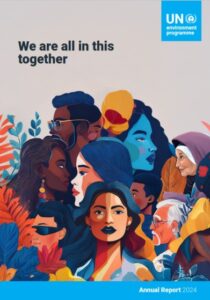 UNEP Annual report
UNEP’s 2024 Annual Report highlights efforts to confront the climate, biodiversity, and pollution crises through science, solutions, and multilateral cooperation. Despite global challenges, the report showcases practical progress and calls for a major increase in ambition and action. As UNEP makes clear, the world must work together across borders and differences to build a fairer, more sustainable future.
 The cost of inaction: A CEO guide to navigating climate risk
This 2024 report highlights the growing financial and operational risks businesses face due to climate change. It warns that unprepared companies could see 5% to 25% of their 2050 EBITDA at risk from climate-related disruptions. The guide makes a strong financial case for action, emphasising the benefits of adaptation and mitigation. It urges CEOs to integrate climate risk into strategy, use scenario planning, and align investments to enhance resilience and competitiveness.
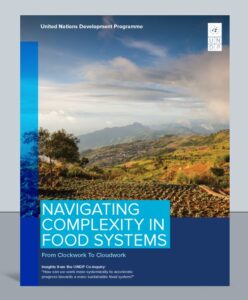 Navigating complexity in food systems
The 2024 report Navigating Complexity in Food Systems: From Clockwork to Cloudwork calls on development actors to embrace complexity in transforming food systems. Drawing on a three-year UNDP-led co-inquiry with global practitioners, it highlights the need to shift from linear, “clockwork” models to more systemic, “cloudwork” approaches. It shares practical insights and recommendations to guide more holistic, adaptive responses to today’s interconnected food system challenges.
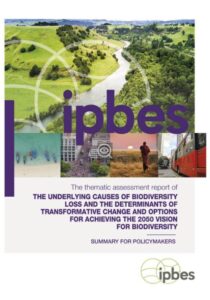
IPBES Transformative change assessment
The IPBES Summary for Policymakers (2024) highlights that transformative change is essential to halt biodiversity loss and achieve the 2050 Vision. It calls for system-wide reorganisation across values, institutions, and practices, addressing root causes of nature’s decline. Emphasising equity and sustainability, it outlines practical steps for governments, businesses, and communities—especially Indigenous and local actors—to shift towards more inclusive, just, and nature-positive pathways aligned with the Kunming-Montreal Global Biodiversity Framework.
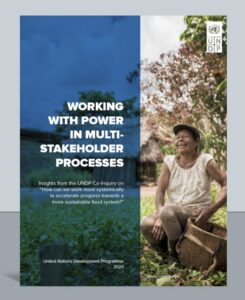
The IPBES Nexus assessment
The IPBES Nexus Assessment (2024) explores the deep interconnections among biodiversity, water, food, health, and climate change. It argues that addressing these issues in isolation leads to missed opportunities and unintended consequences. By examining cross-sector linkages and response options, the assessment supports more integrated governance. Drawing on diverse knowledge systems, it outlines strategies to align policy and action across scales, promoting just and sustainable futures in line with the SDGs, CBD, and Paris Agreement.

A guide to just transitions
This 2023 guide was created by a New Zealand team to help communities and organisations design just transition processes. Addressing challenges like climate change, employment shifts, and renewable energy transitions, it offers practical tools and methods for inclusive problem-solving. The guide draws on tikanga and mātauranga Māori, featuring case studies of iwi, hapū, and community-led transitions across Aotearoa.
What these reports suggest for practice
Across these reports, several patterns recur:
- social and ecological risks are rising faster than the systems designed to manage them
- inequality shapes both exposure to risk and the distribution of benefits
- fragmented governance slows collective response
- inclusive processes and shared learning help actors stay aligned in shifting contexts
- transitions depend on changes in finance, institutions and accountability, not just technology
These patterns echo what many practitioners encounter in their own work. They reinforce the importance of approaches that support coordination, reflection and collective responsibility across diverse actors and over time.
Global reports can sometimes feel distant from day-to-day practice. Yet they serve as a compass. They remind us that the work of collaboration, facilitation, systems thinking and adaptive management is not separate from “real world” change. In complex social–ecological systems, process is one of the main ways change becomes coherent, inclusive and sustainaed over time.
If you are working with cross-sector or cross-scale challenges, you may find the following resource pages useful: Managing collaboration and engagement – guidance for working with diverse actors in complex and contested settings. Facilitation tools and techniques – practical methods to support dialogue, alignment and shared problem-solving. Adaptive management – approaches that treat strategy as iterative and responsive rather than fixed. Each of these areas connects directly to the wider patterns highlighted in the reports above: systems awareness, institutional alignment, inclusion and learning while acting.